





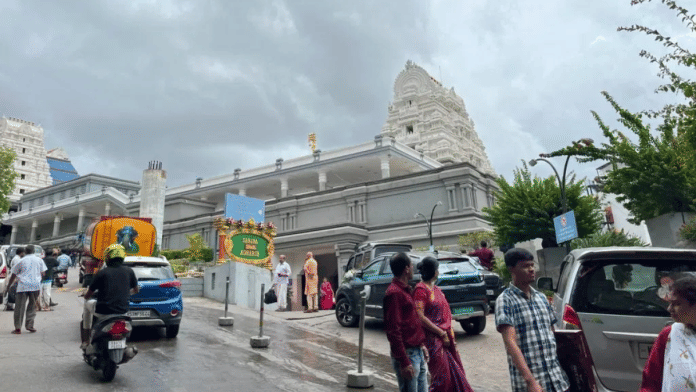



New Delhi: “If (the) finding of fact has been wrongly recorded contrary to material available, that is a ground for review.” With this, a special bench of the Supreme Court Wednesday took up a review petition by ISKCON Mumbai against a May order, in which a faction was handed ownership of a disputed Bengaluru temple.
Led by Justice M.M. Sundresh, the three-member bench of justices P.K. Mishra and Satish Chandra Sharma agreed to reopen the 24-year-old property dispute between ISKCON Mumbai, run by a 1971 Trust, and ISKCON Bangalore (1978 trust).
ISKCON Mumbai filed the review plea after the Supreme Court (SC) in May this year ruled in the dispute in favour of ISKCON Bangalore, declaring it to be the owner of the Raja Hare Krishna Hill temple in the Karnataka capital.
ISKCON Bangalore, opposing the review, argued that the dispute was settled by the two-judge bench of justices Abhay S. Oka—now retired—and Augustine Masih. The “dispute had attained finality”, Senior Advocate C.S. Vaidyanathan, appearing for ISKCON Bangalore, said.
But Justice Sundresh said that a review can be made on the grounds mentioned above, posting the matter for further hearing on 22 January 2026. On that day, the bench will hear both matters of whether it has jurisdiction to hear the review, as well as its merits. Elaborating, he said that if the court did not take into consideration an issue that could have led to a different decision, a review is made out.
Justice Sundresh further remarked that the court would not hear the matter in piecemeal and would “thrash” out all issues together.
“Lord Krishna must be wondering why are you fighting over him,” he said in a lighter vein.
Also Read: SC’s lone woman judge says revisiting orders erodes authority. ‘Written in ink, not sand’
An open court hearing
It is particularly rare for the SC to hear review petitions in open court. According to Supreme Court rules, review petitions are decided through circulation in the chambers of judges. Only death penalty matters receive an open-court hearing under the review jurisdiction.
In the present case, the review petition filed soon after Justice Oka’s retirement in May led to a split view between two judges—justices J.K. Maheshwari and Augustine Masih, who was part of the bench that delivered the May verdict. Justice Maheshwari was the one in favour of a review.
Because the two judges diverged on opinions on whether the review petition should be heard, the matter was placed before then Chief Justice of India B.R. Gavai, who issued administrative orders to place it before a three-judge bench in open court.
The Justice Sundresh-led bench comprises new judges, which means the entire case that remained pending in the top court for 11 years before it was finally decided in May this year will be re-argued before them.
The review process allows the court to consider whether any legal or factual issues were overlooked in its original decision. The task before the present bench is to determine whether ISKCON Bengaluru forged or fabricated documents to establish ownership of the temple, as alleged by the ISKCON Mumbai, and whether the alleged forgery and fabrication were relevant considerations to the ownership question.
ISKCON Mumbai’s stand
According to ISKCON Mumbai, which calls itself ISKCON India, it is the only official International Society for Krishna Consciousness (ISKCON) registered by Srila Prabhupada in Mumbai in 1971.
Between 1971 and 1977, Prabhupada personally established eight more temples across India—including in Vrindavan, Mayapur, Delhi and Hyderabad—which all functioned as branches of the Mumbai society. All 531 temples in India now are branches of this 1971 registration, as instructed by Prabhupada, according to the trust.
In 1978, a group of a few disciples created the Karnataka society, but stopped using it after realising it was a mistake, according to ISKCON Mumbai.
But, in 2001, the Bangalore division filed a suit under the Karnataka Societies Registration Act, demanding ownership of the temple in the city and requesting the court to recognise the shrine as an independent society managed entirely by its local committee, without ISKCON Mumbai’s interference.
The suit, filed by Madhu Pandit Das—who was sent from ISKCON Trivandrum to the Bengaluru branch—was accompanied by fabricated documents, ISKCON Mumbai’s review petition claims.
Das allegedly took this route because his three earlier attempts to stop ISKCON Mumbai from removing him as president of the Bengaluru branch had failed. ISKCON Mumbai said it had initiated disciplinary proceedings after learning that Das was involved in irregularities as president of the Bengaluru branch.
ISKCON Bangalore’s stand
Advocate Kartik Seth, representing ISKCON Bengaluru, told ThePrint that the matter, at its core, is a property dispute, albeit one that has been amplified by deep ideological differences.
“ISKCON Bangalore, under the leadership of Shri Madhupandit Dasa, has consistently professed adherence to the teachings of Srila Prabhupada—the founder of the ISKCON movement. Their commitment to his vision is visibly reflected in initiatives such as the Akshaya Patra Foundation and several other public-welfare activities inspired by devotional service,” he said.
He added: “Ultimately, the dispute can be viewed through the prism of Lord Krishna’s wisdom: ‘If you do not fight for what you want, then do not lament for what you lose.’”
In other courts
After nine years of hearing the case, a civil judge ruled in favour of ISKCON Bengaluru on 17 April 2009, affirming its authority over the temple while restraining the Mumbai trust from interfering in its affairs.
Upon appeal, the Karnataka High Court reversed the civil judge’s decision in May 2011 and accepted ISKCON Mumbai’s argument that the Bengaluru temple was its branch. It held that ISKCON Bengaluru had failed to establish its true independence.
In overturning the Karnataka High Court’s order, the Supreme Court in May this year restored the civil judge’s findings in favour of ISKCON Bangalore.
Grounds for review
ISKCON Mumbai’s review petition has questioned the fact that the Supreme Court judgment came ten months after it was reserved. “…The errors of fact and law may be attributable to the long time that had elapsed between the conclusion of arguments and the pronouncement,” it said.
The judgment was reserved within two days of hearing, resulting in severely truncated oral submissions. On each day, the hearing was spread across four hours.
This was in stark contrast to the previous bench that heard the matter for three weeks and still could not conclude it, ISKCON Mumbai argued. As a result, most vital issues were not considered or dealt with, probably because they could not be highlighted properly in oral submissions, the petition said.
The review petition also stated that the top court selectively examined just one document and erred in holding that ISKCON Mumbai never questioned the genuineness of the documents submitted by ISKCON Bangalore as proof of ownership of the temple.
The Supreme Court’s May verdict put “a premium on the forgery and fraud” committed by ISKCON Bangalore, and allows it to make off with thousands of crores of rupees, seven acres of land and a temple in Bengaluru and Mysore, among other assets belonging to ISKCON Mumbai, the petition said.
ISKCON Mumbai said it had questioned the genuineness of the documents relied upon by ISKCON Bengaluru at every level of the earlier hearings.
The Supreme Court’s observation, in its May judgment, that these documents were never under doubt was incorrect, it said, alleging that ISKCON Bangalore also submitted forged documents to the Bengaluru Development Authority (BDA) for allotment of land meant for the temple.
No witness was examined from BDA to determine the allegation of forgery, it said.
According to ISKCON Mumbai, the rubber stamp seal affixed in a document produced by ISKCON Bengaluru was also a subsequent insertion. The registration number of ISKCON Bengaluru was mentioned in the round rubber stamp seal and not printed on the letterhead placed as part of the court records, it said.
Despite these apparent insertions, the Supreme Court assumed ISKCON’s documents to be genuine without verifying them from BDA. “Thus, it was based on a patent mistake of fact/mistaken assumption that the application has been held to be genuine,” the review petition said.
Since the May judgment is based on a false assumption, it is liable to be set aside, it added.
The Supreme Court did not take into consideration Das’s judicial admission on the status of the Bengaluru temple, the review petition claimed.
In three civil suits filed in trial courts before the ownership-related suit was filed, Das had recognised ISKCON Mumbai as the temple’s rightful authority, the petition said. Judicial admission has a higher evidentiary value and is fully binding on the party that makes it, it added.
In all three suits, filed between 1999 and 2001, Das had unequivocally admitted temple land was acquired by the Bengaluru branch of ISKCON Mumbai from BDA in 1987, it pointed out. The high court had correctly drawn an adverse inference against Das because of his contradictory statements made in these earlier suits, it said.
In its third ground for review, ISKCON Mumbai argued that the Bengaluru branch’s accounts were consolidated with Mumbai’s to file a joint income tax return. This was done on the basis that the temple was an asset of Bengaluru branch of ISKCON Mumbai. This continued till 2001, until the dispute arose and for the first time the Bengaluru division filed its return separately, it said.
(Edited by Prerna Madan)
Also Read: When final judgement isn’t final: Inside Supreme Court’s course of self-correction & the concerns