





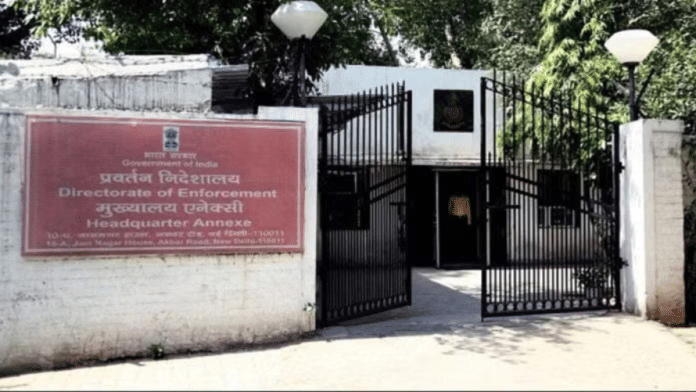



New Delhi: The Tamil Nadu and Kerala governments have moved the Supreme Court challenging a Kerala High Court order, arguing that the Enforcement Directorate is not a juristic person and hence it cannot claim the enforcement of fundamental rights under Article 226.
Article 226 empowers high courts across the country to issue writs such as Habeas Corpus, Mandamus, Certiorari, Prohibition, Quo Warranto, for enforcing the fundamental rights of any person. Essentially, this provision allows aggrieved persons to directly approach any high court for reasons such as the violation of their fundamental rights, or “for any other purpose”.
A writ of mandamus allows a petitioner to request a court to ask a public authority or government body to perform a duty mandated by law. In essence, when a writ of mandamus is granted, the court directs the government or its officials to carry out a legally required act.
On Monday, a Supreme Court bench of justices Dipankar Datta and Satish Chandra Sharma also issued a notice to the ED on the pleas filed by the Kerala and Tamil Nadu governments, challenging the September 2025 order of the Kerala HC, while posting the matter for further hearing in four weeks.
Also Read: ED-Jharkhand Police face-off: HC raps cops, stays probe in assault case against agency officers
Why the 2 states approached SC
The case originates from a challenge to a 26 September 2025 ruling by a two-judge (or division bench) of the Kerala High Court, which held that the Directorate of Enforcement’s plea against the state government were maintainable in law.
The ruling came even as the Kerala government challenged the ED’s action of approaching the Kerala HC in a dispute with the state government. The government argued that under Article 131 in case of disputes between the Centre and the state government, the Supreme Court is the exclusive and appropriate adjudicatory forum.
The Kerala government had also relied on the Supreme Court’s 2003 ruling in Chief Conservator of Forests, Govt. of AP vs. Collector, where the court had frowned upon the practice of Centre and state governments filing writ petitions against each other under Article 226, before high courts,
Pointing to similar practices undertaken by the ED in the state of Tamil Nadu, the state government also argued before the top court that the ED had indulged in a gross and blatant abuse of the process of law by wrongly invoking the writ jurisdiction of the Madras High Court, in order to register a case related to alleged illegal mining in the state.
This is what led the Tamil Nadu government to approach the SC, saying that the ED was acting in a misconceived manner, and had approached the Madras HC with a plea that was not maintainable, and fundamentally flawed.
The facts leading up to case
In 2021, the Enforcement Directorate, through its Deputy Director in Cochin, approached the Madras HC, seeking to quash a notification related to the appointment of an Enquiry Commission. The Commission had been set up to examine whether the contents of a voice clip and a letter, attributed to certain accused in a gold-smuggling case, revealed a conspiracy involving leaders of a political front.
The Kerala government objected to the plea, saying it was not maintainable.
But a single-judge bench of the HC in 2021 allowed the ED’s plea saying the agency is a statutory body created under Section 36 of the Foreign Exchange Management Act, 1999, through a notification passed in June, 2000.
In doing so, the Kerala HC held that a statutory body can essentially invoke the HC’s jurisdiction under Article 226.
In Tamil Nadu’s case, the ED had embarked on an investigation under the PMLA in September 2023. The ED, according to the TN government plea in the SC, engaged a private agency on its own and concluded that there was rampant illegal mining in the state.
Subsequently, the ED conducted searches, seizures and issued summonses to collectors in the state, while saying that many of them were hand-in-glove in the illegal activities. The case reached the Madras HC which asked these collectors to cooperate with the investigation in the case.
While the matter was still pending before the court, the ED wrote to the state DGP in June 2024, informing about the alleged illegal mining in Tamil Nadu.
However, the Madras HC in July 2024 held that the ED’s actions were illegal and foundationally flawed, while quashing the provisional attachment orders issued by the agency then.
This is what led the ED to approach the SC, which also dismissed its plea in September last year.
Finally, the ED made its way back to the Madras HC in October last year through a fresh petition in response to which the court directed the Tamil Nadu government to file an affidavit and status report.
Challenging this, and the Kerala HC order, the Tamil Nadu government also approached the Supreme Court, saying the ED’s actions were untenable.
The Tamil Nadu government relied on a 2003 ruling of the top court which held that a suit filed by a government official acting as a statutory authority “will not be a suit or proceedings for or on behalf of a State/Union of India”.
The 2003 ruling by SC
In the 2003 case, the court had said that every post in the hierarchy of the posts in the government set-up, from the lowest to the highest, “is not recognised as a juristic person”.
It also said that the government cannot be treated as represented “when a suit/proceeding (is filed) is in the name of such offices/posts or the officers holding such posts”.
In the absence of the State being named among the parties in such a case, the cause can also get defeated by not attaching the Centre or making it a necessary party to the dispute before a court or tribunal, essentially meaning a case filed in the name of a government office or officer may be dismissed as the office/officer filing the case does not amount to suing or representing the government.
However, the Kerala HC ruling, under challenge in the present case, said that the plea filed by ED through its Deputy Director was legally tenable since the ED was a statutory authority under the PMLA.
Challenging this, the Kerala government moved the two-judge bench which also upheld the earlier single-judge’s order, causing the state to ultimately move the top court.
This division bench ruling from September, last year, also emboldened the ED to venture into a similar line of action in Tamil Nadu, the state government argued in its plea.
(Edited by Ajeet Tiwari)
Also Read: ED lodged 193 cases against politicians in last 10 yrs, with 2 convictions & 0 acquittals—govt data