





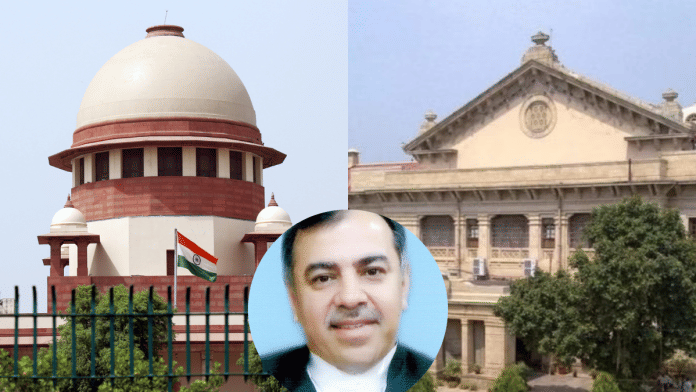



New Delhi: At 60, Justice Pankaj Bhatia of the Allahabad High Court finds himself at the centre of an institutional debate that has drawn in the Supreme Court and the Oudh Bar Association. The controversy erupted after the Supreme Court made critical observations on 9 February against one of his bail orders—remarks that prompted a strong show of support from the Bar and a candid response from the judge himself.
What began as appellate scrutiny has evolved into a larger debate around judicial independence, heightened conflict, and the pressures of mounting pendency in one of India’s busiest High Courts.
The row stems from an appeal heard on 9 February by a Supreme Court bench of Justices J.B. Pardiwala and K. Vishwanathan.
The appeal challenged an October 2025 bail order passed by Justice Bhatia, who had granted bail to the husband of a young woman who died within months of marriage, allegedly due to dowry demands. The FIR alleged the demand of dowry and incessant harassment. The wife died due to asphyxia and strangulation.
Setting aside the High Court order, the Supreme Court termed it “one of the most shocking and disappointing orders” leading to a “travesty of justice”.
“We fail to understand, on plain reading of the order, as to what the High Court is trying to convey. What weighed with the High Court in exercising its discretion in favour of the accused for the purpose of granting bail in a very serious crime like dowry death? What did the High Court do?” the bench asked.
Without commenting on merits as the trial was ongoing, the Court held the order unsustainable in law and directed that a copy of the SC order be placed before the Chief Justice of the Allahabad High Court.
Meanwhile, in the same week, while hearing another bail plea, Justice Bhatia addressed the issue in open court. Observing that no judge can claim their orders have never been set aside, he said the Supreme Court’s observations had a “huge demoralising and chilling effect” on him. He requested a roster change and expressed his desire not to hear bail pleas in the future.
Also Read: Supreme Court Collegium invokes Article 224A to appoint 5 ad-hoc judges in Allahabad High Court
Oudh Bar representation
On 18 February, the 125-year-old Oudh Bar Association wrote to Chief Justice of India Surya Kant, flagging concerns over “repeated adverse remarks concerning Allahabad High Court”.
“The Bar is the mother of the Bench and is (the) best judge to assess the performance of every Judge in (the) Justice delivery system running on two parallel wheels of Justice,” the letter stated.
It said HC judges are sometimes “made to feel the impact of unexpected remarks made by the Apex Court on the judicial side in its appellate jurisdiction”, which has a “demoralising effect on their judicial mind adverse to the capacity as a judge in the dispensation of justice”, compounded by “mounting pressure of ever-increasing pendency of cases”.
The letter added that while erroneous judgments may be criticised, “there is sometimes overreach by our Apex Court in passing remarks on the capability of judges under impugned order, which has a serious jolting psychological effect(s)”.
It further noted that the High Court in Uttar Pradesh, sitting at Lucknow and Prayagraj, is functioning with fewer judges than its sanctioned strength, increasing pressure on those hearing heavy rosters, particularly in bail jurisdiction.
Oudh Bar Association General Secretary Advocate Lalit Kishore Tiwari told ThePrint that if “a person is passing 1,000 orders in a day, 1 order can be of such nature.”
While the appellate court has the right to set aside an order, he said, strong remarks directed at a “relief-giving judge” risk shaping an adversarial environment.
Tiwari, who regularly appears before Justice Bhatia, described him as a “good, non-controversial” judge who rules on merits and treats juniors and seniors alike.
The Bar’s President, advocate S. Chandra, reiterated similar concerns.
Asserting that the low number of judges in the High Court already affects the pace of justice delivery, Tiwari said that with pressure, the “independence of the judiciary” is hampered.
To fill the vacancy, the Bar Association submitted their representation before the Chief Justice of Allahabad High Court and the CJI on 18 February 18th, Tiwari told ThePrint.
Justice Bhatia’s career
Now 60, Justice Bhatia completed his schooling in Gwalior, Madhya Pradesh, and pursued law at Kanpur University. In 1989, he began practice in Kanpur under his father.
Three years later, he shifted his practice to the Allahabad High Court, focusing on civil law, constitutional law, excise & customs, and administrative law. In 2007, he moved his practice to the Supreme Court and the Delhi High Court, continuing in the same fields.
He also served as the counsel for the Bank of India.
He was appointed an Additional Judge of the Allahabad High Court in 2018. After completing the mandatory two-year period, he was made a permanent judge in November 2020. He is set to retire in 2028.
From bail orders in serious criminal cases to rulings on reservation caps, demolition drives, and administrative excess, Justice Pankaj Bhatia’s judicial record reflects an active and varied docket since becoming a permanent judge.
The October 2025 dowry death bail order is not the first time Justice Bhatia has granted bail in such cases.
In December 2025, he granted bail to a man in his daughter-in-law’s death case, observing that “fake cases are on rise” months after the Supreme Court had refused bail to the accused and his wife, holding that prima facie evidence existed against them.
They approached the High Court again after the SC denied them the bail as there were changes in the trial and fresh circumstances emerged during the trial where key witnesses retracted allegations.
In October 2025, he granted bail to 71-year-old Samajwadi Party leader Moid Ahmed, accused in the 2024 Ayodhya gang rape case of a minor.
Sitting on a vacation bench alongside Justice Kshitij Shailendra in June 2025, he granted bail to convict Babu Khan in the Shravan Sahu murder case on parity with another co-accused.
Education rights & RTE ruling
In September 2025, Justice Bhatia allowed a writ petition filed by two students—11-year-old Huzaifa Khan and his 14-year-old brother—detained in the same class by a Lucknow-based ICSE-affiliated private school after the 2024-25 examinations for low attendance and poor academic performance.
He held that the entire Right of Children to Free and Compulsory Education Act, 2009, including restrictions on detaining or failing students till completion of elementary education, applies to private unaided schools as well.
On ‘misuse’ of RSS name
Last week, Justice Bhatia deprecated the misuse of the name and affiliation of the Rashtriya Swayamsevak Sangh in a private Resident Welfare Association dispute.
Holding that criminal proceedings initiated by a disgruntled resident amounted to abuse of process, he observed that a “highly disciplined and respected cultural organisation like the RSS” appeared to have been unnecessarily maligned.
Quoting, “With great powers come great responsibility,” he left it open to the organisation to take action as deemed fit, clarifying that criminal law cannot be weaponised to settle personal disputes.
Livelihood & demolition drives
Holding that Article 21 includes the right to livelihood, Justice Bhatia stayed the demolition drive in Akbar Nagar I and II in Lucknow for four weeks, observing that exposing the “poorest of poor” to harsh winters required judicial scrutiny. He remarked that at that stage, it was unclear what “tearing hurry” justified action against large occupations by relatively poor persons.
In July 2025, he imposed a cost of Rs 50,000 on the Lucknow Development Authority for trespassing on private property and violating Article 300A by dispossessing a petitioner without due sanction of law.
In June 2025, he quashed the Greater Noida Industrial Development Authority’s 2022 decision to cancel land allotted to Royal Golf Link City Projects Pvt Ltd, calling it “arbitrary and illegal”. He also nullified the penalties and granted a three-year extension to complete the project without extra cost.
In July 2025, Justice Bhatia quashed an order removing an elected Gram Pradhan under Section 95(1)(g)(ii) & (iii) of the U.P. Panchayat Raj Act. The district authority had divested the Pradhan of office by exercising powers under the Act based on allegations linked to cow slaughter.
The same month, he stayed the suspension of a Fair Price Shop’s licence in Gonda district, terming the action prima facie concerning. He also stayed further inquiry until orders.
In an interim measure, he directed that Rs 500 charges for photo identification by Bar Associations not be realised from litigants and that affidavits sworn before public notaries be accepted as valid under the Notaries Act, 1952, observing that regressive practices burden access to justice.
In August 2025, Justice Bhatia quashed Uttar Pradesh government orders that had resulted in more than 79 per cent reservation in government medical colleges across Ambedkar Nagar, Kannauj, Jalaun and Saharanpur.
Directing a fresh round of admissions strictly in line with the Uttar Pradesh Reservation Act, 2006, he held that breaching the 50 per cent ceiling requires proper legislative or constitutional backing, which was absent.
(Edited by Ajeet Tiwari)