





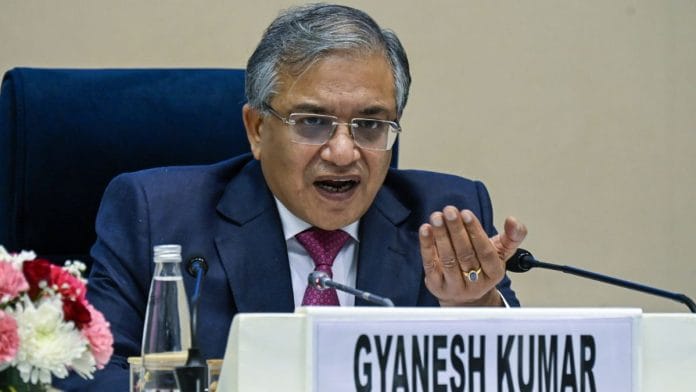



New Delhi: Defending its decision to revise electoral rolls in West Bengal, the Election Commission of India (ECI) cited “successful implementation” of the exercise in Bihar and said that accusations of disenfranchising voters were politically motivated.
The ECI made its stand clear in a 26 November response to a Supreme Court petition filed by Trinamool Congress MP Dola Sen. The petition had challenged the poll panel’s decision to carry out Special Intensive Revision (SIR) exercise in 12 states and Union Territories, including West Bengal.
The petitioner demanded that the next state polls, which includes West Bengal, should be conducted on the basis of existing electoral rolls.
ECI, in its affidavit to the apex court said, “Nobody can deny that electors in the existing rolls who have either died or permanently shifted or have been enrolled in another constituency should be removed from the electoral rolls, and if some non-citizen has been erroneously enrolled he/she should also be removed from the electoral rolls.”
The allegation of mass disenfranchisement by the petitioner, the affidavit read, was an “attempt to politicise the exercise to serve vested political interests” and has been “proven by the successful implementation of SIR in Bihar” as “untenable”.
The ECI reiterated its powers to conduct SIR, asserting that the commission has complete control over all aspects of elections, including the process of preparation of electoral rolls.
Addressing the petitioner’s questions about ECI’s powers to determine citizenship of voters, the poll panel said it was vested with the authority to scrutinise eligibility of a person with regard to their entitlement to be registered as a voter. This criteria includes the assessment of citizenship, it said.
Proof of citizenship sought from existing electors under SIR, the poll panel noted, was for the limited purpose of registration in electoral rolls. “The SIR exercise is not aimed at determining the status of citizenship,” the affidavit said.
But, the affidavit pointed out, the Ministry of Home Affairs, in a circular dated 8 August 2017, had directed all states and UTs to identify illegal immigrants and initiate their deportation process.
“Therefore, if the EROs (electoral registration officers) have reasonable basis to suspect citizenship of an individual, it is their duty to report such cases to the relevant authority,” the affidavit said.
Apart from Sen’s plea, the Supreme Court is hearing a clutch of petitions that have challenged the legality of SIR. Among them is a plea by the Association of Democratic Reforms (ADR) filed with regard to the Bihar SIR, which has sought transparency in the process to revise electoral rolls.
The first phase of SIR this year was carried out in Bihar, where the total count of voters was reduced by around 47 lakh.
Opposition parties have repeatedly accused ECI of colluding with BJP to commit voter fraud. Ahead of recently-concluded Bihar polls, it had said that SIR was an attempt to remove lakhs of people from marginalised communities from electoral rolls.
Last week, the Election Commission extended the deadline for voters to submit their enumeration forms for the second phase of the exercise across 12 other states and UTs. The final roll is expected to be published by 14 February.
The decision comes reports of several deaths, including five suicides of booth level officers (BLOs) engaged in the exercise. BLOs, who are usually state government school teachers and healthcare staffers, have said they are facing extreme work pressures. In UP’s Noida and Ghaziabad, FIRs were also filed against dozens of BLOs for alleged negligence in SIR work.
Also Read: Pause ‘wasteful’ SIR until an audit with public hearing—ex-IAS writes to poll panel amid BLO deaths
‘Narrative to serve political interests’
ECI pointed out that the last special intensive revision (SIR) in West Bengal was conducted in 2002, and that the list of acceptable documents as proof of eligibility has since been expanded from four to 13 documents.
“The possibility of any existing eligible elector being left out from the Draft Electoral Roll is non-existent as adequate care has been taken to ensure that each and every eligible existing elector is accounted for,” ECI said.
On statistics claiming that over 99% of existing voters had been supplied with pre-filled enumeration forms, ECI said the numbers demonstrated that the petitioner’s contention of errors in implementing SIR and mass disenfranchisement were “highly exaggerated” and were “being advanced as a narrative… to serve vested political interests”.
Regarding Matua community’s protest against SIR in West Bengal, ECI told the court there is no reason for any person to panic because of the exercise. The commission, it said, is not aware of any indefinite hunger strike to protest mass exclusion of members of the community.
The poll panel pointed out that on 22 August, the Supreme Court had impleaded all recognised political parties in Bihar and directed them to file status reports on steps taken by them to enable electors in filing claims and objections after the draft electoral roll for the state was released. Only some political parties filed their status reports, it said.
“This further shows that most of the political parties have been virtually inactive in assisting and facilitating the inclusion of the eligible electors, other than appointing BLAs (booth level agents),” it submitted, adding that several claims by the petitioner were “incorrect and misconceived”.
Pointing out that no appeal was filed in Bihar, ECI contended that it showed that the exercise to revise electoral rolls was conducted fairly and the state’s electorate was satisfied.
(Edited by Prerna Madan)
Also Read: Deaths, boycotts over workload threaten to derail SIR. BLOs ask ‘how long should we work?’