





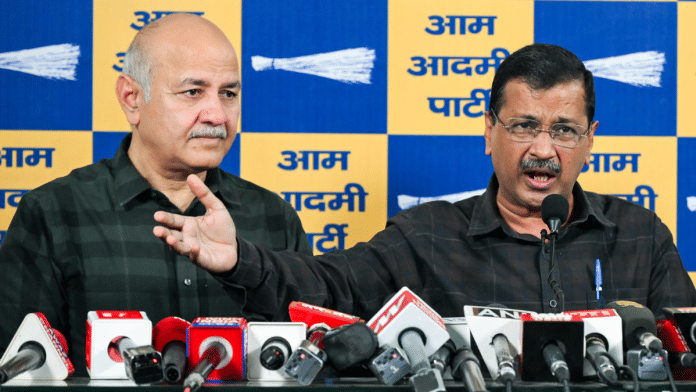



New Delhi: The Delhi High Court on Monday stayed the adverse remarks made against the CBI’s investigating officer by the Rouse Avenue court in its 27 February order discharging former chief minister Arvind Kejriwal, his then deputy Manish Sisodia and others in the 2021-22 Delhi excise policy case.
The HC was hearing the CBI’s revision plea against trial court special judge Jitendra Singh’s order in which he ruled that the agency’s case “did not survive judicial scrutiny”.
On Monday, the single-judge bench of Justice Swarana Kanta Sharma was hearing the CBI’s massive 974-page appeal, filed days after the Rouse Avenue court delivered its judgment discharging all the accused persons in this case.
In her order, Justice Sharma said, “It is also observed that some scathing remarks were made against the CBI. I will pass an order staying whatever observations were made against the investigating agency (CBI)”.
The HC passed this present order after it was also told that in addition to the “scathing remarks” some “factually incorrect” observations also recorded in the February 27 order.
In his 27 February order, Rouse Avenue district court judge Jitendra Singh dismissed the CBI case against the 23 accused in the Delhi liquor policy case in a 598-page order, and pulled up the CBI for procedural “lapses” and overly relying on “hearsay evidence”.
It also recommended a departmental inquiry against an investigating officer (IO) of the CBI for arraying a public servant as an accused.
During the course of Monday’s proceedings, which largely consisted of Solicitor General Tushar Mehta’s submissions on behalf of the investigating agency, the court also remarked that the outcome of this case would affect the Enforcement Directorate’s case against Kejriwal as well.
The money-laundering case registered by the ED was based on the corruption case registered by the CBI.
“I will also ask the trial court to defer the proceedings in the ED’s case to a later date,” Justice Sharma remarked.
This means that the court will first decide the CBI’s appeal against the trial court verdict before it decides the ED’s case against Kejriwal.
Besides this, the court also issued notice to all accused on the CBI’s plea, asking them to respond by the next date of hearing. The matter will be next heard on 16 March, after the accused persons file their responses.
Meanwhile, the Enforcement Directorate (ED) separately moved the Delhi HC late Monday seeking to expunge adverse remarks made by the trial court against the agency.
What CBI argued
Appearing for the CBI, Solicitor General Tushar Mehta claimed the 27 February order of the trial court was “illegal, perverse and factually incorrect”.
Terming the excise policy one of the “biggest scams” in the history of Delhi, SG Mehta took the court through the CBI’s 974 page appeal challenging the trial court’s order which discharged all 23 the accused persons.
“There was a manipulated policy which was created to favour some traders,” Mehta said, adding there isn’t enough material that at this stage on the basis of which the accused can be discharged.
Essentially, the trial court passed the discharge order without conducting a proper trial in this case, Mehta said, while adding that the prosecution had meticulously collected evidence of meetings which had taken place which indicated that corruption was carried out on a massive scale.
“Several documents were collected and witnesses were examined. This is not something which came out of thin air. Speedy justice shouldn’t result in the miscarriage of justice,” he said.
The excise policy “scam” brought immense shame to the nation, the CBI has argued in its please, saying its case was built on scientific evidence and investigation. “When we say there is a conspiracy, we have to establish all its parts, and each part of the conspiracy was established by us.”
The CBI also said that witnesses had shared with them accounts about who all were paid bribes, in what manner, and who paid them. One such person, according to the CBI was Vijay Nair, who was the communications in-charge of Kejriwal’s Aam Aadmi Party (AAP), and was allegedly involved in a bribe to the tune of Rs 100 crore.
Finally, the CBI pointed to the court that the entire fact-finding exercise of the investigation went in vain, after the trial court order.
Following this, the court issued notice to the other side and listed the matter for hearing on next Monday.
CBI’s appeal & the case
In its revision plea, the CBI has claimed that Special Judge (Prevention of Corruption Act) Jitendra Singh conducted a “mini-trial”, and that the judge dealt with “separate limbs of conspiracy in isolation”, rather than cumulatively assessing the evidence.
Pointing out what it sees as “selective reading” of the prosecution’s case, the CBI has claimed that the judge disregarded the material that showed the culpability of the accused.
In his 27 February order, the trial court judge “failed to appreciate” the prosecution’s case with the “correct perspective” which led to his “unwarranted and incomprehensible” remarks about the central agency and the investigating officer, the CBI has further alleged.
The Delhi Excise Policy 2021–22 was “deliberately crafted and implemented as an instrument of corruption, designed to generate large-scale illegal gratification through embedded margin manipulation”, the CBI has claimed. The then Delhi government aimed to distribute and utilise the proceeds and returns from the irregularities towards political objectives, such as the Goa elections, the central agency has said.
According to the FIR registered by the CBI in August 2022, the central agency received information about certain “irregularities” while the Delhi government was framing the excise policy. The agency said it received information from its sources, Praveen Kumar Rai. So, it initiated its investigation.
After the CBI filed five charge sheets against 23 persons for offences such as criminal conspiracy, cheating, causing disappearance of evidence, and bribing public officials, the trial court took up its case on a day-to-day basis and heard arguments between 22 December 2025 and 12 February.
As for the irregularities, the CBI had also stressed that all the politicians and bureaucrats involved were hand-in-glove, but Arvind Kejriwal and Manish Sisodia were the key politicians involved.
Manish Sisodia, “being the minister of excise as well as finance”, was “instrumental” in the formulation and implementation of the policy and Arvind Kejriwal, the “overall in-charge of AAP”, looked after “all its major decisions”, according to the central agency.
“Durgesh Pathak and Vijay Nair, closely linked to them, worked in close proximity to achieve the end goal of the conspiracy,” the CBI’s plea further stated.
What the court said
In its order, the HC said no one appeared on behalf of any of the 23 accused when the matter was called out for hearing, even though they were informed that they would be required to appear.
The court said the CBI presented before it evidence collected by it, which was also filed before the trial court, through chargesheets and supplementary chargesheets.
During the course of the hearing, the CBI also argued that the trial court order had “ignored crucial and admissible evidence at the stage of charge itself”. In doing so, the lower court failed to take into consideration the aspect that at this stage it had to “only take a prima facie view of evidence” collected by the prosecuting agency, rather than conducting a full-fledged trial, the agency argued.
“The attention of this Court was also drawn to certain observations made by the learned Trial Court, which are factually incorrect, contrary to the evidence placed before the learned Trial Court by way of statements of the witnesses recorded by the Investigating Agency and approvers recorded by the Judicial Magistrate,” the court said.
The court also went on to note that the 27 February order made some “scathing remarks” against the Investigating Officer, that were uncalled for and the CBI sought to stay these.
However, the court clarified that since all the accused had been discharged by the Rouse Avenue court, and the bench made observations about the ED’s money laundering case which was also connected to the present matter, an appropriate order will be passed to ensure that the case filed under the Prevention of Money Laundering Act, is not affected by virtue of this order.
Significantly, the court ruled that certain factual discrepancies pointed out in the February 27 order—such as those regarding witness and approver statements—appeared erroneous on the face of it.
The court said these discrepancies needed consideration against the background of well-settled law on charge and conspiracy to determine whether such observations were appropriate at the stage of framing the charge itself.
The court also asked the trial court hearing ED’s case against Arvind Kejriwal and other accused to postpone hearing since the outcome of the matter before the Delhi HC could affect the ED’s case.
Finally, the court agreed to grant the CBI the requested relief and stay the adverse remarks but only to the extent of the observations made by the trial court against the IO, including the court’s direction to lodge a departmental inquiry against him.
“The reasons given for passing such remarks including, concluding that the investigating officer has abused his official position to conduct unfair
investigation, are prima facie foundationally misconceived especially when made at the stage of charge itself.
“Needless to say, at this stage, the reasons given for passing such remarks are also under challenge in the present petition and need consideration as opined by this Court,” the court noted, while listing the matter for further hearing on March 16.
This is an updated version of the report
(Edited by Ajeet Tiwari)