





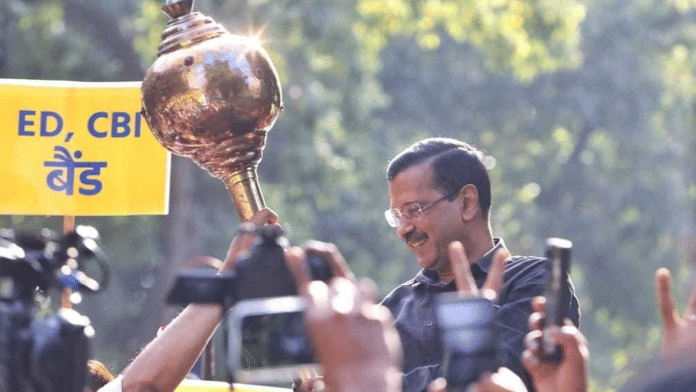



New Delhi: Giving a clean chit to former Delhi chief minister Arvind Kejriwal and his deputy Manish Sisodia, a special CBI court ruled that the Central Bureau of Investigation (CBI) failed to establish, even at the primary level, manipulation of the excise liquor policy.
On Friday, the special CBI judge observed that the agency could not produce any document establishing a meeting of criminal minds, which amounts to the origin of an alleged criminal conspiracy in the formulation of the policy for the year 2021-22.
Drawing from these findings, judge Jitendra Singh further observed that the principal allegations were against Sisodia, who was the minister in charge of the excise department at the time, and that any allegations against Kejriwal could not stand on their own without the validity of the allegations against the former.
The judge refused to frame charges against Kejriwal, Sisodia, their former campaign manager Vijay Nair, Telangana Jagruthi president K. Kavitha, along with 20 others, including businessmen.
The case dates back to August 2022, when the CBI booked Sisodia, Nair, and two officials of the Delhi excise department, along with several others, for corruption and allegations of forming liquor cartels in exchange for bribes to the ruling Aam Aadmi Party (AAP).
Sisodia was arrested by the CBI in February 2023 and spent more than 17 months in jail. On the other hand, Kejriwal was arrested by the Enforcement Directorate in a money laundering case stemming from the CBI case in March 2024, followed by his arrest by the CBI in June that year. The agency had also arrested the then-leader of the Bharat Rashtra Samithi and the daughter of former Telangana chief minister, K. Kavitha.
“Upon consideration of the entire material placed on record, this court is of the considered view that the prosecution has failed to place any material which, even prima facie, suggests that the Delhi Excise Policy-21/22 was manipulated, altered, or engineered to confer any undue or unlawful benefit upon any private individual or the so-called ‘South Group’,” special judge Singh observed.
“On the contrary, the contemporaneous record clearly establishes that the policy was the outcome of a consultative and deliberative exercise, undertaken after engagement with relevant stakeholders and in adherence to the procedure prescribed under law. Though there was no statutory or constitutional requirement mandating the obtaining of suggestions from the Hon’ble Lieutenant Governor, the file notings unmistakably reflect that such suggestions were nevertheless sought, examined, and incorporated. The procedural integrity of the policy-making process, thus, stands affirmed from the documentary record itself.”
The judge observed that “once the formulation of the policy is shown to be the product of deliberation, institutional scrutiny, and procedural compliance,” any subsequent attempt to attribute criminality to its implementation becomes wholly untenable.
“The very foundation on which the prosecution seeks to construct the narrative of conspiracy, centred around alleged payment of ‘upfront money’ and its purported recoupment, stands fundamentally eroded. In the absence of a tainted policy or demonstrably unlawful implementation, the prosecution theory is reduced to conjecture,” the order stated.
The judge further noted that if the “principal allegation against the Deputy Chief Minister does not withstand scrutiny, the attempt to fasten a peripheral role upon Chief Minister (A-18) cannot independently survive.”
Overall, the CBI filed a total of five charge sheets against 23 accused persons, including Kejriwal and Sisodia. All the 23 were discharged by the court Friday.
“In view of the foregoing discussion and the reasons recorded hereinabove, this court has no hesitation in holding that the material placed on record does not disclose even a prima facie case, much less any grave suspicion, against any of the accused persons. Accordingly, accused nos. A-1 to A-23 are discharged of all the offences alleged against them in the present case,” the judge ordered.
A series of contradictions
In the descriptive order spanning nearly 600 pages, the judge discussed at length all facets of the investigation and the evidence presented by the CBI.
He documented that Sisodia was shown as the “principal architect” of the entire scheme and said that the CBI’s case against him stands on four pillars—sidelining of an expert committee report, suppression of a draft cabinet note which contained adverse legal opinions against the proposed policy, broader criminal conspiracy with the so-called “South Group”, and recoupment of bribes extracted from the beneficiaries and its utilisation for electoral purposes.
The court emphasised that the CBI relied upon two draft Group of Ministers (GoM) reports of 15 March and 19 March, 2021. While the first talked about keeping the margin at 5 percent, the second hiked it to 12 percent. This increase was allegedly done at the South Group’s instance, and later the 19 March 2021 GoM was formalised.
According to the CBI’s charge sheet, the South Group was a cartel of businesses from the southern states, including Kavitha, Telugu Desam Party (TDP) MP Magunta Srinivasulu Reddy, his son Raghav Magunta, and businessman P. Sarath Chandra Reddy. According to the CBI, they paid kickbacks totalling Rs 100 crore to the AAP, which was allegedly spent on electoral expenses during the assembly elections.
The CBI alleged that the second draft GoM report, suggesting a 12 percent margin, was inserted and printed by AAP campaign manager Nair at the instance of businessman Abhishek Boinpally to recoup around Rs 100 crore allegedly paid upfront to AAP. It had alleged an abrupt increase in margin as part of a conspiracy and arrangement to recoup the bribe.
The court, however, rejected the argument by analysing the implications of the two draft GoM reports.
The judge observed that the first report did not set any upper limit on the margin, thereby giving a wider latitude to the wholesalers and suppliers to negotiate the financial terms of the deal. The minimum 5 percent margin was maintained to ensure the quality of the liquor supply and to avoid any contamination.
On the other hand, unlike the first one, the second GoM report fixed an upper cap of 12 percent margin that limited the companies’ ability to recoup excessive revenues generated from the increased margin, instead of giving them a free hand in negotiations.
The court faulted CBI’s interpretation on the first draft GoM report and said it did not fix the margin at a 5 percent ceiling. Instead, it set a base of 5 percent, leaving the final margins to the business enterprises, meaning thereby the parties entering into the deal had more headroom in revenue generation by fixing a higher margin based on market value and conditions.
“The first draft did not prescribe a 5 percent ceiling; it prescribed only a floor. The second draft replaced a flexible regime with a uniform rate. It is also of significance that the investigating agency has not alleged manipulation in the first draft,” the judge observed.
“The allegation of manipulation is directed only against the second draft, and that too on the premise that the wholesale margin was enhanced to facilitate recoupment. If the first draft had culminated into the final policy, the wholesaler entities such as M/S Indospirit and M/S BSPL, who are alleged to be part of the conspiracy for recoupment, would have operated under a regime with no upper cap on distributor margin.
“Such an arrangement, in theory, provided a wider commercial latitude and a greater opportunity to accumulate higher margins. The second draft, by introducing a standardised 12 percent margin, curtailed that flexibility,” the judge observed.
Having discussed the implications of the two draft recommendations, the court observed that the policy changes narrowed their discretion, contrary to the prosecution’s hypothesis that this was done to benefit the accused.
“A policy that replaces an uncapped negotiable margin with a fixed standard cannot, on its face, be said to enlarge the scope for windfall accumulation. If anything, it narrows discretion. The suggestion that a group would design a framework disadvantageous to its own alleged objective renders the theory internally inconsistent,” the judge observed.
The court junked another allegation that the eligibility criteria for an L-1 license were increased from Rs 100 crore in annual revenue over the past five years to Rs 500 crore and then this revenue criteria was reduced first to Rs 250 crore and then was further brought down to Rs 150 crore.
As per the CBI, the revenue metric was increased to exclude the smaller players. However, the court rejected this argument saying that one of the firms charged as beneficiaries of the conspiracy was a smaller player and was excluded from availing the license, even though the financial eligibility criteria was brought down to Rs 150 crore.
“The very entity alleged to be beneficiaries of the conspiracy, M/S Indospirit, were themselves confronted with difficulty in meeting the turnover requirement. The material placed before the court indicates that M/S Indospirit Marketing Private Limited (M/S IMPL) struggled on the turnover criterion and was unable to satisfy even the reduced benchmark of Rs 150 crore in the final policy, leading to withdrawal of its application and a subsequent attempt under the name of M/S Indospirit,” the judge observed.
“If the prosecution theory is that the eligibility threshold was deliberately raised to eliminate competitors and secure advantage for conspirators, the fact that the alleged conspirators themselves faced disqualification on the very same turnover condition introduces a serious inconsistency. A clause that renders the supposed beneficiaries ineligible cannot, on its face, be described as a provision crafted exclusively for their benefit.”
(Edited by Tony Rai)