








New Delhi: At 94, K.K. Venugopal has lived through nearly the entire modern history of India’s legal system. From arguing motor vehicle cases as a young lawyer in the 1960s to serving as Attorney General of India, the senior advocate has been engaged in the most politically and constitutionally significant cases in Indian legal history.
In an interview to ThePrint, he spoke about the dramatic changes in legal education, memorable courtroom experiences, the importance of pro bono work, the Collegium system of judicial appointments and the need for greater representation of women in the judiciary.
Speaking on the changing culture of the profession, he said, “The culture which a lawyer should have is to do justice to his case, to study the brief thoroughly, to research sufficiently so that he always keeps up to date with the latest decisions on the particular subject which he is handling,” he said.
However, he also expressed concern that the profession may have shifted focus in some instances.
“Now I do not think that all lawyers would follow this culture because today I do not know whether all the lawyers, which would include me perhaps, were more fond of the money which the profession generates rather than handling pro bono cases or sitting and studying a case thoroughly without wasting any time.”
“My personal feeling is that we may today have or the profession may have degenerated to a little extent where one is more concerned about the remuneration…I am not saying that as a general rule but perhaps in some cases.”
For Venugopal, public interest litigation has been one of the most significant developments in Indian constitutional law.
“Looking back, my personal feeling is that public interest cases where a huge area of deprivation of the rights of the people is brought to the focus of the Supreme Court or the high courts brings in a tremendous amount of benefits,” he said.
He contrasted such cases with ordinary disputes involving individual grievances.
“Unlike individual cases where you go and say this land of mine has been taken away or this rent control case has resulted in high rents and therefore I have a war that my landlord is trying to evict me. Public interest litigation falls into a totally different category,” he said.
He invoked a famous remark by British wartime leader Winston Churchill to illustrate the scale of impact.
“I remember Churchill saying after the war that never before in the history of man has so much been done by so few people for so many…Therefore, the public interest litigation has done tremendous good across the complete scheme of litigation and I think it is something which is very good because it brings benefit to not one individual but to a huge community.”
Collegium debate and judicial appointments
Venugopal also reflected on the evolution of the system for appointing judges to the higher judiciary. “First of all what the original Constitution said in Article 124 was that the President of India, which means the Government of India, will appoint judges to the higher judiciary in consultation with the Chief Justice of India.”
This arrangement, he noted, changed through judicial interpretation. “All through mere judicial interpretation or misinterpretation according to me of Article 124 of the Constitution… the entirety of the selection of the candidates then recommending the candidate to the central government insisting that their (Collegium’s) candidate be appointed.”
“If the government sends it back once, on the second occasion the government has to accept it. And all this was rewriting the Constitution and creating a new Constitution for the appointment of judges,” he said.
Referring to the Supreme Court Advocates-on-Record Association v. Union of India (2015) decision striking down the National Judicial Appointments Commission (NJAC), he said: “What the NJAC wanted to do was excellent… both the ruling party and the Opposition, all of them agreed unanimously except for one dissent—that of Ram Jethmalani.”
“That means the whole of the Rajya Sabha, the entirety of the Lok Sabha had agreed. Now that is the one which has been struck down. According to me that is wholly unjustified… why on Earth was it struck down and the result of the Collegium…you find it has been criticised on all sides.”
Women in the judiciary
Venugopal also raised concerns about the limited representation of women in the Supreme Court despite the increasing number of women entering the profession.
Ever since the culture of National Law Universities started, he said, it has produced capable lawyers across the board. “In which event, why on earth do we find only one woman judge on the bench of the Supreme Court—Justice Nagarathna?” he asked.
“According to me, if not an equal number at least a nearly equal number of representatives are needed. There is a judgement and feeling that women lawyers will not make good judges,” he added.
Drawing the moral line
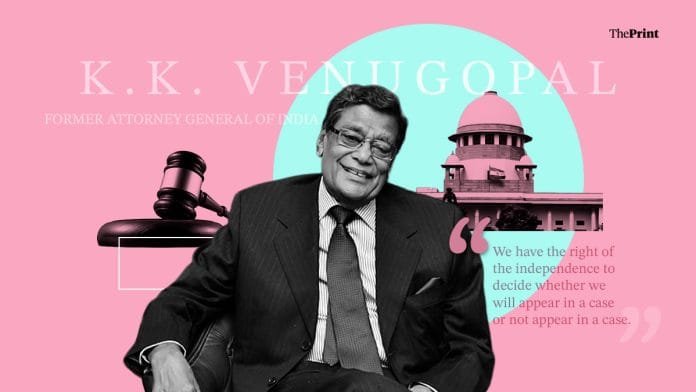
Venugopal also emphasised that lawyers must exercise moral judgment when deciding whether to appear in certain cases. “We have the right of the independence to decide whether we will appear in a case or not appear in a case. And therefore we should exercise that independence depending upon whether you believe that so far as the case is concerned it is something which you should appear in and put over to the court.”
He recalled being misled by the then Uttar Pradesh Chief Minister Kalyan Singh in the dispute surrounding the Babri Masjid. “In the Babri Masjid case, I was misled by my client Kalyan Singh. He told me specifically that I will not allow kar sevaks to cross the bridge and demonstrate at the Babri Masjid.”
He also described an exchange with Justice V. R. Krishna Iyer which left a deep impression on him. “I remember Justice Krishnan telling me when I appeared against the Scheduled Castes in regard to promotions, Venugopal you have to pay for what you have done in the last 5,000 years to the Scheduled Castes.”
“But what he meant was that we, the non-Scheduled Castes had oppressed the Scheduled Castes for centuries… From that day onwards I have never appeared—and this was 30 years, 40 years back—against the Scheduled Castes in any case,” he said.
(Edited by Viny Mishra)
Also read: SC reconsiders 3-yr legal practice mandate for judicial office. What this will mean for women