





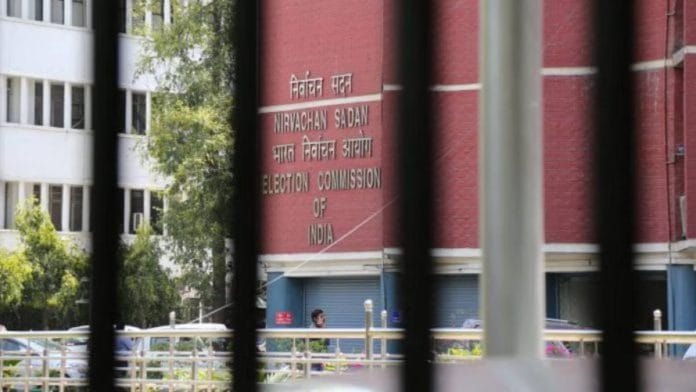



New Delhi: The Election Commission of India (ECI) has asserted its right to verify citizenship status for the purpose of revision of electoral rolls. In its written submissions filed before the Supreme Court Tuesday, the poll panel claimed it derives this power “directly from the Constitution”.
Responding to the challenge over its jurisdiction, ECI further contended “The Citizenship Act, 1955 and the Foreigners Act, 1946 do not detract from the power of the ECI with respect to assessment of citizenship”.
ECI gave its written submissions to the court of Chief Justice Surya Kant and Justice Joymalya Bagchi, which is hearing petitions challenging the constitutional validity of the SIR exercise.
Appearing for ECI, senior advocate Rakesh Dwivedi referred to the Constituent Assembly debates to assert that ECI is responsible for preparation of electoral rolls and can enquire into citizenship status as well as exclude those who are not citizens from the electoral rolls.
In its written submissions the ECI mentioned a resolution moved by Jawaharlal Nehru in the Constituent Assembly on 8 January, 1949, much before the poll panel came into existence, to support its stand on citizenship enquiry. This resolution, ECI said, required the authority vested with the power to prepare an electoral roll to ensure that no non-citizen shall be included in the electoral roll of the constituency.
It was this resolution, which, after adoption, was ultimately inserted in the Constitution in the form of Article 289-B that was later re-numbered as Article 326.
Article 326, read with Article 324, assimilates the intent of the framers of the Constitution with regard to ECI’s jurisdiction to verify the status of citizenship.
Article 324 says superintendence, direction and control of elections would be vested in an Election Commission while Article 326 lays down that elections to the House of the People and to the Legislative Assemblies of states shall be on the basis of adult suffrage.
To buttress its point that the Constitution desired to confine the electoral field only to Indian citizens, the ECI highlighted the Cabinet Mission’s strong objection to the inclusion of Europeans as voters and delegates for the Constituent Assembly. This opposition forced the European Association from voting and contesting or being delegates in the Constituent Assembly, even though British acts like the Government of India Acts of 1919 and 1935 provided for separate electorates even for Europeans.
The allegations that the SIR amounted to a parallel exercise to prepare a National Register of Citizens (NRC) was described as “rhetorical”.
To the petitioners’ contention that determination of citizenship does not fall within ECI’s purview and the same vests with the central government under the central law—The Citizenship Act—the commission’s written submissions said its exercise was only on the aspect of confirming citizenship status.
Section 9(2) of The Citizenship Act, which the petitioners have cited to question the SIR exercise by ECI, was concerned with termination of citizenship on account of voluntary acquisition of foreign citizenship and the central government has exclusive jurisdiction only in this regard.
On citizenship, ECI insisted that other relevant authorities can inquire into it for their purposes.
“Section 9 of the Citizenship Act has no application to the SIR exercise. The entitlement to be registered as a voter in the electoral roll flows from Article 326 of the Constitution, read with Sections 16 and 19 of the Representation of People’s (RP) Act 1950…Article 326 provides for in-built qualifiers which an individual, claiming a right to be registered in the said rolls, must fulfil. Similar is the position under Sections 16 and 19 of the RP Act 1950. The burden to meet the prescription of aforesaid provisions falls on the person who claims the right to be registered in the electoral rolls,” it contended.
For this, necessary documents are required that are known to the individual claiming to be a citizen and it is incumbent upon them and not the ECI to provide such proof, the commission said.
Drawing a distinction between the SIR exercise and an enquiry under Section 9 of the Citizenship Act, the ECI said under the former citizenship of an individual does not terminate if he or she is found ineligible for registration in the electoral rolls. This exercise does not overlap with the assessment of an individual’s citizenship under Section 9.
No one has exclusive powers to determine citizenship as the Constitution has various provisions that vest such power in different authorities, it said.
As an example, ECI quoted Article 102 read with 103 that empowers the President to decide on cases of disqualification of members elected to the House of People on the basis that such person is not a citizen of India.
Identical powers, it contended vest in the Governor with respect to the state legislature under Article 191 read with 192. Pertinently, in both cases, ECI’s opinion is a must when such a disqualification is under contemplation.
ECI also drew support from previous SC rulings that recognised the Commission to look into citizenship for the purposes of electoral roll.
(Edited by Amrtansh Arora)
Also Read: 2.89 cr names struck off electoral roll in UP draft SIR; highest deletions in Lucknow, Ghaziabad