





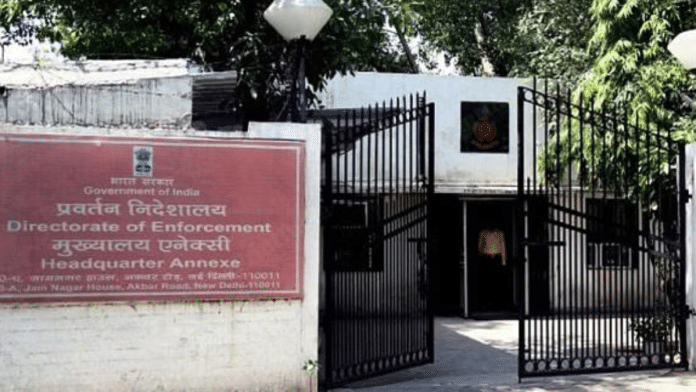



New Delhi: Granting ‘limited’ relief to a petitioner, Allahabad High Court earlier this month stopped the Enforcement Directorate (ED) from carrying out any further arrests, searches or seizures in the case. However, the same two-judge bench refused to quash the Enforcement Case Information Report (ECIR), the ED’s version of an FIR, on the grounds that it is an “internal document” not amenable to writ jurisdiction.
The bench of Justices Lakshmi Kant Shukla and Chandra Dhari Singh also ruled that clubbing of FIRs does not prevent the ED from adding those FIRs to an ongoing investigation within the pre-existing ECIR.
Each FIR, the high court said, is to be treated as a distinct offence for proceedings under PMLA.
The bench was hearing a petition by businessman Satinder Singh Bhasin, former managing director of Bhasin Infotech and Infrastructure (BIIPL). Bhasin is facing a money laundering probe stemming from two real estate projects—Grand Venice Mall in Greater Noida and Mist Project in Noida.
Multiple investors accused him and his associates of promising timely delivery of commercial units they said were never completed or handed over to them.
The ED launched its money laundering probe against Bhasin in 2021 on the basis of the first FIR filed against him in 2015 under sections 420 (cheating) and 406 (criminal breach of trust) of the Indian Penal Code.
Section 420 was later removed at the chargesheet stage.
Subsequently, 43 other FIRs were filed on complaints pertaining to the Grand Venice Mall, and another 5 pertaining to the Mist Project—which were added to the ECIR earlier this year and led to searches in April.
Bhasin had earlier moved the Supreme Court seeking clubbing of all FIRs against him. The apex court granted his plea in May 2022.
In his plea before the high court, Bhasin sought quashing of the ECIR opened by ED in this case, as well as that of the non-bailable warrant issued against him by a special PMLA court. He also petitioned the court to declare illegal earlier searches by the ED at his premises.
In its 77-page judgement delivered on 18 December, Allahabad HC directed ED not to carry out any “investigation, inquiry, summons, searches, seizures, attachment or any other coercive measures” against Bhasin.
This was in favour of an argument put forth by Bhasin’s counsels that ED lacks jurisdiction to continue any proceedings “since the predicate offence as against him survives only under Section 406 IPC, which is not a scheduled offence under the PMLA and the trial of the said predicate offence” was stayed by a single-judge bench of the high court in April 2023.
To that effect, the high court’s order said: “To permit the ECIR to breathe independently while the predicate remains in judicial suspension would amount to circumventing the stay order, a proposition antithetical to the rule of law and the principle of judicial discipline.”
A predicate offence is a criminal case registered by law enforcement or investigative agencies under sections in the PMLA, 2002, that fall within its schedules.
The high court also quashed non-bailable warrants issued against Bhasin, observing that he did not evade the investigative process and instead demonstrated “sustained cooperation”. It also said ED “failed to place material on record demonstrating evasion, noncompliance with summons, or persistent absence”. The agency, it said, had “ample opportunity to conclude its inquiry” since the probe has been pending for over four years.
Commenting on Allahabad HC’s judgment in the case, an ED official told ThePrint on condition of anonymity that the agency will challenge it before the Supreme Court after the Winter vacation. “The ECIR has not been quashed, but it has been effectively stayed by staying any search or attachment proceedings in the case. This will be challenged.”
‘Each clubbed FIR a distinct offence’
The Allahabad HC in its order also said if there are multiple FIRs against the accused, each is to be treated as a distinct scheduled offence under PMLA. It said the Supreme Court in its order directing that all FIRs be clubbed did not grant Bhasin immunity from a money laundering probe, nor did the consolidation order affect collapse of subsequent FIRs.
It took note of senior advocate Zoheb Hossain’s argument that barring the first FIR, sections invoked in other FIRs include IPC sections 406, 420, 467, 468, 471, and 120-B, all of which are scheduled offences under PMLA.
Arguing on ED’s behalf, Hossain submitted: “…addendums are a legitimate internal step reflecting expansion of investigation as new facts emerge.”
On this count, the bench concurred.
“Even if several FIRs were directed to be merged for police investigation by the Hon’ble Supreme Court, their statutory character as independent allegations, particularly for purposes of special statutes such as PMLA, does not stand obliterated. The effect of consolidation is procedural, and it does not amount to quashing or discharge,” read the two-judge bench’s order.
The two-judge bench also dealt with another issue—is the ED’s ECIR to be treated differently from an FIR? It said an ECIR is different from an FIR in that, unlike an FIR an ECIR is not bound by “procedural rigidity”.
“Therefore, the argument that ECIR cannot be based on FIRs later added is unsustainable. Clubbing under CrPC occurs for administrative consolidation of trial. It does not erase the scheduled offences for purposes of Section 3 PMLA. Nor does it bar ED from investigating proceeds of crime arising from such offences,” read the high court order.
In ruling so, it held that the ED’s decision to add subsequent FIRs to the ECIR was “lawful, justified, and consistent with the scheme of the PMLA”.
At the same time, the high court rejected ED’s argument that once an ECIR is opened the umbilical cord connecting it to the FIR loses relevance. This argument, the high court observed, would be correct when the predicate offence exists and continues to generate proceeds of crime.
Impact of stayed FIR on PMLA proceedings
The court addressed another larger legal argument—distinction between a stay order, a quashing order and an acquittal.
The ED, for its part, argued that a mere stay order does not extinguish the existence of a scheduled offence and hence cannot form the basis for quashing an ECIR. This argument, the high court noted, was “technically correct” as the underlying FIR remains intact even after a stay order.
However, it observed that the stay order renders any case judicially ineffective, meaning that no accused can be tried, no evidence can be sifted, and no investigation can continue to collect evidence or determine guilt.
Based on these observations, the high court directed the ED to refrain from any coercive measures till the stay on the predicate offence is not lifted.
The high court also rejected ED’s arguments that its proceedings are not governed by protective orders, stating that the protective order in this case was a comprehensive stay of the entire proceedings and not merely a bail order issued in Bhasin’s favour in 2019. “When a High Court stays proceedings, it does so to prevent prejudice to the accused, to preserve the status quo, or in response to compelling legal circumstances. A stay order thus carries greater judicial weight than a protective order,” read the order.
Pulling up the agency over its stand, the bench also said: “The ED’s argument that PMLA investigations must continue despite the stay of predicate proceedings amounts, in substance, to circumventing the judicial order of stay, a course impermissible under the principle of subordination to superior court orders and the doctrine of judicial discipline.”
(Edited by Amrtansh Arora)
Also Read: Can state-owned firm be prosecuted under PMLA? Legal opinion divided on CJI’s remarks in TASMAC case