





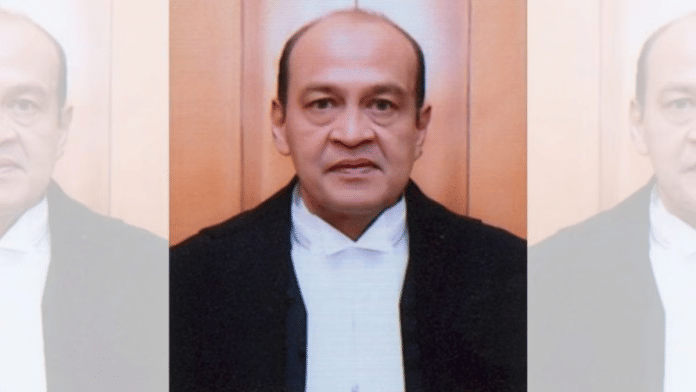



New Delhi: The Supreme Court Wednesday expressed its prima facie view on the constitution of a probe panel by the Lok Sabha Speaker to enquire into the alleged discovery of cash from Allahabad High Court judge Justice Yashwant Varma’s official residence in Delhi.
A bench of justices Dipankar Dutta and S.C. Sharma disagreed with Justice Varma’s argument that the Lok Sabha Speaker could not have formed the enquiry panel against him on a motion moved by parliamentarians, because the Rajya Sabha chairman had rejected a similar motion by members of the Upper House.
Both these motions were moved separately before each authority, but on the same day, 21 July 2025.
Referring to section 3(2) of the Judges Inquiry Act, 1968, Justice Varma’s counsel Mukul Rohatgi argued that if removal motions are submitted on the same day before the two Houses, then a joint committee should be formed to enquire into the alleged misconduct of a sitting judge, in case of their admission.
However, the judge contends that since the Rajya Sabha rejected the removal motion, signed by 56 MPs, on 11 August 2025, the Lok Sabha Speaker’s unilateral decision to form the enquiry panel a day later violates the law.
Justices Dutta and Sharma are hearing Justice Varma’s petition that challenges the constitution of the enquiry panel on three grounds, including one mentioned above. The other two grounds would come into play in case the court explicitly rejects the first one.
The second ground questions the Rajya Sabha deputy chairman’s authority to reject the motion.
It may be recalled that the then Rajya Sabha Chairman Jagdeep Dhankhar had resigned on 21 July, 2025, following which the post was vacant. Deputy Chairman Harivansh stepped in to fill the vacuum and, in that process, also took the decision to reject the motion.
According to Justice Varma, the Judges Inquiry Act, 1968 clearly empowers the Chairman, and not the Deputy Chairman, to proceed under the law. If this ground is accepted by the court, then Justice Varma’s plea for constitution of a joint committee could be allowed.
The judge’s third ground is that Dhankhar had admitted the motion on 21 July 2025 soon after he received it. And that, the Deputy Chairman could not have reviewed it later, which he did by the motion’s rejection on 11 August.
Justice Varma has premised this argument on an official note by which Dhankhar had sought information from the Lok Sabha speaker on whether a similar motion has been submitted to him or not.
According to the judge, this step of Dhankhar meant admission of the motion. In case the court agrees with this argument, then the judge’s request to quash the current probe panel and constitute a fresh joint committee could be accepted.
During the hearing Wednesday, justices Dutta and Sharma told Justice Varma’s counsel, senior advocate Mukul Rohatgi, that they did not see much merit in his first argument.
“The procedure requires a formal admission of the motion. Here, when one House is found to have rejected the motion, where does it say that the other (House) cannot act,” the judges wondered, as they construed the implication of the construction of section 3(2) of the 1968 Act.
The section, the judges articulated, does not contemplate a situation that has arisen in the present case. Therefore, they explained, the court was required to read the section and the proviso in a way to give effect to the intention of the legislation. “It does not say on its own terms that if one House has rejected, then the other cannot act,” the bench added.
Further, they appeared dissatisfied with Justice Varma’s second limb of the argument on the aspect of Deputy Chairman’s jurisdiction.
Also Read: Why SC refused to entertain PIL seeking FIR against Justice Yashwant Varma in cash row
‘Chairman, Dy Chairman’s role clearly defined’
The judge’s lawyer Mukul Rohatgi said the act and the rules framed under it clearly delineated the role of a Speaker, Deputy Speaker, Chairman and the Deputy Chairman in the impeachment procedure.
In terms of this, only a Chairman of the Upper House had the jurisdiction to admit or reject the impeachment motion signed by its members.
But in the present case, the Deputy Chairman had taken the decision, which Rohatgi asserted was a procedural irregularity.
However, the bench reminded Rohatgi that Article 91 envisaged three situations under which a Deputy Chairman can perform the role of a Chairman. One of them talks about a circumstance when the post is vacant, while the other relates to a time when the Chairman is absent. The third assumes a situation when both are not around.
In the present case, the Chairman’s post was vacant and it was not a situation when he was absent, the judges pointed out, distinguishing between the two scenarios.
Rohatgi’s third argument that Dhankhar, as the Chairman, had admitted the motion and the Deputy Chairman could not have reviewed it later did not find much force with the judges.
They repeatedly told the senior counsel that Dhankhar had simply written to the Lok Sabha Speaker and had not given a finding on the motion.
“There has to be a categorical finding to say that the motion is admitted or accepted,” the judges said.
However, the court gave a little ray of hope to Justice Varma when it said that the Deputy Chairman’s rejection order went into the merits of the charges, which was impermissible.
It ordered that a copy of the same should be provided to him so that he gets a chance to argue on that.
With this, the bench cautioned the judge that it would entertain him only if they are convinced that the rejection order was highly prejudicial to him or his case.
A large amount of cash was recovered at the Delhi residence of Justice Yashwant Varma after a fire on his premises on 14 March. He was then a judge on the Delhi High Court. Later, judicial work was withdrawn from him and he was repatriated to the Allahabad High Court.
(Edited by Ajeet Tiwari)