








New Delhi: When the Union government goes to courts, it does so overwhelmingly through male voices.
An analysis of empanelment notifications from high courts across the country in 2025 shows that women account for barely one in five central government counsel—a pattern that experts say mirrors the gender gap at every tier of the Indian judiciary, and beyond it.
The advocates—designated central government standing counsel, senior panel counsel, and government pleaders—are appointed by the Union Ministry of Law and Justice through its Department of Legal Affairs.
Each court in the country, including the 25 high courts, has a panel of lawyers that represents the Union government in case of any litigations. There is no uniform or established strength for these panels, to which lawyers are appointed on the central government’s discretion and necessity. While the law ministry appoints them, the notification is made in the name of the President of India to formally represent the central government in courts.
Also Read: SC reconsiders 3-yr legal practice mandate for judicial office. What this will mean for women
What data shows
ThePrint found in its analysis that panel data from across courts tells a consistent story.
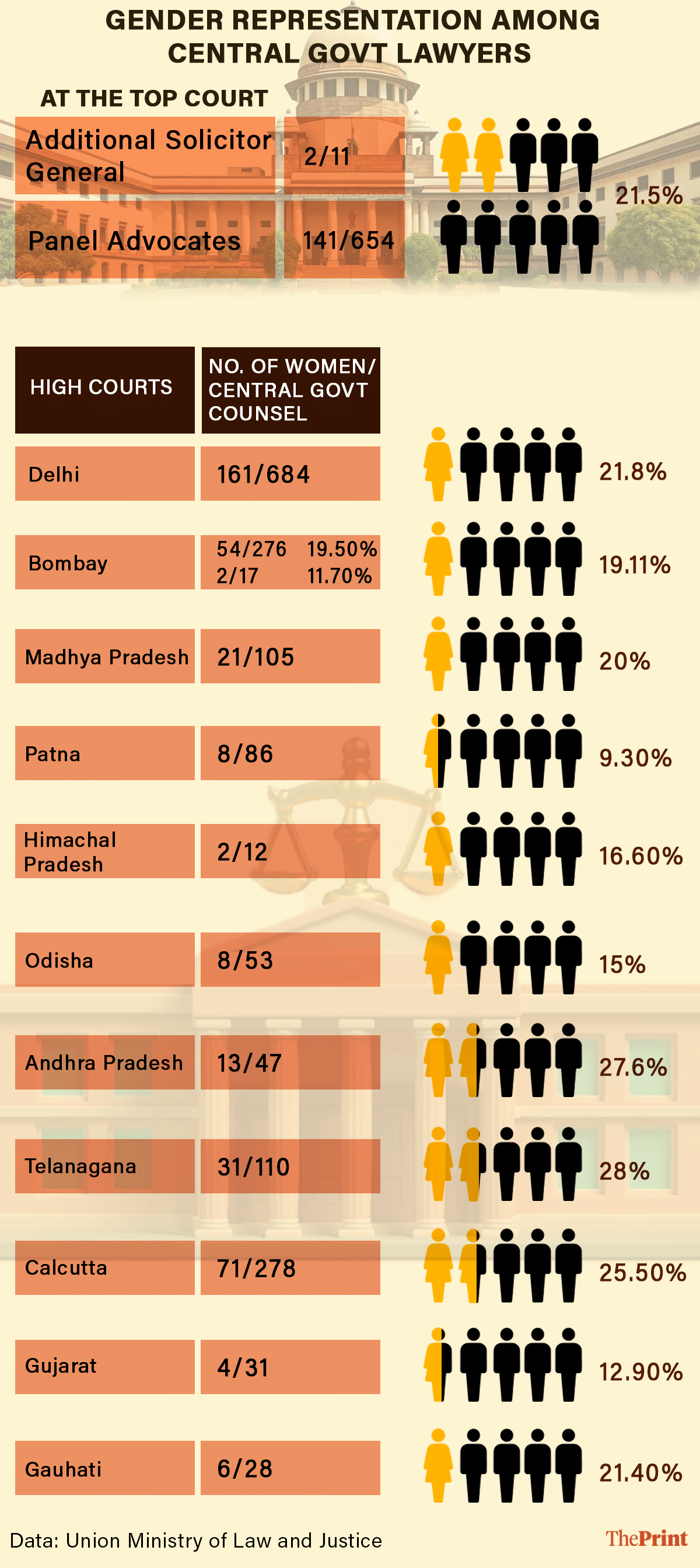
In the Supreme Court, only 2 of the 11 additional solicitor generals (ASGs) currently appointed are women. Among panel advocates—on the latest list, notified in November 2025—141 of the 654 are women, placing representation at 21.5 percent.
Across the high courts where panels were re-notified or extended in 2025, women lawyers made up for a minority of central government counsel.
At the Delhi High Court, women accounted for 161 of 684 central government counsel, or 21.8 percent, according to the September 2025 notification. At the Bombay High Court, two separate notifications from last year told a similar story: a November 2025 panel listed 54 women among 276 counsel (19.5 percent), while a September 2025 notification included two women among 17 counsel (11.7 percent), bringing combined representation to 19.11 percent.
At the Madhya Pradesh High Court, which operates across three benches in Jabalpur, Indore, and Gwalior, women made up 21 of 105 panel counsel — 20 percent — as of the March 2025 notification. The Karnataka HC panel, according to the November 2025 notification, saw identical representation of central government counsel: one in every five names on the list was a woman.
At the lower end was the Patna High Court, where women constituted only 8 of 86 counsel—9.3 percent, the lowest share among the High Courts examined, according to a June 2025 notification.
The Himachal Pradesh High Court’s panel notified in May 2025 listed two women among 12 counsel (16.6 percent), and the Odisha High Court’s January 2025 notification showed eight women among 53 counsel (15 percent).
In several High Courts, representation was comparatively better.
The Kerala High Court’s multiple panels notified in 2025 showed women at 15.3 percent, 23.5 percent, and 31.4 percent across different empanelment lists — a combined rate of 26 percent.
At the Andhra Pradesh High Court, women constituted 13 of 47 counsel (27.6 percent) in a December 2025 notification. In the December, 2025 notification for the Telangana High Court, the figure was 31 of 110 (28 percent). And the Calcutta High Court, which includes multiple circuit benches, had 71 women among 278 counsel or 25.5 percent, as seen in the August 2025 extension notification.
In multiple high courts, no fresh empanelment was notified in 2025, with earlier panels continuing through extensions—the Punjab and Haryana High Court, Gujarat High Court, Chhattisgarh High Court, Allahabad High Court, Uttarakhand High Court and Gauhati High Court among them.
In some of these courts, the most recent panels date back years. The Gujarat High Court’s last notified panel, from 2018, had four women among 31 counsel (12.9 percent). The Gauhati High Court’s last panel, from 2019, included six women among 28 counsel (21.4 percent).
What government says
The gender disparity was also visible in figures placed before Parliament.
A reply by the Ministry of Law and Justice in the Rajya Sabha in 2023 showed that the department’s panel of lawyers comprised 5,382 male counsel and 411 female counsel. This includes central government counsel along with other positions.
Currently, there is no formal reservation or seat allotment for women on the panel.
ThePrint Saturday reached out to the Law Ministry for comment on gender representation on the panels. The report will be updated if and when a response is received.
Questions have also been raised about how empanelment decisions are made in the first place.
In December last year, the Delhi High Court directed the Centre to frame and notify clear, transparent guidelines for empanelment of advocates representing the Union government across Indian courts within three months. Currently, there are no explicit rules to guide panel appointments.
The directive came on a public interest litigation (PIL) that had challenged the HC panel appointed through a September notification. The PIL alleged that some of the lawyers on the panel had not cleared the All India Bar Examination, a requirement for advocates to practise law.
The HC, in its direction, cited the need for a non-arbitrary, objective framework to ensure fair, merit-based, and transparent appointments. The matter is pending.
What women lawyers say
For senior advocates who have themselves held posts, the low numbers are not a surprise. They told ThePrint that these figures are simply a consequence of structures that have remained largely unchanged, and of informal barriers that formal appointments alone cannot resolve.
Senior advocate Pinky Anand, who had served as the additional solicitor general of India from 2014 to 2020, emphasised that the problem was not merely one of headcount: it lay equally in whether meaningful and substantial work was allocated on a level playing field once women are empanelled.
Anand said entry into government panels replicates the broader challenges women face across the profession.
“Access to entry-level opportunities and sustained career progression remains difficult for many women, and the persistence of a ‘boys’ club’ culture continues to reinforce these barriers,” she said.
The qualities that government panels reward are not themselves the problem, she argued, it is the way they are coded.
“Networking, pursuit, ambition, commitment, time, and energy are all essential features for rising up the ladder,” she said, adding that the “stereotyping of women” remains one of the major blocks to progress because these features are often considered alien to a woman’s being.
“Yet another major impediment is women’s responsibility, perceived or otherwise, towards their families, marriage, children, running homes, and their ability to maintain a continuous stream of the requisite practical experience needed to qualify for these panels,” she said.
Career continuity, she argued, lies at the heart of the problem. “There is frequently a break in careers, and entry after marriage and family life often cuts the cord of continuity”.
Addressing the disparity, Anand said, requires changes in institutional structures and social perceptions, with access and opportunities determined purely on merit. She cautioned against a tendency that can subtly diminish women lawyers even while appearing to elevate them: the assumption that their expertise lies in women’s issues.
“Women are equal partners in society and contribute across all areas of law. Such compartmentalisation undermines equality,” she said.
Senior advocate Nandita Rao, who has served as standing counsel for the Delhi government, argued that such panels, because they are not market-driven, have the potential to improve diversity in the legal profession.
“In my view, government panels are a very good way of encouraging women and first-generation lawyers by giving them an opportunity to prove their merit,” she told ThePrint, noting that such appointments can help broaden access to work that might otherwise be difficult to secure.
Rao proposed that a 30 percent reservation for women on government panels, coupled with a mandate to ensure diversity among selected women across caste, religion and sexuality, could significantly improve representation. Greater diversity, she said, would also strengthen the profession by allowing new talent to emerge.
Such measures, she added, would be consistent with the constitutional commitment to equality and dignity under Articles 15 and 21 of the Constitution.
Senior Advocate Madhavi Goradia Divan noted that there has been a fairly substantial number of women standing counsel in the top court. She added that it would be blinkered to look at it purely from the standpoint of women who reach a particular position in the profession. Rather, she said, the problem lies in the fact that we are not able to create an environment where women are able to stay the course in large numbers.
Pointing to the large number of women in law colleges, often outperforming male colleagues and having a high enrollment rate at the bar, she explained that there is high attrition rate as the years go by. Women are not able to stay the course because the system is not tailored to suit their needs, she said. Additionally, they aren’t well supported within the profession when they need to balance family life, and the system is traditionally tailored for men.
Even where women stay the course, it often comes at the cost of their personal lives, which, she said, is not even talked about.
This is an updated version of the report.
(Edited by Prerna Madan)
Also Read: 8 of 25 high courts have only 1 woman judge. Data shows poor representation in higher judiciary
Why is everyone so worked up about the ‘gap’. I don’t hear people complaining that women outnumber men by a worse ratio when it comes to kindergarten school teachers, primary and secondary school teachers, nursing and paramedical staff, beauty clinic staff, and many more fields.
Why does everyone fixate on ‘gender gap’ – what good comes out of it?