





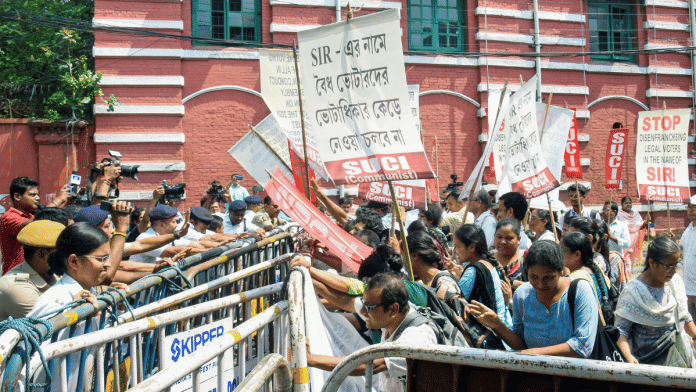



New Delhi: Justice Joymalya Bagchi of the Supreme Court questioned the Election Commission for adopting a different mechanism to conduct the Special Intensive Revision (SIR) in West Bengal.
The judge specifically shared his concerns over the introduction of a new category of ‘Logical Discrepancy’ to review a voter’s status in the ongoing SIR and called for having a “robust appellate mechanism” to consider appeals of those deleted from the electoral rolls.The judge also touched upon the continuing right of a voter to vote.
The oral comments were made when the Chief Justice of India (CJI)-led bench, also comprising Justice Bagchi, came across a writ petition filed by a group of persons from West Bengal.
The petitioners requested the top court to extend the date of freezing of electoral rolls so that they can vote in the impending assembly elections, in the event their appeals are allowed.
These petitioners were not included in the final list of voters following SIR’s conclusion in the state and their appeals against the exclusion are pending before the Appellate Tribunals.
On 9 April, the EC froze the electoral roll, meaning thereby those whose names figured in this list would be eligible to vote in the upcoming state elections.
The petitioners argued they were mapped in the 2002 roll and possessed Aadhaar cards and Passports.
At the outset, CJI Surya Kant showed reluctance to interfere, observing the issue was before the Appellate Tribunal, which is the appropriate forum to adjudicate the issues related to SIR.
However, when the petitioner’s counsel accused the EC of non-cooperation for not producing the relevant materials before the Tribunal, Justice Bagchi spoke at length over EC’s deviation in Bengal compared to the Bihar SIR where persons who found place in the 2002 electoral roll were not required to upload documents. The EC denied such a suggestion.
“When the Bihar SIR was argued, the submissions of EC were unequivocal that the 2002 list members need not give any document. Please see your written submissions in the Bihar case. You had said the 2002 electorate need not give documents,” Justice Bagchi pointed to EC’s lawyer, senior advocate D.Seshadiri Naidu.
When the senior counsel maintained that persons who were mapped in the 2002 roll need not upload any documents, except showing they are those who were in that list, Justice Bagchi retorted: “Now you are improvising the submissions which you made earlier.”
The judge advised the EC and the state government against indulging in a blame game and, instead, focus on the “voter being sandwiched between two Constitutional authorities.”
The trust deficit between the two institutions led the top court to employ judicial officers to examine the objections against exclusion of voters.
However, the insurmountable task of studying voluminous documents daily can introduce errors in the decision-making process, Justice Bagchi warned, as he emphasised to have a robust appellate mechanism and a continuing right (to vote).
Judicial officers performing SIR adjudication cannot be expected to work with 100 percent accuracy amidst the high-pressure situation, the judge said.
“When a person is dealing with over 1,000 documents a day against a tight deadline, even an accuracy of 70 percent would be deemed ‘excellent’,” Justice Bagchi said.
Hence, there was a need for a robust appellate mechanism, he stressed.
“If 10 percent of the electorate does not vote and the winning margin is more than 10 percent…what will happen? Suppose the margin is 2 percent and 15 percent of the electorate who are mapped could not vote, then maybe, we are not expressing any opinion, but we would definitely have to apply our minds. Please keep this in mind that the concern of a vigilant voter whose name correctly or incorrectly is not in the list is not in our minds,” Justice Bagchi told Naidu.
‘Sentimental issue’
Describing the right to vote in India a sentimental issue, instead of constitutional, Justice Bagchi said: “It is like you are a part of democracy and help in electing a government.”
The judge underscored that the 19 Appellate Tribunals must hear the appeals on the “principles of inclusion.”
However, the bench did not entertain the petition and suggested those aggrieved approach the Tribunal for relief. However, it added, that if the appeals are allowed, “necessary consequences shall follow.”
Towards the end of the day, the bench took up the main SIR issue. During this hearing, Justice Bagchi remarked that those whose appeals were allowed by 9 April would be included in the voter list.
“If adjudication is completed by April 9, even a few days later…the electoral roll will include their names for the elections. That was clarified earlier,” the judge said.
After perusing the Calcutta High Court Chief Justice’s letter on the latest development in the SIR exercise, the bench clarified that it cannot allow those people whose cases are pending before the Tribunal to vote in the elections.
“We cannot create a situation where we burden the appellate tribunal judges. There is another plea with us today which stops the appeals,” CJI Surya Kant said, referring to the case argued in the morning before his bench.
The top court also noted that over 34 lakh appeals have been filed so far before the appellate tribunals by people challenging their non-inclusion in the voter list. It ordered the security that was provided to judicial officers following an untoward incident in the state would not be withdrawn until further court orders.
“If the judicial officers had completed their adjudication in the first instance in respect of any assembly constituency by 9th of April, even if they have exceeded one or two days… we have given the answer,” Justice Bagchi said orally.
“123 constituencies whose last date of nomination is 6th of April, the list was published on the night of 6th of April. There was some spill over, those names will be included in the electoral roll for the 23rd April election. If their names are there, they can vote.”
(Edited by Tony Rai)
Also Read:On Bengal voter rolls, ‘parent with 389 kids, a grandparent younger than 40’. EC defends SIR in SC