







New Delhi: People forcefully made to consume acid fall under the ambit of the Rights of Persons with Disabilities Act, 2016, the Supreme Court has said, widening the scope for recognition of acid attack victims.
In doing so, a bench of Chief Justice of India (CJI) Surya Kant and Justice Joymalya Bagchi also made it clear that acid-attack victims, who don’t have any visible injuries or visible external harm, would also be covered under the definition of “acid attack victims” under Section 1A(e), with retrospective effect from 2016 onwards, when the law was first passed.
Although the Act defines an acid attack victim as a person disfigured due to violent assaults by throwing of acid or similar corrosive substance, it presently does not cover victims who have suffered internal injuries, due to an acid attack. To cure this lacunae in law, the top court directed the government to make suitable amendments to the 2016 Act, and to notify the same, in a formal manner, if possible.
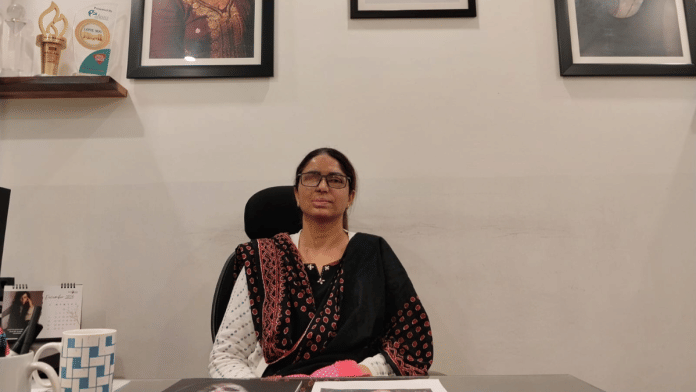
The SC move came while it was hearing a plea of acid-attack survivor Shaheen Malik, who was 26 years old, when she was attacked with acid outside her office in Panipat, Haryana in 2009.
On Monday, the division bench remarked that even without outer or visible disfigurement, acid attack victims should have been included under the 2016 Act from its very inception.
Shaheen Malik, who had moved the Supreme Court in the present case, lauded the order as a “welcome development”. “In today’s hearing, senior advocate Mukul Rohatgi told the court that victims who are forcibly made to ingest acid should also be covered under the 2016 Act. The court accepted this argument,” she told ThePrint.
In the hearing, Malik, through her lawyers, pointed to the widespread sale of acid, saying that it can be openly and freely bought in the country.
“In 2019 I filed a Public Interest Litigation (PIL) before the Delhi High Court, as part of which the court ended up giving directions to the government to regulate its sale. However, on ground, nothing much has changed,” Malik said.
Explaining how during the case before the Delhi HC, she bought 60 bottles from different states to illustrate how easily acid can be purchased in India, Malik told ThePrint that she stood before the court to properly regulate its sale.
“Why would we come to the court if the government was regulating its sale in the first place?” Malik said, adding that most regulations have fallen on deaf ears, and the sale of acid has not been banned yet.
Presently, the 2016 Act grants certain benefits including reservation in government jobs to such victims, but fails to clarify that acid attack victims without external injuries or disfigurement are also entitled to it.
Malik also told ThePrint that one of the acid-attack victims she knew weighed less than 40 kg, and was unable to even sleep or eat properly. However, due to the fact that her injuries were not visible, she was never given the benefit of the 2016 Act.
The case will be heard again in two weeks.
Also Read: Too little, too late: After 15 year legal battle, acid attack survivor gets Rs 8 lakh
Malik’s case before SC
By way of her PIL, Malik had sought to address a critical legislative gap that prevents victims of forceful acid ingestion from being recognised under the 2016 Act. She sought their inclusion along with those acid-attack who don’t have visible injuries, so that these groups can avail the same compensatory and rehabilitative measures as other victims covered under the Act.
The plea said that such victims suffer from severe and lasting internal injuries that significantly impair their ability to perform basic life functions like eating, swallowing and speaking, yet they are unable to access the support systems designed for other acid attack victims.
Section 124 of the Bharatiya Nyaya Sanhita (BNS) penalises the crime of causing grievous hurt through acid, and imposes a ten-year punishment on individuals who cause permanent or partial damage, burn or disability to another, by throwing acid on them, or by using any other method even. Such individuals are even slapped with a fine to cover the medical expenses of the victim, the plea points out.
A disability certificate, which is a mandatory requirement for accessing financial assistance and rehabilitative schemes, is not accessible to such victims of forceful ingestion, the plea points out.
By creating an arbitrary distinction on the basis of the method of attack, that is throwing or administering, the law is acting contrary to Article 14 (right to equality) of the Constitution, the plea said.
Instead, it said, that the result of the attack should be focused on, and that the gravity of the harm caused must be taken into account.
Denial of essential support to these victims violated their right to live with dignity under Article 21 of the Constitution, which covers the right to life, the petitioner said.
(Edited by Tony Rai)
Also Read: Forced acid ingestion survivors’ fight for recognition as PwD before SC. ‘How do I show my insides?’