





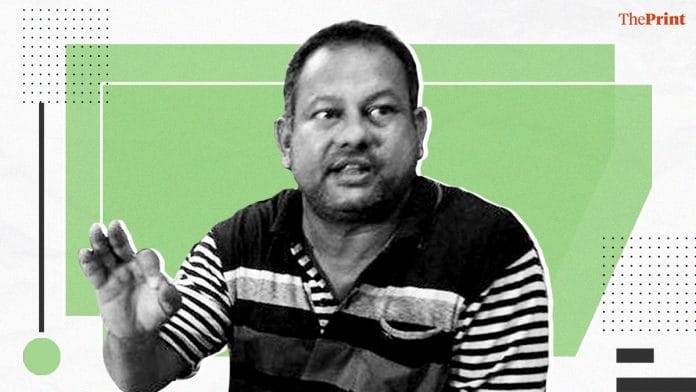



New Delhi: Charges were framed last month against advocate Surendra Gadling in the Gadchiroli-Surajgarh arson case which has long been stalled and linked with the Bhima Koregaon case, the Supreme Court was told Thursday.
In an affidavit filed before the apex court, the Registrar General of the Bombay High Court (Nagpur Bench) submitted details of the exact steps taken by the High Court to ensure video conferencing for Surendra Gadling. It said the trial court framed charges in the case on 18 March this year.
The Supreme Court is hearing Gadling’s plea for bail in the case. Gadling, in jail as an undertrial for seven years now, is also an accused in the Bhima Koregaon case pending before a special National Investigation Agency (NIA) Court in Mumbai.
The arson traces back to December 2016 when a group of suspected Maoists torched mining equipment at Surajgarh, a region where tribal opposition to mining projects has been longstanding. Accused in the case, human rights lawyer Surendra Pundalik Gadling has spent almost seven years in jail after his arrest in January 2019, as the case was linked with the Bhima-Koregaon case. According to the prosecution, both incidents were part of a single conspiracy by the banned Communist Party of India (Maoist) to destabilise the region, with primary links of documents and digital evidence collected from Gadling and co-accused activist-writer Varavara Rao’s home.
After the top court in January directed the Registrar General to ensure appointment of judicial officers to the court hearing the Surajgarh arson case in Maharashtra’s Aheri, the latter filed a compliance affidavit. In January, the top court also allowed Gadling to inspect the records of the Bhima Koregaon case pending at the Special NIA Court in Mumbai.
The Bombay High Court Registrar General’s affidavit submitted that the direction was complied with. According to the affidavit, the case has moved a stage forward in the Aheri trial court following the inspection of records by Gadling within the stipulated three-week period.
Following this, framing of charges was on 18 March, and arguments by some accused against that and for discharging them were recorded via video conferencing which was reported to be “working satisfactory”.
Varavara Rao’s plea, however, could not be recorded immediately and the charges against him could not be read out to him by the court’s ‘Special Messenger’ as he was released on bail on medical grounds and was not found at his Mumbai residence during the scheduled time, and “could not be contacted through mobile”.
Additionally, the court was informed that the fourth accused in the case, Lalu Kehka Gundaru, is deceased. Following these proceedings, the records were transmitted back to the Special NIA Court in Mumbai on 30 March 2026.
Also Read: New book investigates Bhima Koregaon—‘riots are manufactured, not spontaneous’
Trial court order
A 12-page common order passed by Additional Sessions Judge Rohan B. Rehpade at the Aheri court, effectively rejecting the discharge applications filed by the accused persons and framing of charges and officially setting the stage for trial was passed on March 18, 2026. ThePrint has accessed a copy of the order.
Interestingly, Judge Rehpade noted in the order that since “framing of charges is not mini-trial and what the court has to see is whether or not there is sufficient material to frame charge against accused persons, it is clear that detailed reasons for framing of charge are not required”.
The chargesheet in this case was filed in June 2019 against six persons: advocate Gadling, writer Varavara Rao, and tribals Masa Mura Hichami, Lalu Kehka Gundaru, Thuge Dalsu Hichami and Dinesh Masu Pungati. Trial proceedings began in the Gadchiroli Court in July 2019 and continued until July 2023 when the case was transferred to the Aheri court.
ThePrint had earlier reported how the trial in the case had been stuck for various reasons, including a weak video-conferencing facility in the court.
Opposing framing of charges, the accused had argued that the entire case was vitiated because the initial cognisance and remands beyond 90 days were handled by a Judicial Magistrate First Class instead of a Special Court, which they claimed was mandatory under the Unlawful Activities (Prevention) Act (UAPA). However, the court dismissed these contentions, citing Supreme Court precedents that “unnecessary committal procedure would not vitiate further proceedings” and that illegality in investigation only invalidates a chargesheet if it causes a “miscarriage of justice”.
As for Gadling, the trial court noted that he was “reluctant to cooperate and not interested in arguing his application on discharge. His advocate also did not appear” and therefore via a 10 February order, advocate R. Mahadevan was appointed as amicus curiae (friend of the court) for Gadling.
Gadling’s application for cancellation of appointment of amicus curiae was also rejected by the same court. “Although opportunity was given to accused Surendra to address the court, he did not avail the said opportunity. Therefore, advocate Shri R. Mahadevan addressed the court on discharge applications filed by accused Surendra and accused Warawararao,” the court noted.
Mahadevan submitted that in this case sanction is granted by Additional Chief Secretary to Government of Maharashtra and not by Secretary to Governor as per law. Furthermore, the sanction order isn’t even dated and “reflects that there is no application of mind”.
To this, the court said, “It is true that date is not mentioned in sanction order. However, sanction order indicate that (the) entire material was considered. Moreover, sanction order is issued by order and in the name of Governor of Maharashtra. Whether or not there is application of mind while granting sanction is a matter that falls within domain of trial. Prima facie there is sanction under Section 45 of UAPA.”
Mahadevan also argued that the time limit set out in the Unlawful Activities (Prevention) (Recommendation) and Sanction of Prosecution Rules has not been followed – thus arguing that the sanction is illegal and allegations against Gadling are based on “wild imagination and surmises”. The court also noted that in the Bhima Koregaon case, evidence indicating involvement of accused Gadling and Rao was found. “Copy of that digital evidence is produced in this court and original evidence was also made available to accused Surendra for inspection,” the court noted.
Charges framed by Aheri Court
In his order, Judge Rehpade proceeded to frame charges against all five accused, except the one who passed away, for offences of criminal conspiracy, attempt to murder (with common object), wrongful restraint, wrongful confinement, mischief by fire or explosive substance with intent to cause damage, voluntarily causing hurt, intentional insult with intent to provoke breach of peace, criminal intimidation, punishment for being a member of an unlawful assembly, punishment for rioting, rioting, armed with a deadly weapon, all under the Indian Penal Code.
Also Read: New book investigates Bhima Koregaon—‘riots are manufactured, not spontaneous’
Beyond that, the court also framed charges under the Bombay Police Act for Penalty for contravention of rules or directions under sections 37, 39, or 40 (e.g., violating prohibitory orders regarding public assemblies, processions, or carrying weapons in public) and sections 16, 18, and 20 of the Unlawful Activities (Prevention) Act (UAPA).
The Maharashtra government’s core contention, as noted in the order, was that the accused conspired to damage and set fire to trucks on 23 December 2016, as members of the banned organization CPI (Maoist). The court found “sufficient material” to proceed with the trial, largely based on digital evidence recovered during the investigation of a related crime.
The order notes: “Digital evidence is consisting of correspondence between accused Surendra and other members of banned organisation, namely, Communist Party (CPI). Literature seized at the instance of accused Surendra shows policies of said banned organisation. One letter shows that accused Surendra has made publicity at the incident that has taken place at Surajgarh. Accused Warawararao also made funds available. Another letter is addressed by accused Warawararao to accused Surendra wherein it is mentioned that fund was made available to accused Surendra for activities in Gadchiroli and Buster. In Maoist information bulletin, there is to reference incident involved in the present crime. Another correspondence also shows that accused Surendra has been actively involved in the said organisation. Accused Surendra also responded to accused Warawararao and conveyed that he had started making funds available to comrade. He also referred to Sai Baba case.”
“Thus, there is sufficient material to indicate that accused Surendra and accused Warawararao are members of CPI (Maoist) which is banned organisation and funds were made available for Terrorist Act. On the basis of support provided by accused Surendra and accused Warawararao, trucks were damaged and burnt. So far as hard disks having same serial number is concerned, that would be subject matter of trial.”
(Edited by Nardeep Singh Dahiya)
Also Read: A year after Bhima-Koregaon clashes, here’s why the Maharashtra village erupted