


New Delhi: The Madhya Pradesh High Court has directed a sessions court in Bhopal to make every endeavour to decide the criminal appeals arising from the 1984 Bhopal gas tragedy, preferably within 30 days, observing that victims have waited long enough for the criminal law to reach its logical conclusion.
A single-judge bench of Justice Himanshu Joshi, in an order dated 18 November, dismissed three petitions filed by convicts S.P. Choudhary, J. Mukund and Kishor S. Kamdar. The petitioners had challenged a sessions court order refusing to decide separately their applications alleging fundamental defects in the charges framed against them.
The applications, filed under Section 464 CrPC (absence or irregularities in framing charges) in April 2022, sought to establish that the charges were vague and did not specify the individual acts attributable to each convict. They argued that these defects had prejudiced their defence and resulted in a failure of justice.
The high court said the convicts could not demand a separate hearing on their objections to the charges before the criminal appeals were heard. It said the sessions court could consider these objections while hearing the appeals. However, it left the decision on whether the charges were defective to the sessions court.
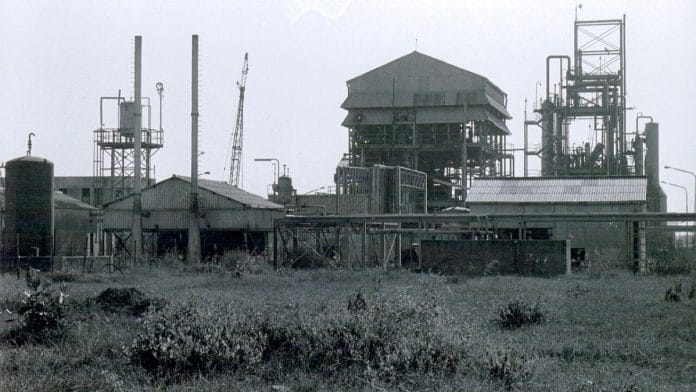
The criminal case arose from the leakage of methyl isocyanate (MIC) gas from the Union Carbide India Limited (UCIL) plant in Bhopal on the night of 2-3 December 1984. Following a trial in which the prosecution examined 178 witnesses and produced approximately 3,000 documents, the Chief Judicial Magistrate, Bhopal, convicted the accused on 7 June 2010.
The convicted persons subsequently filed criminal appeals (in 2010) before the sessions court, which remain pending.
Why the convicts challenged the charges
Initially, charges had been framed against the convicts under Section 304(II) of the Indian Penal Code (IPC), which deals with culpable homicide not amounting to murder. However, following a Supreme Court order dated 13 September 1996, the proceedings continued under Section 304-A IPC, which deals with causing death by a rash or negligent act. The revised charges were framed by the Chief Judicial Magistrate on 29 August 1997.
In their applications under Section 464 CrPC, the convicts alleged two categories of defects, which they described as ‘macro error’ and ‘micro error’.
While the ‘macro error’ concerned the very basis for framing the charges, ‘micro error’ related to their alleged vagueness and failure to specify the precise acts attributable to individual persons.
They also questioned the prosecution’s account of the circumstances leading to the gas leak in Bhopal, arguing that the charges ought to have been confined to two aspects—the entry of water or contaminants into the MIC storage tank and the alleged deficiency in maintaining positive nitrogen pressure.
The convicts further submitted that they had conducted an independent inquiry into the incident and intended to rely on its findings as additional evidence.
They also pointed out that arguments on their applications had already taken 36 days before the sessions court. They apprehended that deferring the decision until the final hearing of the appeals could result in the exercise having to be repeated if the presiding officer was transferred or elevated.
The CBI, Union government and Madhya Pradesh government opposed the plea, arguing that determining whether a defect in the charges had resulted in a failure of justice required examination of the entire trial record, including witness depositions and the statements of the convicts.
What the high court said
Explaining Section 464 CrPC, the high court said that a mistake in framing charges does not automatically invalidate a conviction. The convict must show that the mistake affected their defence and resulted in a failure of justice.
Justice Joshi relied on the Supreme Court’s decisions in State of Andhra Pradesh v. Thakkidiram Reddy (1998), Kamil v. State of Uttar Pradesh (2018) and Kalicharan v. State of Uttar Pradesh (2023).
The court said that deciding whether the convicts faced prejudice would require examining the trial evidence, their defence and the trial court’s findings. These issues were also part of the pending criminal appeals.
It also distinguished the Supreme Court’s decision in Asim alias Munmun alias Asif Abdulkarim Solanki v. State of Gujarat (2020), on which the convicts had relied. That case concerned Section 391 CrPC, which empowers an appellate court to take additional evidence. The high court held that the principle of deciding such applications preferably soon after filing could not automatically be extended to applications under Section 464.
It also identified six considerations for appellate courts, including whether the objection had been raised earlier, whether it repeated previous grounds, whether the defect could be examined independently, whether it had resulted in a failure of justice, whether it overlapped with the appeal and whether separate adjudication would advance justice or cause further delay.
The high court found that the convicts were not merely pointing out mistakes in the wording of the charges. They were also questioning the basis of the prosecution, the evidence and the circumstances leading to the gas leak. The court said these issues would have to be examined while hearing the criminal appeals.
It also noted that the issue of framing charges had earlier reached the Supreme Court, but this did not prevent the convicts from raising objections under Section 464.
Dismissing the petitions, the high court clarified that it had not decided whether the charges were defective, whether the convicts faced prejudice or whether their convictions were valid. These issues were left for the sessions court to decide.
“The judicial process must not become an endless journey; it must remain a path towards a lawful and just determination,” the court observed, directing the Sessions Court to avoid unnecessary adjournments and make every endeavour to decide the appeals within 30 days of receiving a copy of its order.
(Edited by Viny Mishra)