









New Delhi: Year after year, the Parliament data returns with a familiar picture of the judiciary: India has too few judges for too many people, and too many cases for too few courtrooms. The numbers are reported, the concern is noted, but the debate quietly vanishes from the people’s consciousness, what stays back leads to the normalisation of the shortages.
The latest available figure, via the Parliament records for 2025 places 22 judges per million Indians—up marginally from 21 in 2024 and 2023. Earlier, the ratio stood at 21.03 judges per million in 2021 and 2020; 20.39 in 2019, 19.78 in 2018, and 17.48 in 2014. In 1987, India had 10 judges per million.
Way back in 1987, the Law Commission recommended increasing judge strength from 10.5 judges per million population to 50 judges per million, a benchmark that the Supreme Court reiterated in its 2002 judgement directing the government to increase the judge strength from the existing ratio of 13 judges per 10 lakh people to 50 judges per 10 lakh people within a period of five years.
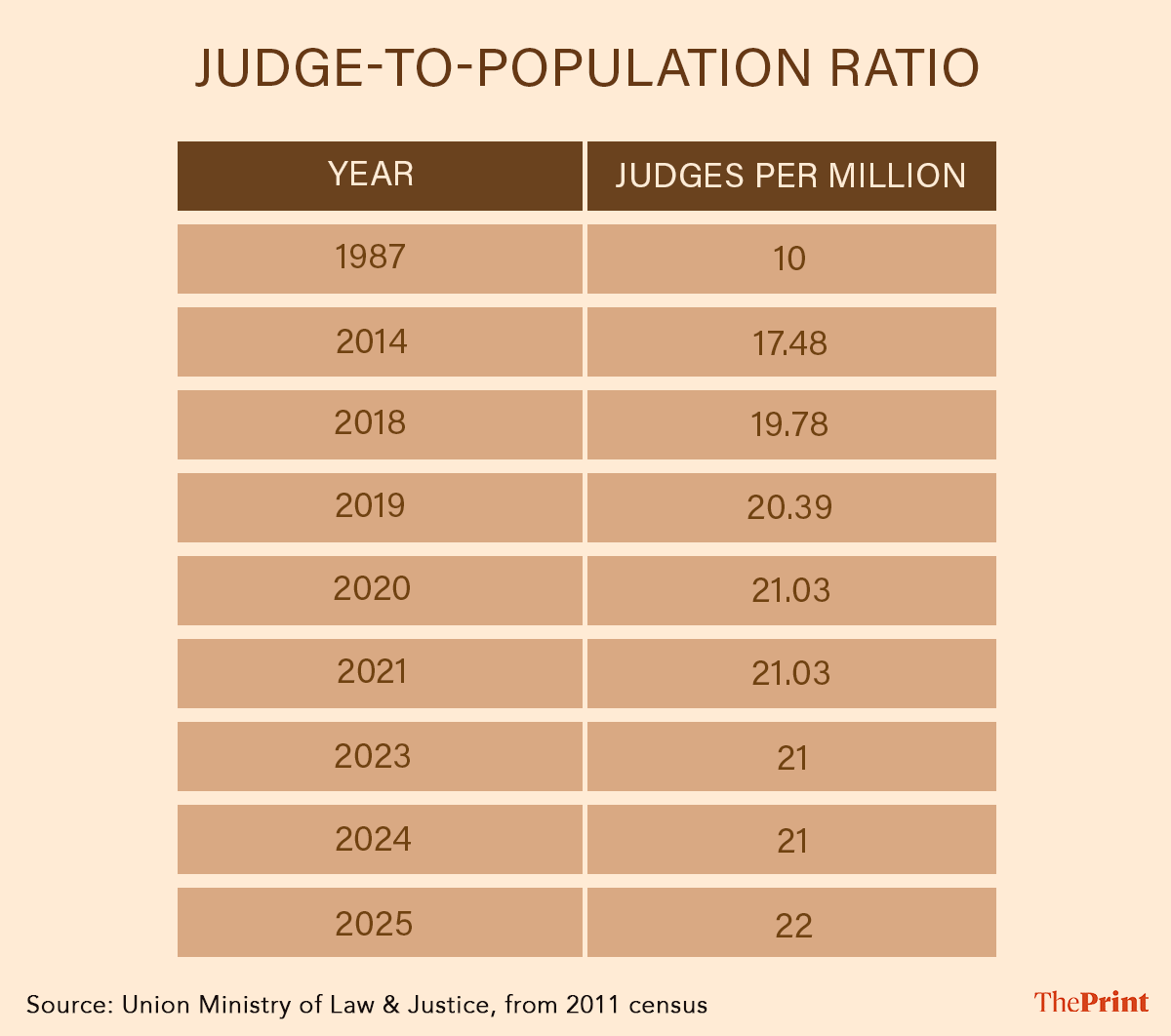
Nearly four decades, repeated judicial directions and long-standing expert recommendations later, India is nowhere near that target—the country is not even halfway there even as case pendency in district courts has surged.
Consider this: Pendency stood at 2,20,736 cases in 2016, rising to 2,84,042 in 2017, 3,82,191 in 2018, and 5,01,256 in 2019, according to National Judicial Data Grid data. Although the backlog dipped to 4,38,804 in 2020 – the pandemic year, it rose sharply thereafter: 6,91,502 in 2021, 10,52,430 in 2022, 13,94,476 in 2023, 18,50,948 in 2024, and 26,85,836 in 2025.
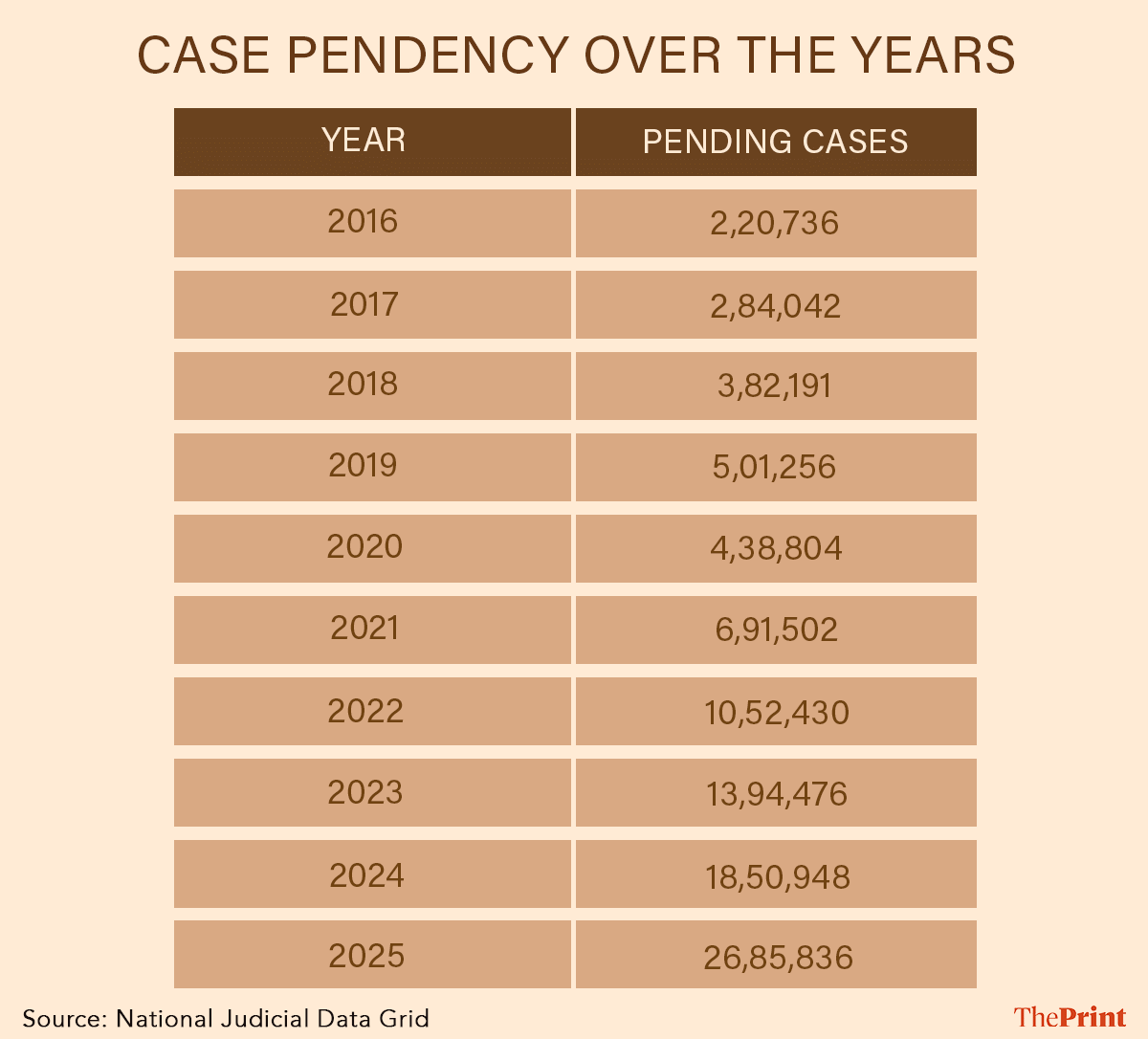
Put to scale—while the judge-population ratio rose from 17.48 in 2014 to 22 in 2025, pendency climbed from 2,20,736 in 2016 to 26,85,836 in 2025.
The Union government has repeatedly maintained that appointments are a “continuous and collaborative exercise” between the executive and judiciary, while noting that vacancies in district and subordinate courts lie in the domain of High Courts and State Governments.
India’s low judge-to-population ratio continues to leave judges burdened with “unmanageable caseloads”, even decades after the Law Commission recommended a far higher benchmark, Valay Singh, part of the India Justice Report (IJR) told ThePrint.
Data from IJR shows that in 2022, the sanctioned strength was at 15 judges per million and the same number stands true in 2025.
“Judges are handling unmanageable caseloads primarily because the judge-to-population ratio remains at 20 or so, which is less than half of what was recommended by the Law Commission four decades ago, when most of India’s present population wasn’t even born.”
It is in this backdrop that the country saw a face-off between judiciary and executive on appointment of judges in October 2016. The then Chief Justice of India (CJI) T.S. Thakur accused the government of trying to “decimate the judiciary and lock justice out”. That same year in April, he had flagged the urgent need to increase judge strength to deal with an “avalanche” of cases.
“On the one hand the Government has blamed the judiciary that Collegiums are not recommending the names to the Government, on the other hand, the judiciary has its own stand and said that how could the government expect the Collegiums to recommend more names when the decision on the previously recommended names was still pending,” Anand Sagar, a research scholar, wrote in 2016 in the International Journal of Management and Applied Science.
Regarding the executive-judiciary blame game over appointments, Priyamvadha Shivaji, Senior Resident Fellow with the Justice, Access and Lowering Delays in India (JALDI) at Vidhi, said the issue is more relevant to the higher judiciary, not the district courts, but agreed that it has materially worsened since 2016.
“You have instances where certain transfers requested by the government are acted on expeditiously, whereas other Collegium recommendations are kept on hold for six months or even a year,” she told ThePrint, after which the individual gradually withdraws her/his application.
The 2025 transfer of Justice Atul Sreedharan at the Union government’s request and the non-confirmation of senior advocate Saurabh Kirpal’s elevation rightly tests the waters there.
At the same time, she cautioned against placing all blame on the executive alone, noting that the Collegium system itself remains opaque. “We don’t have enough transparency regarding the internal decisions of the Collegium and the rationale itself.”
“The major thing that needs to happen is for all judges to commit to a proper case management strategy— a differentiated case management strategy.”
Noting that all cases cannot be handled in the same way, she believes that the registry also has to identify what kind of intervention each case requires – which could be a good way to tackle the pendency crisis.
Also Read: Why India’s lower judiciary rarely reaches high courts. Supreme Court looks into ‘anomaly’
Inconsistency of judicial exams
One aspect relating to the so-called normalisation of vacancies also includes judicial exams that often get delayed or stalled, thereby stalling the entry of judges.
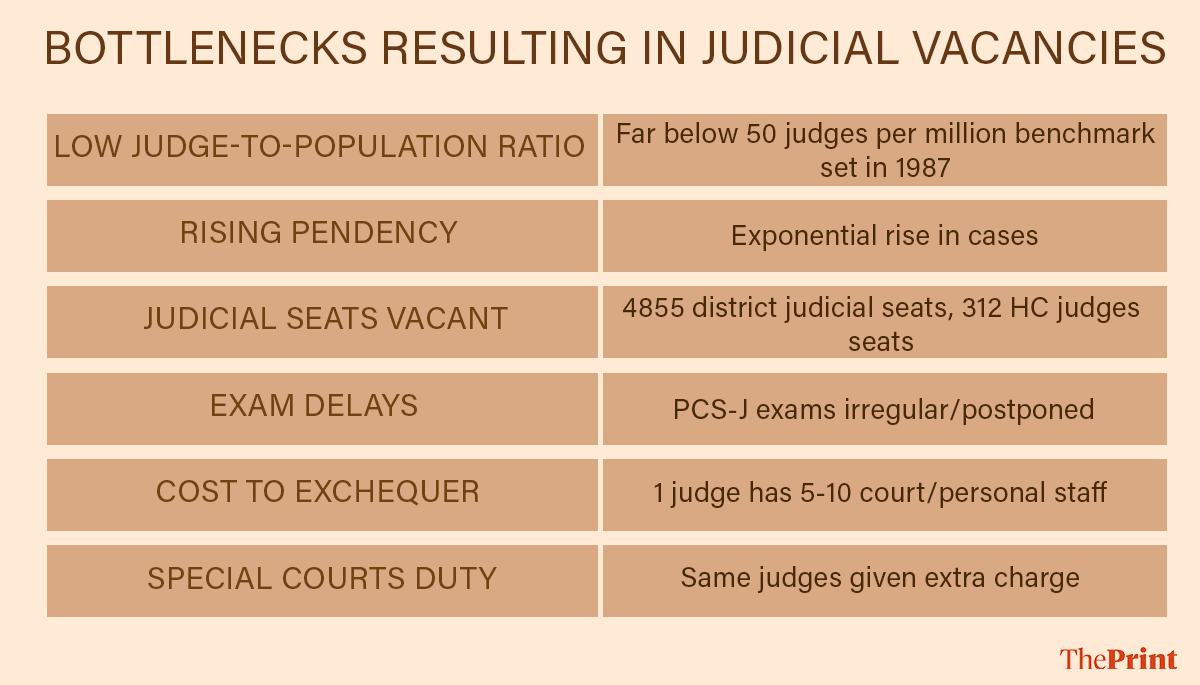
For the district judiciary, the Provincial Civil Service-Judicial (PCS-J) exams are held under the domain of state governments or respective high courts. These entrance exams often do not have a fixed schedule, resulting in them being held either after 3 years of the notifications, if not postponed or even cancelled.
Shivaji from Vidhi noted that while sanctioned strength in the higher judiciary is often discussed, the district judiciary faces a more basic issue: the absence of a uniform and regular recruitment cycle for state judicial service examinations.
“One really big issue is the fact that we don’t have any uniform mechanism for when the state judicial service exams should be conducted. In every state, these exams are notified according to essentially the whims and fancies of the system, and the recruitment cycle does not happen on a regular basis,” she told ThePrint.
“You end up appointing judges to certain posts without even their preliminary training being completed…..and when that’s not enough, instead of recruiting more, you just keep shuffling people around to contain the growing pendency problem.”
In 2006, the Supreme Court laid down a mandatory schedule for the recruitment to the district judiciary, beginning with the notification of vacancies by 31 March and concluding with appointment letters by October 31 of every year.
Working at the Supreme Court for the last 30 years, senior advocate Vijay Hansaria also flagged a less-discussed issue: even where recruitment is initiated, many states are unable to fill all advertised posts because enough candidates do not qualify.
“If you invite applications for 200 posts, sometimes only 100 get selected. We cannot compromise on merit because the judiciary is too important. But the fact is that you are not able to attract sufficient talent,” he said.
In his view, this points to a deeper problem of attractiveness of judicial service, especially at the entry level. “You have to give better emoluments and better service conditions. Earlier there was a lot of respect in society; gradually perhaps that has not been attracting people in the same way. Better perks are necessary if you want to attract sufficient talent.”
On the recurring argument that there are not enough qualified or willing candidates to fill judicial vacancies, Singh said the answer lies in strengthening the pipeline, especially through better-supported state judicial academies.
“So far as the inadequate pool of candidates is concerned, this could be addressed by strengthening the state judicial academies, which are themselves functioning with meagre staff and resources.”
At the same time, he cautioned that the debate cannot begin and end with simply adding more posts. The first question, he said, India must answer is a more foundational one: what should the country’s optimum judicial strength actually be?
Drawing on IJR findings, Singh said judges are currently handling caseloads in the hundreds, leaving them with “virtually no time” to meaningfully manage their dockets.
He argued that one of the most immediate and underused reforms would be to free up judicial time by introducing professional court managers, rather than requiring judges to shoulder administrative burdens alongside adjudication.
“The other alleviating intervention is certainly taking steps to free up judicial time by introducing professional court managers. There is ample evidence in other jurisdictions that this works to improve judicial efficiency,” he said. “Law schools could introduce specific modules or courses towards enabling interested students to be better equipped for judicial service.”
Old census, new data
Another anomaly to be noted is that the Ministry of Law and Justice has stated that the judge-population ratio is calculated using the population data as per Census 2011 (1210.85 million) – essentially meaning that the official ratio continues to be derived using a 15 year older population base.
Shivaji of Vidhi said the reliance on the Census 2011 data likely understates the extent of the shortage. “One hundred percent, we are much worse off. The general consensus is that the population has significantly grown since 2011, and the pace of growth of sanctioned posts has not been the same. So there is no doubt that we are much worse off,” she said.
Cost to exchequer
Valay Singh of IJR said that while explanations such as an inadequate pool of candidates and the limits of increasing judge strength are often cited, the public debate tends to overlook a central issue: the financial cost of building real judicial capacity.
“What we don’t hear very often is the financial implications of increasing the sanctioned strength of judges. Typically, recruiting one judge in the district judiciary would require at least 6–10 court staff, as well as residential quarters and courtrooms. This would be a considerable investment in increasing the capacity of the judiciary.”
He added that this investment must be weighed against the economic cost of judicial delays, especially in a country where slow dispute resolution continues to affect contract enforcement and, in turn, economic growth. “When seen against the economic cost of judicial delays, which also affect economic growth as contract enforcement remains a serious issue, this is an investment that cannot be ignored.”
Shuffling of judges
Shivaji flagged another under-reported problem: the rise of special courts, including those dealing with cases under the POCSO, the SC/ST Act, and the PMLA, often without proportionate addition of judicial personnel.
“What happens is that for these special courts, the same judges who are currently magistrates or session judges are given additional charge. So, on paper, you have created a new post, but in reality you have appointed the same person to do more work. That judge has no time to hear either the regular duties or the special cases properly.”
Senior advocate Hansaria pointed to the example of the Allahabad High Court, where, he said, there is a substantial number of vacancies, while recommendations themselves remain pending or incomplete. “Unless the Chief Justice of the High Court initiates and gives the appropriate number of recommendations, the process cannot move.”
One structural reason, in his view, is the short tenure of High Court Chief Justices, which prevents them from settling in, understanding the Bar and the court, and initiating a proper appointment process.
“A Chief Justice has to know the lawyers, the Bar, the judges, and then recommend. But somehow that is not happening. That is a big gap in the recommendation process.”
(Edited by Tony Rai)