





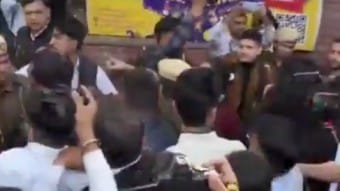



New Delhi: On 13 February, a protest at Delhi University’s North Campus over the University Grants Commission’s equity regulations descended into violence after YouTube journalist Ruchi Tiwari alleged she was assaulted by a mob.
The episode quickly sparked political clashes and prompted a police investigation into claims of caste-based targeting.
Since then, the Delhi Police have filed two FIRs — one based on Tiwari’s complaint of molestation and assault by members of the left-wing student group All India Students’ Association (AISA), another against the right-wing Akhil Bharatiya Vidyarthi Parishad (ABVP) and another on the complaint of AISA DU Secretary Anjali Sharma who alleged allegations of abuse and assault by Tiwari and the ABVP.
Videos circulating online show Tiwari being grabbed and surrounded, leading some social media users to call it “mob lynching” and sparking outrage under hashtags like #JusticeForRuchiTiwari on X and Instagram.
The incident, however, has generated sharply contrasting narratives about what actually happened. While Tiwari and some witnesses in conversation with ThePrint described her being attacked while reporting about the protest, others alleged that Tiwari provoked tensions by confronting fellow reporters and attempting to seize their equipment.
“While our programme was going peacefully, Ruchi Tiwari entered in the name of coverage and started confronting another journalist from the Dalit community named Naveen Kumar Nandan, who runs a YouTube channel. When she started pushing him around, all the people gathered there confronted her to stop,” AISA National General Secretary Prasenjeet Kumar told ThePrint.
The clash has brought longstanding tensions over caste, representation, and higher education reforms into sharp focus.
The mobbing
According to Tiwari, she read about the protest on campus and decided to cover it. She told ThePrint that she reached the location with her cameraman roughly an hour after the protest had already begun.
“I didn’t even ask a question there. I didn’t even take out my camera mic. I didn’t even put a mic in front of anyone. I was trying to understand the situation,” she recalled.
The situation escalated, Tiwari said, when Nandan repeatedly called out her name. “So, what happened was he called out to me. He repeated my name. So, in a way, he was provoking me,” she said.
When she approached him to ask why, she claimed he demanded personal details. “He said, ‘Tell me your full name.’ After that, he said, ‘Tell me your caste.’”
She added that Nandan began gesturing and appeared to make a call. From there, the situation quickly spiralled out of control after she tried to intervene; people suddenly closed in on her from behind.
“My throat was pressed. My clothes were torn, and they tried to pull them off. They lifted my clothes and filmed me. The boys protesting with him touched me inappropriately and made videos. I also received rape threats,” Tiwari said.
However, Nandan said the version being circulated tells only “half the truth”.
According to him, the sequence began when Professor Ravi Kant of the University of Lucknow arrived on campus for a scheduled protest. After the professor’s speech, Nandan approached him for an interview.
He said tensions began only after the interview ended. According to him, Tiwari and her associates tried to stop him mid-recording.
“After we completed our interview, Tiwari came to me and started snatching my phone. I asked her, ‘Why are you snatching my phone? I don’t even know you,’” he recalled.
He said that Tiwari demanded the deletion of a video aired by his news outlet, Bamcef News. He said he called for help, after which other students intervened. He credited a student, Anjali Sharma, in helping keep Tiwari from taking his phone.
Rejecting allegations of caste hostility, Nandan said, “This is completely wrong. Who gave Tiwari the right to come and snatch my phone? I got scared. Two or three of her colleagues were behind her, and she kept pulling my hand towards her body. You understand the kind of case that could have been made.”
Tiwari runs Breaking Opinions, a street-style opinion YouTube channel known for its high-energy, headline-driven videos. The channel covers some of the most controversial and burning political issues, from the various SIRs and UGC protests to the Bihar elections. It was launched on 24 June 2024.
In one of her videos, she can be seen urging a man: “Drop the reservation. Say on camera that you don’t want it. Speak into the mic.”
She added, “They won’t openly say they don’t want reservation, yet they tell others not to practice casteism. They claim casteism is done by Brahmins, so don’t practice Brahminism.”
Also Read: Equity helplines to penalties—What are the new controversial UGC rules?
What AISA intended
AISA Delhi University President Saavy Gupta, said that the gathering was organised by various student groups, led by them, to protest against the newly imposed UGC regulations. Professors from the university, students from marginalised communities, and multiple organisations had joined.
As speeches and discussions were going on, arguments began breaking out at different spots. She said that members of ABVP began provoking the crowd.
Nandan was present at the protest, and tensions reportedly rose during his interactions with Tiwari. According to Gupta, Tiwari took Nandan aside and assaulted him, prompting her and others to immediately intervene.
She said that Tiwari had a pattern of provocative reporting at previous protest sites, often invoking caste identity in ways that inflamed tensions. “There are videos of her at Jantar Mantar telling people that if they accept reservation, they will face casteism.”
The AISA president further added that this confrontation followed a similar pattern, when Tiwari was being stopped, she allegedly turned violent. Gupta said that she and her colleague Sharma were beaten, and that ABVP members joined in, intensifying the violence. She also said that they were touched inappropriately and assaulted.
After the clash, Gupta and her colleagues went to Maurice Nagar Police Station to file complaints and get medical examinations and medico-legal certificates. But she said a large crowd gathered outside the police station.
“Outside the station, around 7 pm, there were around 60 ABVP members. They barged in with sticks in their hands. They were shouting slogan like ‘Long live Brahmanvada’, ‘Shoot these people,’ ‘The country’s traitors,’” Gupta said.
Also Read: New UGC rules challenged in Supreme Court, plea seeks ‘caste-neutral’ definition of discrimination
A pattern emerges
Among those present was Prithviraj, a member of the Krantikari Yuva Sangathan (KYS), who said the events of Friday cannot be seen in isolation. In his view, what unfolded was part of a larger and recurring pattern.
He recalled that the protest began around 2 pm as a joint programme where students, members of various student organisations, including AISA, and teachers had gathered for what he described as a “peaceful discussion on caste discrimination in higher education”.
“This didn’t happen yesterday; we are seeing it even before this. Especially wherever there are protests, we see that one after the other, there are continuous attempts to dominate the narrative. To shift the focus to a topic. And to polarise it,” he said.
He alleged that such efforts are deliberate, aimed at manufacturing a controversy and then fracturing the discourse, shifting attention away from substantive issues.
Branding UGC’s new rules “anti-Brahmin” or “anti-Rajput,” he said, is itself a political construction meant to polarise opinion.
At the heart of his argument is the demand for stronger institutional safeguards. He described the existing regulatory framework as structurally weak, concentrating excessive authority in the hands of vice-chancellors and internal committees.
The demand, he emphasised, goes beyond representation. “It is about complete participation — Dalits, Adivasis, OBCs, economically weaker sections, women, and even those categorised as “general” — within a system that dismantles caste rather than reinforces it,” he said.
Also Read: Is Delhi University no longer in demand? Vacant seats, misfit faculty, bloated syllabus
The FIRs
With multiple FIRs and viral videos in circulation, the incident has now devolved into a battle of competing narratives between the various student groups and the ABVP.
Prasenjeet said that during the incident, Tiwari started making allegations against the gathering because they were raising slogans against Brahmins and other upper-caste people.
“After this, the ABVP mobilised their cadres and started sloganeering there. Our DU Secretary Anjali Sharma was also assaulted and pushed to the ground by Tiwari. There is a video showing that,” he said.
On the other hand, the ABVP state convenor, Siddharth Prashar, refuted the allegations, claiming that no ABVP members were present at the protest site when the scuffle broke out.
“There were some students from the Arts Faculty, who were known to the camera person accompanying Tiwari, who went to rescue her during the assault. But the ABVP was not present at the site,” he asserted.
The matter then shifted to the Maurice Nagar Police Station, where AISA functionaries alleged that the ABVP cadres had assembled in large numbers and raised slogans. There are several videos from the incident sites, but ThePrint has not independently verified each of them.
Delhi Police officers refused to share details of the FIRs, citing “sensitivity” of the cases, including one filed under a section covering molestation of a woman.
In one of the complaints filed with the Maurice Nagar Police station, Sharma alleged that while she was taking part in a peaceful protest, a few journalists and unknown persons approached her for an interview. Soon, however, they started misbehaving, she recalled, adding that at the same time, one YouTuber, Ruchi Shandilya, started hitting her in various parts.
She said that a group of men also joined in, who allegedly pushed her to the ground and passed defamatory remarks. She named three students from the Arts Faculty in her complaint, a copy of which ThePrint has seen.
“One of them misbehaved with me and touched me inappropriately on my breast and buttocks. I repeatedly pleaded with them to stop, but they continued to assault and abuse me. I was able to protect myself with the help of others present at the time,” Sharma said.
(Edited by Insha Jalil Waziri)