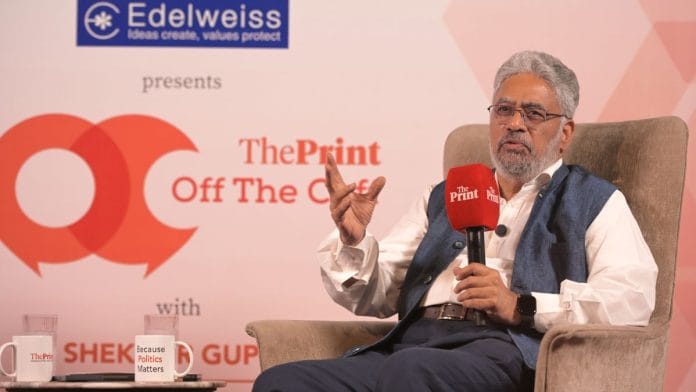



New Delhi: India’s footprint in the Gulf far outstrips anything Pakistan can bring, and perceptions over Islamabad’s role as a mediator in the West Asia conflict says more about Indian elite’s “insecurity” than about geopolitical reality, foreign policy expert C. Raja Mohan said Monday.
Speaking at ThePrint’s Off the Cuff at the Quorum Club in Mumbai—in conversation with ThePrint Editor-in-Chief Shekhar Gupta—Mohan said the fixation on Pakistan’s diplomacy was disproportionate given the vast and widening gap between the two countries’ economic standing.
“I think it’s really Pakistan’s envy. I think it seems so dominant in our discussion that it’s a pity. India, today, has an economy 10x bigger than Pakistan’s. Pakistan is stuck at 400 billion dollars GDP aggregate. It is under the 25th or 26th IMF programme, its per capita income is smaller than Bangladesh’s today. Its elite are completely unconcerned by the economic situation and they love playing these geopolitical games,” Mohan said.
India’s relationship with the Gulf had matured far beyond anything Pakistan could replicate, he argued. “I mean, it’s only our little elite that are getting worried about this. Our weight today in the Gulf is far higher than Pakistan can ever bring because unlike Pakistan, which is constantly going to Saudi [and] saying ‘give me one more billion, roll over this debt I need this’… today the Gulf invests in India, we invest in the Gulf,” Mohan said.
He added, “Today, the nature of our relationship is much deeper, much bigger. There are more Indians in the Gulf than Pakistanis. That is the reality.”
Pakistan confirmed last week that it has been conveying messages between the US administration and Iran. On Sunday, Islamabad hosted the foreign ministers of Egypt, Türkiye and Saudi Arabia for talks aimed at finding a path out of the five-week conflict among the US- Israel and Iran. Tehran, however, clarified it would not participate in the framework Pakistan was seeking to convene, having not agreed to its terms.
Islamabad’s role in mediating the West Asian conflict has stoked criticism in India that New Delhi is being sidelined in Washington’s worldview. US President Donald Trump spoke with Prime Minister Narendra Modi only on 24 March—weeks after the conflict began — while US Secretary of State Marco Rubio had spoken with External Affairs Minister S. Jaishankar just days before the two leaders connected.
Mohan was dismissive of the idea that Pakistan’s mediation would yield any meaningful dividend.
“If you see the last 75 years, Pakistan’s weight in the Gulf has actually declined. But I think today they play a role, I mean that’s fine. In the end, if anyone thinks mediators are going to fix the problem between Iran and the US, I think they are fundamentally mistaken,” he said.
“You can facilitate something, you can create a meeting room. Look, the US is the biggest power in the world, Israel now [is] almost like a superpower and Iran is a Goliath compared to the Arabs. These are big countries playing big games. The notion that, you know, Pakistan will kind of get something out of this, I think it’s our fears because it tells something about insecurity rather than the real world,” he added.
Pakistan does have its own stakes in the conflict: it is facing energy shortages and has imposed rationing measures in recent weeks. Islamabad also holds a mutual defence agreement with Saudi Arabia, signed last September.
Speculation about a Pakistan-anchored Islamic military alliance—an “Islamic NATO”—drew equal scepticism from Mohan, who pointed to a century of failed pan-Islamic solidarity as evidence of its implausibility.
“To think that somehow Pakistan can fix Islamic unity, which the OIC [Organisation of Islamic Countries] has not been able to do… Arab unity has not been possible, pan-Islamic, pan-Islamism has not been successful. I think it’s a grand delusion. But I think we should be the last ones who are worried about it because history speaks for itself,” Mohan said.
He pressed India to look past Pakistan’s manoeuvres and focus on the country’s own trajectory. “I think the problem has been our elite’s insecurity, immaturity, I would even say to constantly worry about what Pakistan is doing. That is the problem, it is not the way the world works. For example, is Pakistan’s diplomacy more important than the eight billion dollar deal that Google does at the AI Summit with India? Or that Pakistan is organising a peace conference, that’s more important,” he questioned.
Mohan noted that India and the US are expanding collaboration across technology and artificial intelligence, yet public discourse keeps gravitating towards Pakistan’s perceived leverage in Washington. He acknowledged that Islamabad has been a core American partner since the 1950s, and that a Trump pivot towards Pakistan in the past year should not come as a surprise.
“I think we should be confident in our own steam rather than worry about Pakistan. I think I can understand why it is, because the partition with Pakistan looms large on our mind, but we shouldn’t let it. As I said we are 10x bigger than them and getting bigger all the time,” Mohan said.