





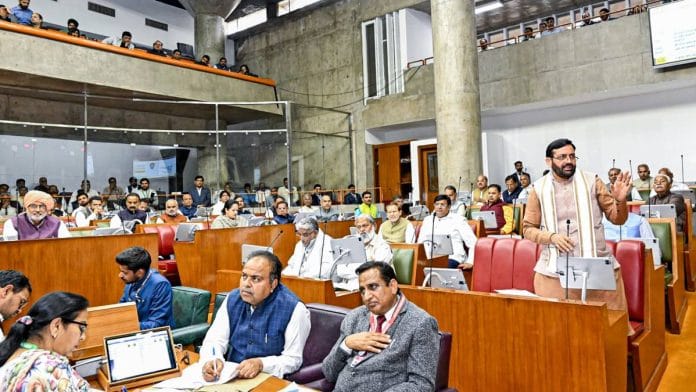



Gurugram: When Haryana Vidhan Sabha’s budget session began Friday, few in the corridors of the sprawling Chandigarh secretariat found it surprising. It almost always begins on a Friday.
Records of previous state assembly sessions show that on most occasions, the proceedings have begun on a Friday. The ongoing budget session, starting 20 February, will run till 18 March with nine holidays spread over 17 working days.
On the question of why Friday, those who have occupied the chair in the house had some candid observations.
Kuldeep Sharma, who served as Speaker of the Haryana Vidhan Sabha during the Bhupinder Singh Hooda regime, did not mince words. “The basic purpose of beginning the session on a Friday is to allow the MLAs a little more daily allowances,” he told ThePrint.
According to amendments to Haryana Legislative Assembly (Salary, Allowances and Pension of Members) Act, 1975, an MLA is entitled to Rs 2,000 per day for each day of attendance at a session, committee meeting or official business conducted under the Speaker’s orders, subject to a maximum of 15 days in a month.
The arithmetic is straightforward. With the session beginning on Friday, MLAs get their daily allowance for Thursday too, because they must arrive in Chandigarh a day earlier to be present in time for the assembly. When the session rises on Friday evening, they are entitled to the allowance for Saturday as well, for the return journey to their constituency. And since the session resumes Monday, Sunday’s allowance comes along too. A three-day session can thus effectively yield allowances for five to six days.
Sampat Singh, a six-time MLA who has represented Bhattu Kalan, Fatehabad and Nalwa over the decades, agreed with Sharma but said there was more to it.
“Daily allowances and travel allowances is one thing, but that doesn’t matter much these days as people have a lot of money and these allowances don’t count much,” he said. “The bigger factor is that with the Governor’s address on a Friday, assembly members get at least two days to prepare for their debate on the address.”
Singh recalled a time when these allowances were not incidental. When he began his stint as an MLA in the early 1980s, the travel allowance of Rs 16 per kilometre was significant enough for him and his colleagues to plan their journeys with some care.
“Late Chaudhary Virender Singh, who represented Narnaund assembly constituency in Hisar, had a Fiat car. He would come from his Hisar residence to mine, to pick me up, and we would drive to the Hisar bus stand. After parking there, we would take a Haryana Roadways bus to Chandigarh and a rickshaw to reach the assembly on time. In reimbursement, we would get Rs 16 per kilometre as travel allowance every week, which meant a lot for us at that time,” Singh said.
Today, MLAs get Rs 18 per kilometre for travel, and the weekly sub-committee meetings mean that the assembly-related allowances flow through most months, not just during the assembly session.
Not everyone was willing to engage with the question, though.
Varun Chaudhary, former Congress MP from Mulana whose wife Pooja now holds the seat, said the question of dates was the domain of the Governor, who notifies the session schedule, and it would not be appropriate to comment on the reasons.
He said the more important question was not which day the assembly session began, but how many days it actually ran.
It is a point worth dwelling on. This budget session, which will run till 18 March, has nine holidays built into 17 working days. On 16 March, when voting is scheduled for two vacant Rajya Sabha seats from Haryana, proceedings will begin at 2 pm, with all members expected to cast their ballots before that. On the days following a holiday, the house will start at 2 pm. On regular days, it will run from 11 am to 5 pm.
A Haryana government spokesperson told ThePrint that the dates of the assembly session were fixed keeping several factors in mind, and additional allowances for MLAs was not one of them.
(Edited by Nida Fatima Siddiqui)
Also Read: How a sense of humiliation gave rise to the modern Jat identity & impacted Haryana’s politics