





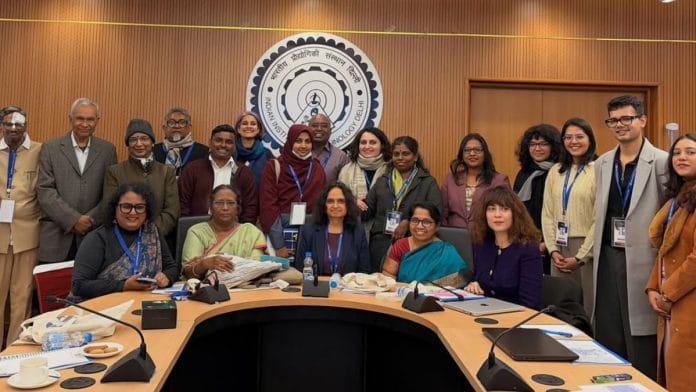



New Delhi: The Indian Institute of Technology-Delhi’s three-day conference titled “Critical Philosophy of Caste and Race” has led to the formation of a committee that would investigate “concerns raised about the conference”. The institute has not disclosed who raised the concerns and what they are.
The conference, held from 16-18 January, was the third edition of the event. It was organised by the Department of Humanities and Social Sciences as part of a series marking 25 years of the United Nations’ Durban Declaration and Programme of Action (DDPA) against racism and caste-based discrimination. A week later, IIT Delhi posted a statement on X, saying it had constituted a fact-finding committee after “serious concerns” were raised “over the choice of speakers and content of the conference.”
“Appropriate actions will be initiated in accordance with institutional protocols, based on the committee’s findings. The Institute remains committed to national goals, academic integrity, and established institutional guidelines,” the statement added.
Speakers from global universities who attended the conference were “saddened” about how IIT Delhi was handling the matter.
“I don’t know why this is such a crime. Where are we heading? The debate and discussion make the institutes strong and when I was talking about the issue, it was not just about India. According to me, there are 26 countries where the problem of caste and race exists,” said Prof Paul Divakar, the convenor of the Global Forum of Communities Discriminated on Work and Descent. He delivered a keynote lecture on ‘Dalit Rights to Global CPWD: From Naming to Norms, from Norms to Justice’.
“I even proposed how India has the best measures, policies, and legislative provisions to address such issues. There are multiple discussions and debates that need to take place as India is a global power and this is not just a domestic issue or a South Asia issue. Latin America, Japan, and Africa also go through this. But how IIT Delhi has reacted is very sad,” Divakar added.
According to IIT Delhi’s official programme, the January 2026 “Critical Philosophy of Caste and Race” conference covered topics such as Dalit identity, caste psychology, caste-race theory, minority discourse, history writing, and book discussions.
The organisers have rejected allegations that the event engaged in political activism, insisting it remained “academic in aim and scope.”
“The conference is devoted to promoting and securing the constitutional values of equality, liberty, dignity and fraternity through scholarly discussion of the past and present Indian contributions towards combating social inequalities and social injustice. Therefore, speakers include scholars, award-winning academics, writers and artists, and participants of the United Nations’ WCAR 2001 in Durban who have contributed to this area and have been the subject of existing academic research,” Divya Dwivedi, philosophy professor and one of the organisers, told ThePrint over email.
“The entire conference is academic in its aim and scope, which is to generate critical thinking on social inequalities towards an egalitarian and sustainable world for all, and it builds on existing academic research and publications,” she added.
Students who attended the conference told ThePrint that most of the sessions were “purely academic,” with some even describing them as “boring.” The programme featured multiple panel and book discussions, with faculty and scholars from India and abroad presenting research and speaking on caste, race and social inequality.
“We attended the sessions and it was purely academic. There was nothing problematic. It’s been more than a week and everything was fine. The statement of IIT Delhi has come as a shock to us,” a student who attended the three-day conference said on the condition of anonymity.
‘Institutions are for creating knowledge’
While a few social media posts claimed that one of the speakers faced opposition when they compared the condition of Dalits in India to Palestinians, none of the people ThePrint spoke to confirmed this.
“There was no opposition,” said Dwivedi. “The presentation was based on the speaker’s previous research and publications, which are part of established academic scholarship on the topic.”
The academics expressed surprise at the action, arguing that the attendees included individuals who have made the issue of caste discrimination a global talking point.
“This was part of the 25th anniversary of the Durban conference that declared race and caste crimes as crimes against humanity. It included many scholars from various parts of the world — internationally acclaimed professors, academics and activists who have already published against race and caste,” said Prof Ajay S Sekher, associate professor and research supervisor in the Department of English at SSUS Kalady, Kerala.
An IIT Delhi student who had attended the previous two conferences said the opposition this time could be the result of the new UGC guidelines and the choice of speakers.
“This time, the speakers were invited from all over the world and included academics and activists. Maybe this is an issue for the management. It was the usual conference that happens,” said the PhD student on the condition of anonymity.
The conference had nine main speakers, supported by multiple chairs and discussants from universities across India and abroad, including TISS Hyderabad, Presidency University, and Ashoka University.
Shekhar joined one of the sessions online — a panel discussion on a book titled Tamil Buddhism and Brahminism in Modern India: Deep Resistance Against Caste by Dr Gajendran Ayyathurai, an anthropologist and historian from the University of Göttingen, Germany.
“Academic institutions are for creating critical knowledge and for critical and epistemological interventions, especially related to social issues like race and caste,” Shekhar said. “Racism, casteism and sexism — all these violent injustices are crimes against humanity. Any student of philosophy, humanities or social sciences must be exposed to these kinds of issues. That is why we are having such conferences and meetings.”
(Edited by Prashant Dixit)