





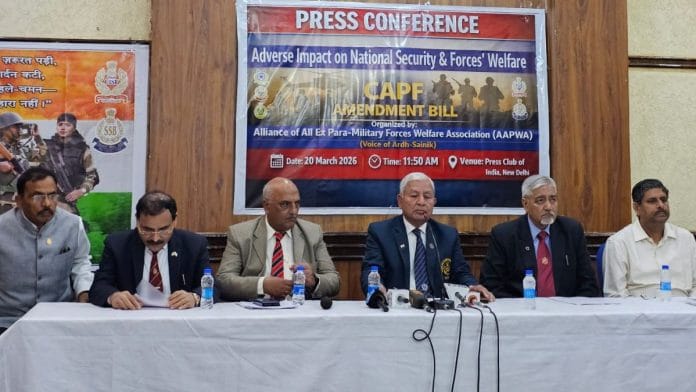



New Delhi: A group of veterans protesting the Centre’s bill to codify the deputation of Indian Police Service (IPS) officers to the Central Armed Police Forces (CAPF) stressed Friday that the bill resulted from “pressure groups” and “lobbying”, while CAPF officers continue to be denied entry into such influential, policy-making ranks.
Addressing the media at the Press Club of India Friday, veterans from the Central Reserve Police Force (CRPF), Central Industrial Security Force (CISF), Indo-Tibetan Border Police (ITBP) and the Sashastra Seema Bal (SSB) stated they are protesting not only for ranks and promotions but also for constitutional equity and a say in policies concerning the CAPFs.
“To put it bluntly, we do not have a lobby—our voices do not directly reach the government, they reach through imposed leadership,” said retired BSF additional director general (ADG) Sanjiv Krishan Sood, adding that the bill did not originate from a “mistrust of CAPF officers” but was a “consequence of pressure groups”.
The press conference took place days after Opposition leaders—including Congress President Mallikarjun Kharge, Rashtriya Janata Dal Rajya Sabha MP Manoj Kumar Jha, and Samajwadi Party MP Ram Gopal Yadav—voiced concerns over the proposed Central Armed Police Forces (General Administration) Bill, 2026, which the Union Cabinet cleared on 10 March.
Union Home Minister Amit Shah is set to table the bill in Parliament Monday.
The Opposition and cadre associations contend that the bill seeks to effectively bypass a final Supreme Court ruling aimed at reducing the presence of IPS officers in the CAPFs.
In addition to retired ADG Sood, retired CRPF ADG H.R. Singh, retired Inspector General (IG) BSF M.S. Malhi, retired IG BSF Vikas Chandra, retired IG SSB Pradeep Gupta, retired IG CRPF K.K. Sharma, and retired ADG ITBP Sanjay Kumar Chaudhary were present at the press conference.
‘CAPF is domain force but never consulted’
Retired IG BSF Vikas Chandra said bringing senior IPS officers to the CAPFs on deputation was envisaged during the forces’ inception because no automatic leadership was in place then.
However, Chandra added that people like L.P. Singh and Khusro Rustamji also envisaged a model in which homegrown officers would emerge as the forces’ senior leadership, based on their maturity and years of service with the forces. L.P. Singh was Union home secretary from 1964 to 1971, and Rustamji was the founding Director General (DG) of the Border Security Force (BSF), which was raised in 1965.
Retired IG Chandra said that deputation to a certain rank or above is not the main point of their objections and protests; rather, they want a say in policymaking. “When we were battling insurgencies in the Northeast and Kashmir, as well as the naxals in Chhattisgarh, we hoped—we ‘had’ hoped—that policymakers in Delhi would consider and be cognisant of our efforts,” Chandra said. “However, as recruitment rules were formulated, we were never consulted, and our say, if at all, mattered very little.”
The veterans emphasised that they do not want to position themselves against IPS officers, stating they are not questioning the IPS officers’ credentials at all. However, they asserted that in-house officers of the forces had a more hands-on understanding of the troops’ problems and of managing those issues.
“The IPS officers are very qualified, and we are not questioning them. However, they better understand how to maintain law and order in other domains. In domains such as border security, we are the more experienced forces, and our in-house officers and commanders have a better understanding of the ground situation than they do,” said retired IG CRPF K.K. Sharma.
Proposed bill contrasts 2025 SC ruling
In a landmark ruling in May 2025, the Supreme Court ordered the Ministry of Home Affairs (MHA) to conduct a CAPF cadre review—initially due in 2021—within six months. Saying that, the court ordered the MHA to “progressively reduce” the deputation of IPS officers to CAPFs over a period of up to two years. Later in October 2025, the MHA challenged the judgment in a review petition, but the court rejected it.
Still later, in February this year, the MHA informed the court that it was planning a “statutory intervention”. The ministry also requested the court to grant up to 20 months for the cadre review exercise. The exercise was intended to create new posts for CAPF officers and jawans facing prolonged stagnation, such as no promotion for over a decade.
In contrast, the Central Armed Police Forces (General Administration) Bill, 2026—proposing reservation in 50 percent of inspector general (IG) and 20 percent of deputy inspector general (DIG) posts in the forces for IPS officers—is set to provide statutory backing to the existing system.
(Edited by Madhurita Goswami)
Also Read: Uddhav Sena goes its own way on Maharashtra Bill seeking to curb ‘unlawful’ conversions