







New Delhi: Political drama in Chennai has moved from the campaign trail to Raj Bhavan in the aftermath of the 2026 Tamil Nadu Assembly elections. Actor-politician Vijay’s Tamilaga Vettri Kazhagam (TVK) emerged as the single largest party, winnning 108 seats in the 234-member Assembly, though falling short of the 118-seat majority mark.
The Dravida Munnetra Kazhagam (DMK)-led coalition is at 73 seats, and the All-India Anna Dravida Munnetra Kazhagam (AIADMK)-led grouping at 53. No single party or coalition getting a clear majority means that the path to government formation will involve coalition-building and gubernatorial oversight.
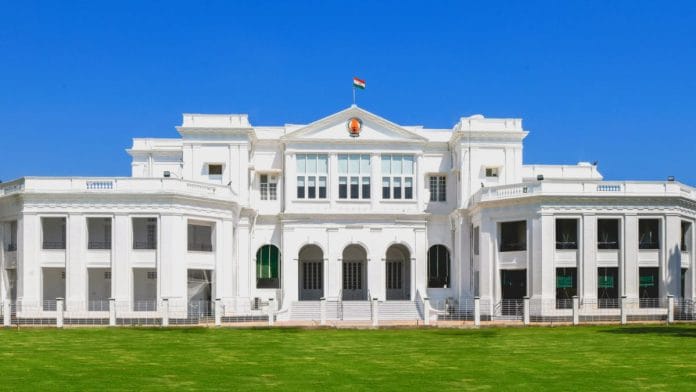
Vijay’s TVK has formally staked claim to form the government, but Tamil Nadu Governor Rajendra Vishwanath Arlekar has not announced a final decision.
Without detailing procedure, Article 164 of the Constitution simply states: ‘The Chief Minister shall be appointed by the Governor’. This makes the process of appointment Constitution-conventional, combining express provisions in the statute with political custom and precedents from Supreme Court rulings.
Articles and precedents
The Constitution assigns the Governor a pivotal role in government formation, but not without limits. Under Article 163, the Governor normally acts on the aid and advice of the Council of Ministers, except in cases where the Constitution expressly recognises discretionary powers.
Article 164 empowers the Governor to appoint the Chief Minister, and Article 174 allows him to summon, prorogue or dissolve the Assembly. Article 356 provides for President’s Rule if the government cannot function in accordance with the Constitution.
Over time, the Supreme Court has clarified that gubernatorial powers are not limitless, and are bound by democratic norms. Further, the Court has held that while the Governor’s personal actions are legally immune, official actions are subject to judicial review.
In the landmark case of S.R. Bommai vs Union of India (1994), a nine-judge bench held that a floor test in the Assembly is the only legitimate test of majority, and that the Governor’s subjective opinion cannot override this. The court also held that President’s Rule is unconstitutional if a stable majority is demonstrably possible.
In Rameshwar Prasad vs Union of India (2006), the court emphasised that the Governor must act in good faith within the principles of natural justice. It was held that dissolving the Assembly without even summoning it is a misuse of discretion.
In Nabam Rebia v. Deputy Speaker (2016), the apex court held that the Governor’s powers are not absolute, and must be exercised within constitutional standards, not as a political actor.
The Sarkaria Commission was a constitutional policy body set up by the Union government in 1983 to examine Centre-State relations. The Commission’s 1988 report emphasised that a Governor’s powers should be judiciously employed, and that the office must remain apolitical.
The Governor’s options
The conventional choice would be to invite the single largest party, in this case the TVK, to test its majority. This would involve inviting Vijay to form the government, and subsequently prove his majority on the floor of the House within a reasonable period of time. This is the standard practice in a hung Assembly, and is supported by the Supreme Court’s S.R. Bommai precedent of the ‘true test of majority’.
In the Rameshwar Prasad case, the court said: “The Constitution enjoins upon the Governor that after the conclusion of elections, every possible attempt is made for formation of a popular Government representing the will of the people expressed through the electoral process.”
The Governor may ask the TVK to submit letters demonstrating support from others that push it across the 1180seat majority mark. The same would also hold in the unlikely scenario of a DMK-AIADMK coalition.
The Supreme Court has warned against tactics to delay a floor test. In the S.R. Bommai case, it said, “The assessment of the strength of the Ministry is not a matter of private opinion of any individual, be he the Governor or the President. It is capable of being demonstrated and ascertained publicly in the House.”
The Governor can also explore alternative alliances if it seems that the TVK cannot muster required support. This is allowed only as a genuine exercise, and not as a way to block the single largest party.
Another option is to dissolve the Assembly under Article 174, effectively declaring fresh elections. The Supreme Court has, however, held that dissolving the Assembly without even convening it is inherently suspect because it deprives the legislature of the chance to express its view.
President’s Rule under Article 356 is the most drastic option available. If the Governor concludes that no party or coalition of parties can form a workable government, he can recommend President’s Rule.
The Sarkaria Commission recommended that the power under Article 356 should be used only as a last resort. The S.R. Bommai case too is unambiguous on this point – Article 356 is permissible only when all other alternatives have been exhausted. “It would be a case of failure of constitutional machinery,” the court said.
Saumya Sharma is an alum of ThePrint School of Journalism, currently interning with ThePrint.
(Edited by Nardeep Singh Dahiya)