





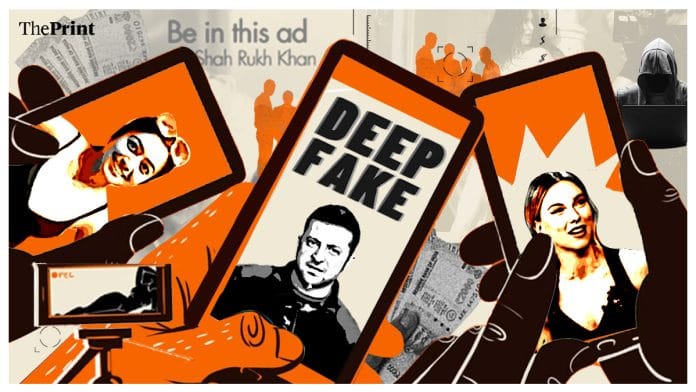



New Delhi: The Ministry of Electronics and Information Technology held an informal, closed-door brainstorming session with major technology firms to discuss growing concerns around deepfakes, AI-generated misinformation, and bot-driven content amplification, but stopped well short of signalling any imminent regulation.
The Thursday meeting, which lasted just under an hour, was attended by representatives from Meta, Google, OpenAI, Snapchat, ShareChat, the Broadband India Forum, and the Internet and Mobile Association of India, among others, ThePrint has learnt.
People familiar with the proceedings described it as an exploratory conversation rather than a formal consultation, with the ministry seeking to understand what platforms are already doing and what a future framework on combating the menace could look like.
MeitY indicated this was an initial consultation without a draft regulation in place, and invited stakeholders to provide both formal and informal submissions as the process develops.
A central concern raised in the room was the use of bots to amplify messaging and misinformation, particularly in election-related contexts, people familiar with the matter said.
With assembly elections approaching in several crucial states including West Bengal, Assam, Kerala, and Tamil Nadu, the issue has taken on added urgency, even as those present noted that the problem extends well beyond the electoral sphere.
Participants drew a careful distinction between AI-powered generation of bots and content— where large language models are used to produce synthetic accounts and material automatically at scale—and older, human-driven forms of coordinated inauthentic behaviour.
“The need to address both the generation and the dissemination stages was a key point,” said one person familiar with the discussions, speaking on condition of anonymity. “It is not enough to focus on one without the other.”
Participants acknowledged, however, that technology-based solutions have inherent limits. Platforms are already deploying detection tools, but those deploying bots consistently find ways around them. “It will always be a cat-and-mouse situation,” said another person familiar with the matter, also speaking on condition of anonymity.
The ministry’s interest, these people said, was in exploring whether a standardised minimum obligation could be placed across platforms rather than leaving each company to address the problem on its own terms.
Also Read: Why the deepfake menace is likely to get worse in 2026
Personality rights
The meeting also took up the question of deepfakes and personality rights, specifically, whether a consent layer should be required before AI systems can generate synthetic likenesses of real individuals.
The ministry raised the question of whether existing privacy and personality rights frameworks offered a legal basis for such an obligation, or whether new legislation would be needed.
The discussion ranged across a wide variety of scenarios—from celebrities’ likenesses being used without consent to promote financial products, to fabricated videos of public figures simulating endorsements or causing reputational harm.
International approaches were also on the agenda. California’s Bot Disclosure Law — which requires operators of bots used to influence elections or commerce to disclose their automated nature — and regulatory developments in the Netherlands were cited as reference points.
“The challenge is that existing frameworks were not designed with this pace of technological change in mind,” said a third person familiar with the matter, speaking on condition of anonymity.
People familiar with the proceedings were clear that Thursday’s session was not a precursor to any imminent regulation. The ministry, these people said, was at an early stage — gathering perspectives before deciding whether or how to proceed. One person familiar with the matter described it as “a thinking-aloud exercise,” with no formal ask made of the companies in the room.
The session comes as the Election Commission also prepares to hold its own routine pre-election meeting with social media platforms on Saturday — a sign of how widely the concern around AI-generated content has spread across arms of the government.
(Edited by Ajeet Tiwari)
Also Read: What are India’s new deepfakes & AI-content guidelines?