





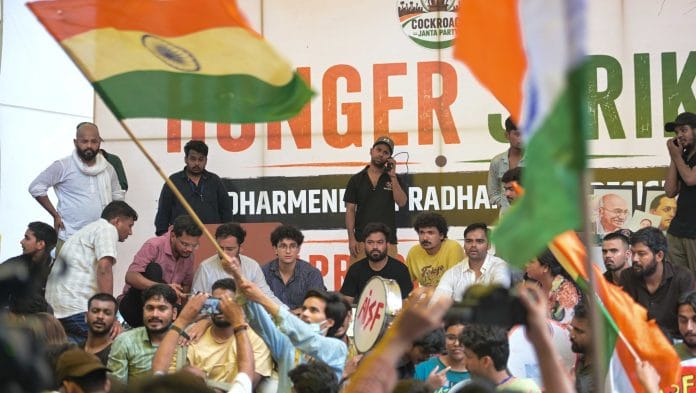


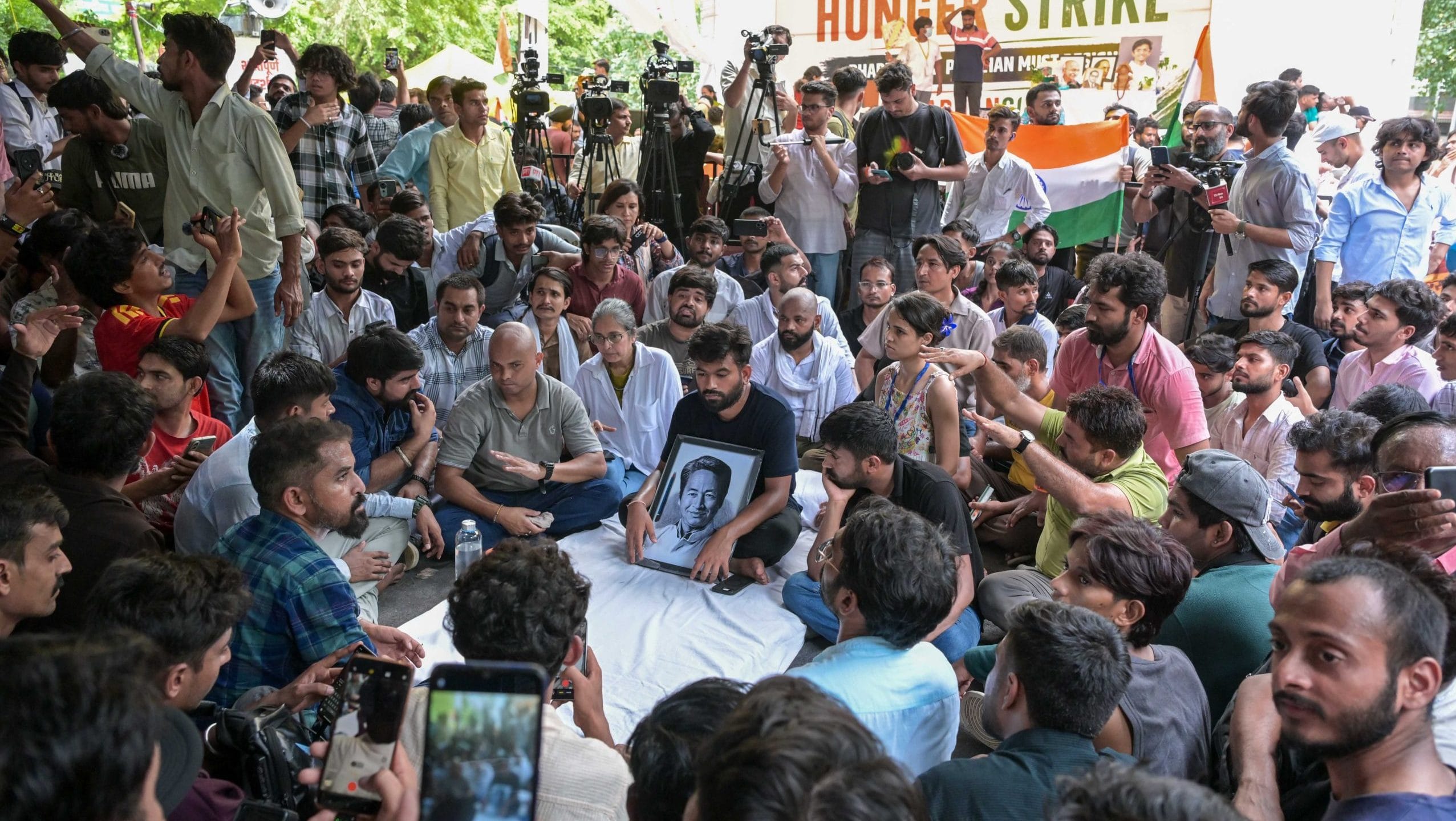
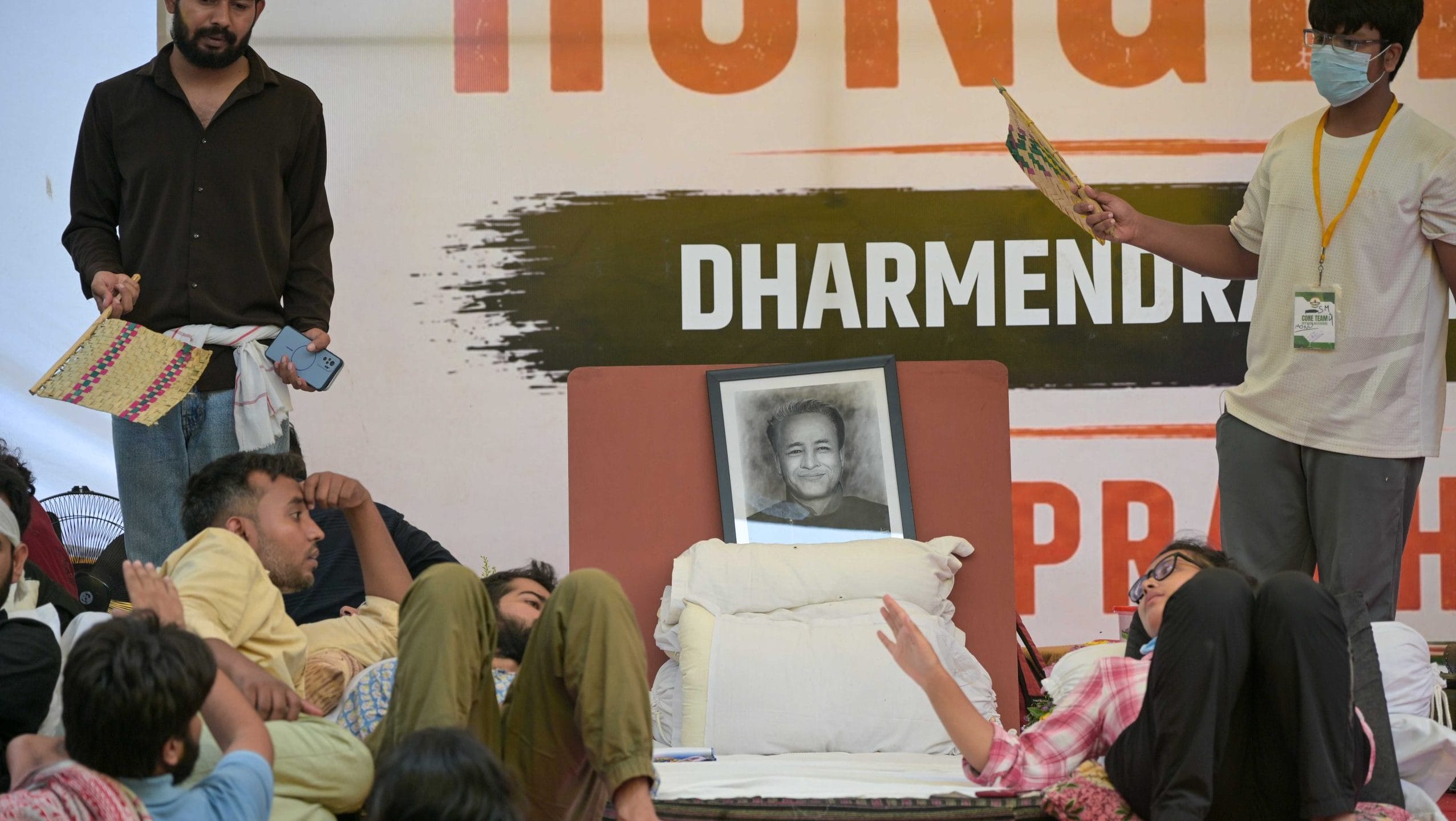
New Delhi: It is 6 pm on Saturday, 18 July. The sun has begun to soften, but there is little relief. Humidity hangs heavy over Jantar Mantar, and sweat trickles down the faces of hundreds of protesters gathered beneath a makeshift stage where activist Sonam Wangchuk observed an indefinite hunger strike for 20 days until Saturday morning.
For nearly three weeks, the protest settled into a familiar rhythm. Supporters from all walks of life came to the site throughout the day, while Wangchuk, lying on a thin mattress under the tent, greeted visitors with a faint smile.
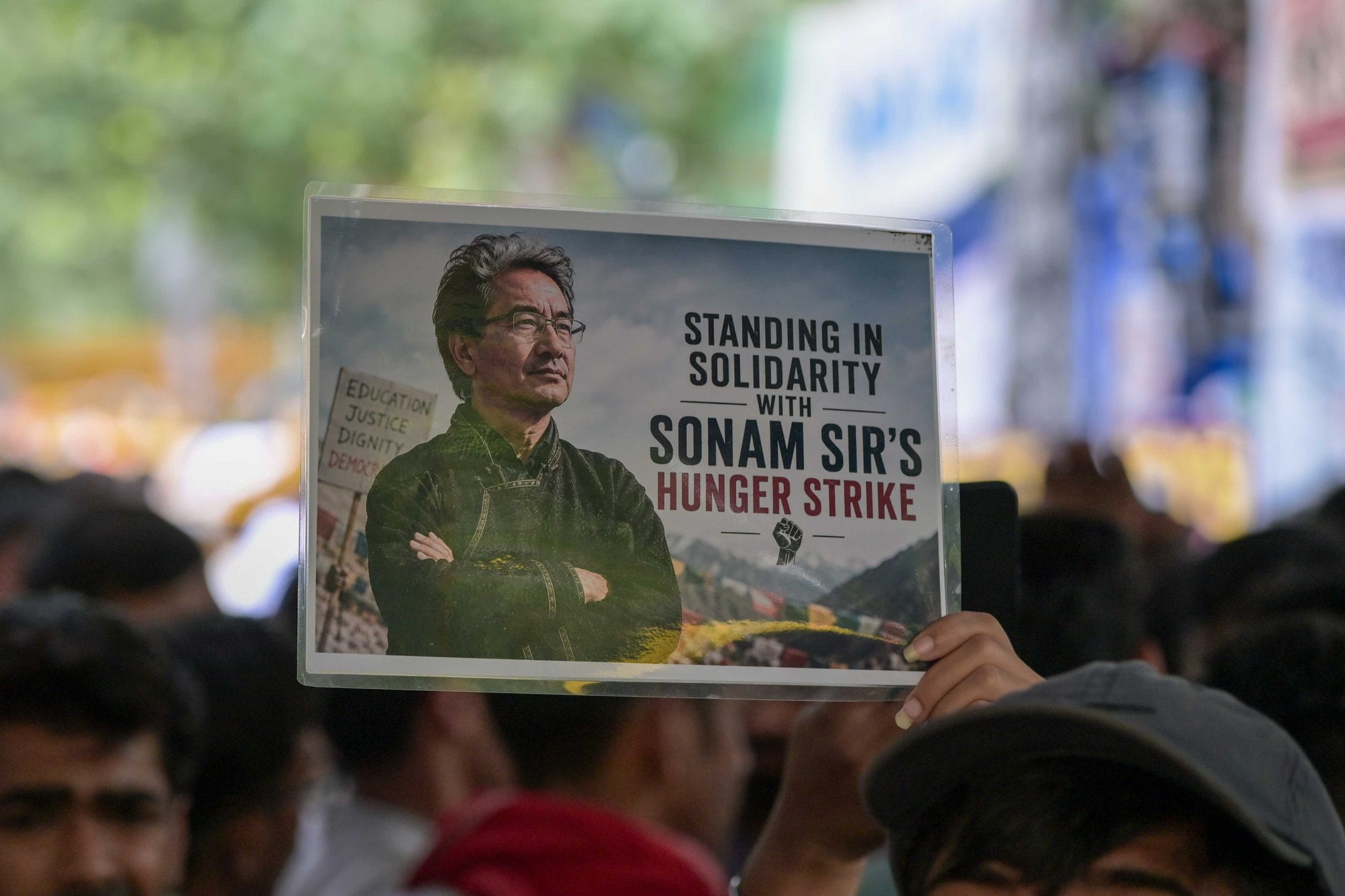
Evenings drew the largest crowds. Chants of “Halla Bol” echoed across Jantar Mantar as placards reading “Stop Institutional Murders of Students”, “Scrap NTA”, and “Our Future Is Not a Political Experiment” reflected the anger that had brought the protesters together.
Volunteers from the Cockroach Janta Party (CJP) waded through the crowd, managing visitors hoping to catch a glimpse of Wangchuk. Nearby, artists painted posters depicting Prime Minister Narendra Modi as Hitler and sketched caricatures of him carrying Union Education Minister Dharmendra Pradhan in his lap, while others distributed drinking water to those waiting in the heat.
That routine came to an abrupt end Saturday morning.
Around 7 am, police personnel arrived at the protest site, dispersed the gathering and removed Wangchuk, citing his deteriorating health. Protesters alleged he was forcibly taken away. But instead of ending the agitation, the action seems to have given it fresh impetus. Many refused to leave, and hundreds more arrived at Jantar Mantar in solidarity, swelling the crowd to nearly 1,000.
With Wangchuk no longer at the site, protesters appeared more determined than before, accusing the government of high-handedness and vowing to make Monday’s scheduled march to Parliament a show of strength.
For many school students at the protest, Sonam Wangchuk was a name they had barely heard before. Much of his activism had been centred on Ladakh, far removed from the concerns of students protesting the NEET paper leak. But as news of his fast spread, many began reading about his work—and, for some, he quickly became an inspiration.
Fiza, a class 10 student from Ghaziabad, said she first heard of Wangchuk only after the hunger strike began. Curious, she looked up his work and then insisted that her parents bring her to Jantar Mantar.
Krishna, who also lives in Ghaziabad, shared a similar story. “I had no idea who he was before this. But he is a real-life hero. I came here just to catch a glimpse of him. He has always stood up for his people, and now he is standing up for us. The least we can do is be here and support him,” he said.
Also read: Delhi Police ‘shift’ Wangchuk to hospital, CJP’s Dipke alleges activist taken ‘by force’
‘Lawyers, students to ex-servicemen—all seeking answers’
The protest has drawn far more than just angry students seeking answers. Retired and serving government employees, lawyers stopping by after court, parents carrying infants, Class 10 students, ex-servicemen, and auto-rickshaw drivers all find space in the crowd.
Their backgrounds may differ, but their demands are the same.
They not just seek accountability for the NEET paper leak, but also demand an acknowledgement of systemic failures by the government, restoration of public faith in the country’s examination system and an “apology”.
Hritik, from Jharkhand, who appeared for the examination on 3 May before it was cancelled, says, “No one knows why the paper was leaked. Who will give us answers? Who is the culprit? I should know—I deserve to know. And who is responsible for the students who took their own lives?”
He adds, “We are seeking the resignation of Dharmendra Pradhan, because to hold these exams fairly and properly was his responsibility and he failed. His resignation may not serve the purpose but it will definitely send a message across. The worst part is that the government does not even want to acknowledge this leak as a failure.”
Questioning the Prime Minister’s silence on the issue, he asks, “Why hasn’t there been even a single statement from the Prime Minister on a crisis that affects so many students? Isn’t it the Prime Minister’s responsibility to assure people that this will not happen again and that the matter will be investigated fairly? The government has neither said anything nor taken any action.”
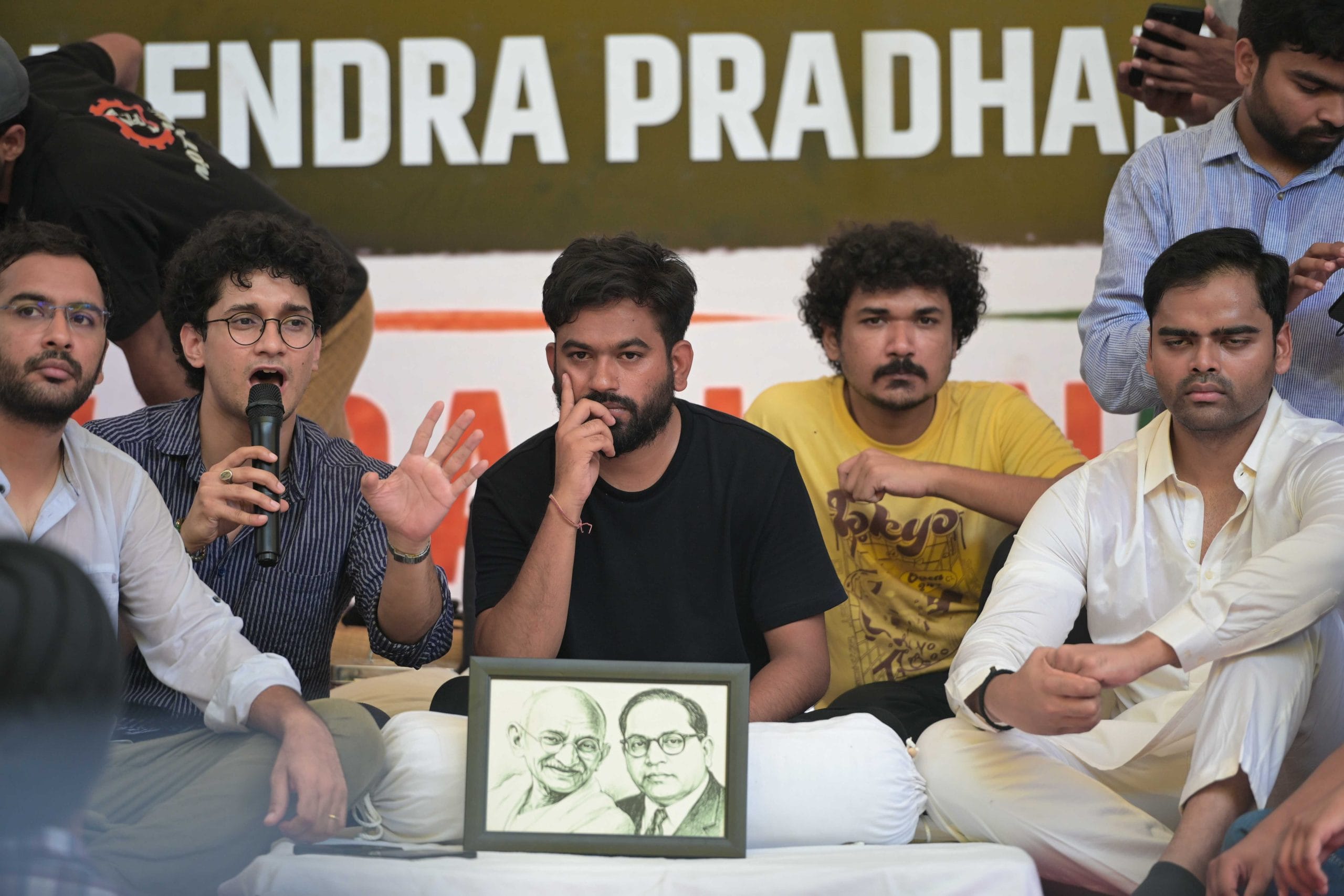
Prateek, another student, highlights the need for reforms.
“Students spend lakhs of rupees on coaching centres. Many families take debt just so their children can appear for a single examination. After investing their parents’ life savings, they are hit by a paper leak. Families put everything they have into their children’s education, and when leaks happen, it breaks the students,” he says.
“Bigger reforms are needed. The coaching industry must also be regulated. Right now it appears that the students are trapped from all sides,” he adds.
Mumma Sanwar, an auto-rickshaw driver who has been attending the protest every day, says he sees the movement as a fight for the country’s future.
“The future of our students should not be left in darkness or held hostage to paper leaks. They are the future of this country. After a long time, this protest made me feel that our Constitution is alive because people are finally questioning those in power,” he tells ThePrint.
Calling the protest an organic one, he adds, “This is not a political party’s movement. The government should understand that it is the very people who elected them who are out here protesting. It is their duty to engage in a dialogue with the people.”
He explains why he returns every day: “I come here every day to mark my presence so that our children know their grandparents stood with them. I don’t have children of my own, but I am here for the students. I am here for the kids.”
Subedar Major Lal Chand Yadav, an ex-serviceman who has visited the protest several times, resonated the same sentiment.
“I am here because of the students. They are being discredited by being labelled as the ‘tukde tukde gang’. I have come here two or three times. Those who are true nationalists should come here and support this protest. This is a country of revolutionaries. The government thinks of us as cockroaches and of itself as kings. They should come here and urge Wangchuk to end his fast,” he says.
‘The online stars’
What is hard to miss at the protest is the number of people holding up their phones—livestreaming, recording videos, interviewing protesters, or delivering pieces to camera.
“This is our duty. When the mainstream media fails to show the ground realities, we step in. We are here to do the job that the media should be doing,” says a YouTuber covering the protest.
Much of the coverage is being driven by smaller regional outlets, independent YouTube channels, and social media creators, who are livestreaming the protest and broadcasting developments directly to their followers in real time.
One content creator, who says he has been documenting the protest since its first day, adds, “We have been here from day one. We document every day of the protest and speak to people every day to understand who is joining and why.”
Pausing briefly to tell his livestream audience that he would soon show them a glimpse of Abhijeet Dipke, he says, “Since I started livestreaming this protest, my following has grown. That tells me people are interested. Even if they cannot be here physically, they are watching and following what’s happening.”
The ‘fear’
Prateek, a JEE aspirant taking a drop year, says he is worried that genuine protesters could be discredited if outsiders create trouble on 20 July when a march to the Parliament is planned. “In many protests, we have seen people suddenly start raising anti-national slogans, and later the police use that to target genuine protesters. It gives them an opportunity to defame the entire protest,” he adds.
He also expresses concern that the protest could be infiltrated. “On 20 July, government agents may pose as volunteers and provoke a confrontation with the police. That could then be used as a pretext to crack down on the protesters,” he alleges.
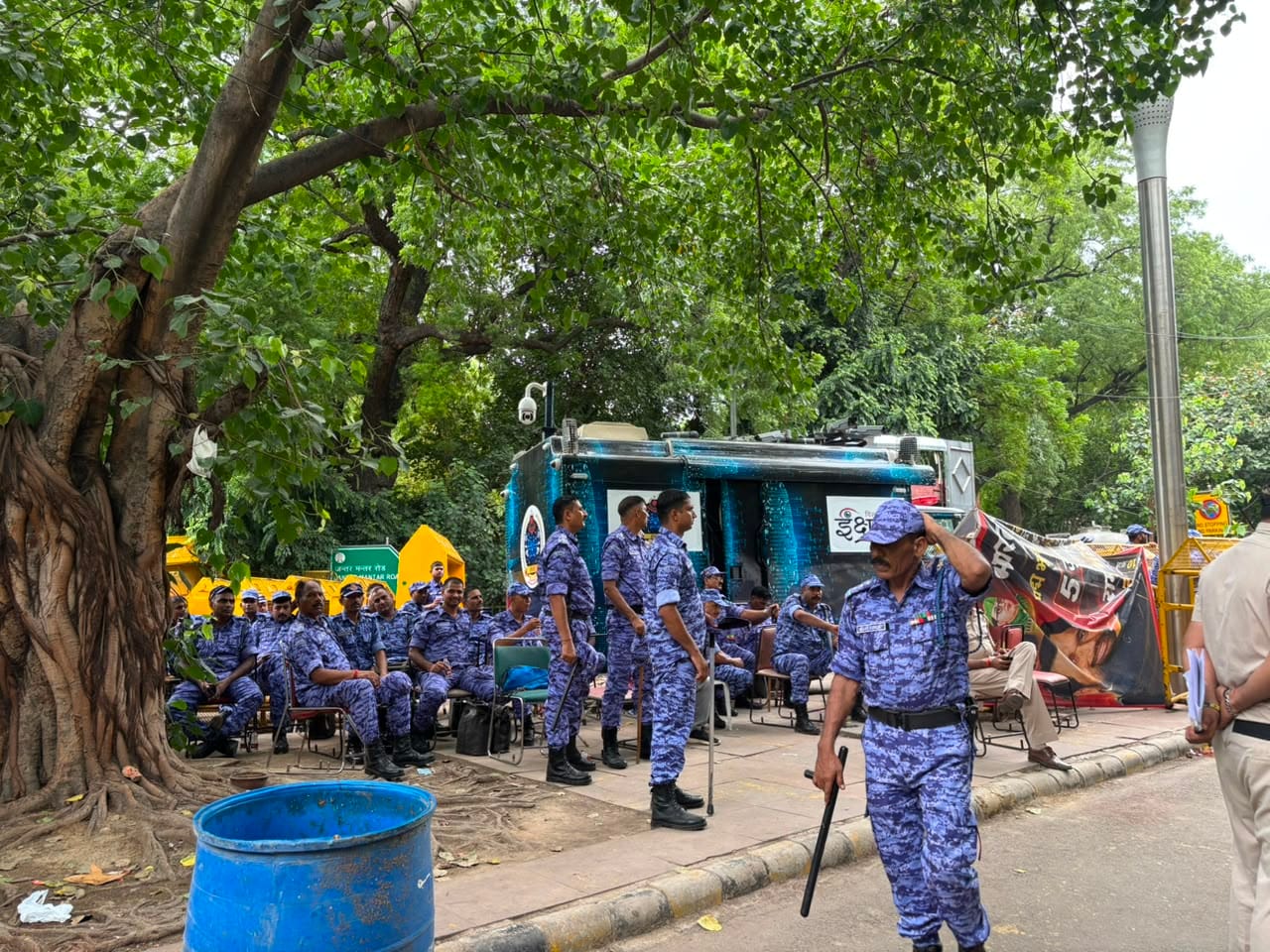
As night falls, the crowds slowly disperse. The slogans become faint, and a sense of calm returns to Jantar Mantar. Even the Rapid Action Force personnel deployed at the site appear relaxed.
Another day of the protest is over. But as supporters leave with promises to return, everyone knows the site will fill up again tomorrow. The protest continues, and so does the hope for a response.
(Edited by Vidhi Bhutra)