







National politics has overtaken what’s happening in Pakistan-occupied Kashmir; proceedings in Parliament and Congress leader Rahul Gandhi’s later press conference are more significant right now
The most important issue now is the political follow-up to the students’, or the children’s, protest. I say children because a lot of those aggrieved by the National Eligibility cum Entrance Test (Undergraduate) leakages are not 18 yet, because most children are just 17 when they pass their Class 12 and appear for the Joint Entrance Examination or the pre-medical test.
Worldwide Web: Their protest, and Rahul Gandhi’s sit-in outside the Prime Minister’s house, his eviction by the police, was on camera for the whole world to see. In fact, the Financial Times had it as a lead picture on their front page the next day. And now the focus is Parliament, because the education minister has been made to resign, the key demand of the protesters. And then the government brought a new law in Parliament.
Basically, it’s not really a new law; it’s the old one with a little more firepower built into it. All punishments have been increased, and the burden of evidence shifted more to the accused—not really a revolutionary change. There was a law in 2024, and this is a fortified version of that law.
Remember, 20 July, the day the trouble took place, was the opening day of the Monsoon Session. That is when the protesters had announced their ‘Sansad Chalo’, or march to Parliament. Parliament did not function as usual; there were the usual obituary references of the first day, and then hungama (chaos).
Next day, again hungama. The Lok Sabha got going in earnest on Tuesday, and that’s when Gaurav Gogoi and Priyanka Gandhi spoke for the Congress.
Opposition resurgent: Rahul Gandhi came in on Wednesday, and that was supposed to be the big statement from the Opposition which is now smelling blood as their body language shows, as does the language in their conversations, press conferences, when they meet people, and the solidarity they seem to now exhibit. On Wednesday, for example, when there were repeated interruptions in Rahul Gandhi’s speech, Samajwadi Party leader Akhilesh Yadav stood up in his defence. Both are also partners in Uttar Pradesh where elections are due early next year.
Rahul Gandhi was not allowed to complete his speech because some of his words were objected to by the Treasury benches, most vehemently by Parliamentary Affairs Minister Kiren Rijiju. The Speaker was intervening all the time, saying you speak on the Bill, not on the home minister who Gandhi was attacking.
The speech could not be completed, and several parts of the proceedings were expunged. In fact, the list of expunctions is coming in right now. That’s how Parliament functions, and that’s a bit of joke now because everything is seen live anyway.
The whole country saw whatever happened live; websites, including ours, carried live reports. The video of Gandhi’s speech is on maybe a few thousand websites across the country.
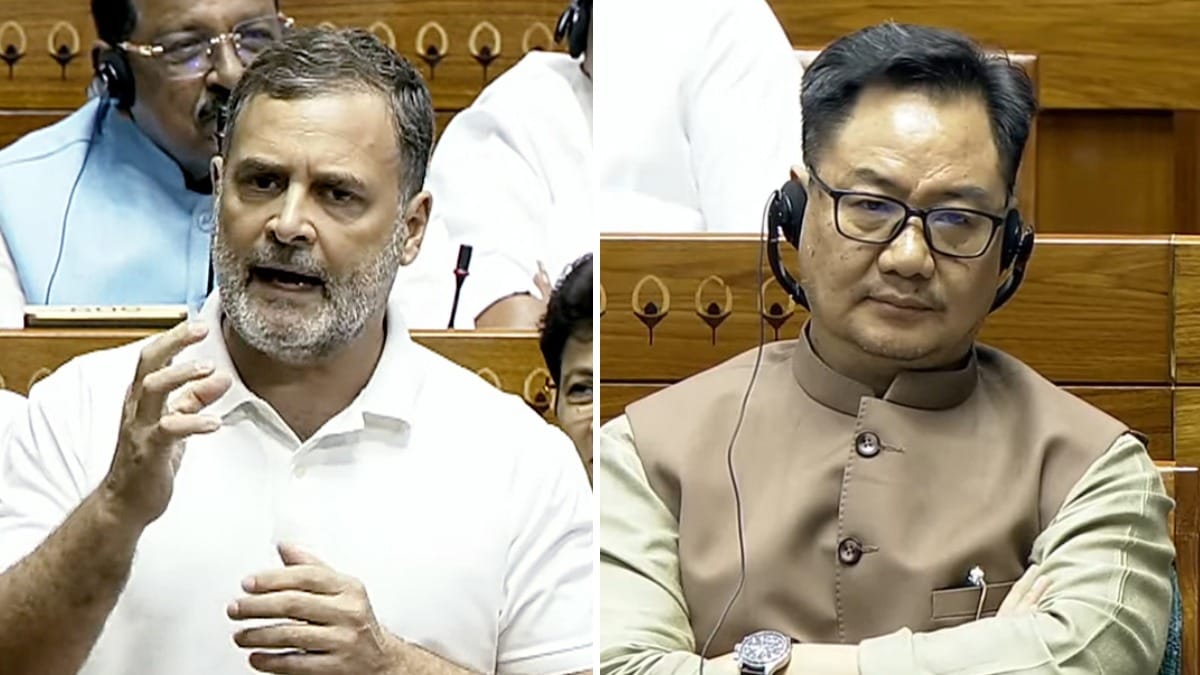
Despite that, the Speaker sends out the list of expunctions by evening, things that he has removed from the record of Parliament. But by that time, the horse has bolted: all those words are out. So I will go by what I’ve seen published and in the speech that is all around.
What sparked this pushback from the ruling party benches? The House was adjourned; Gandhi said the Leader of the Opposition was not allowed to speak, so he came out to hold a press conference and made the same allegations that he was making inside the House. He did not use that particular phrase that lit the fire in Lok Sabha.
The five punches: Let me break down the Opposition attack into five main points.
One, Gandhi said that Home Minister Amit Shah ordered the use of force personally. He said so in Parliament and he said so outside at the press conference because he must have been concerned that that reference will probably be expunged from parliamentary records.
He also said there in Parliament he was asked if he had any evidence, the Speaker asking him if he had seen any court findings or inquiry report? Junior minister in the Prime Minister’s Office Jitendra Singh later stood up and said that ministers don’t order police action or police firing, and that is the magistrate on the ground who gives the orders. That said, Rahul Gandhi made this allegation in the House as well as outside in his press conference.
The attack is on Shah, the leader closest to Prime Minister Narendra Modi and the leader most critical to the Bharatiya Janata Party (BJP) after Modi. He’s also effectively the No. 2 , somebody who runs the party and election machinery, and manages the party in the states.
Two, the allegation that the education ministry is run by the Rashtriya Swayamsevak Sangh, that Dharmendra Pradhan’s resignation (from position of education minister) is superficial, that ministers come and go, but the ministry is run by a barely hidden power, which is the RSS, as Gandhi said.
Further, that the minister has no powers; all decisions are taken by the Officer on Special Duty (OSD) sitting there. That’s what Gandhi said in Parliament. What that implies is that the OSD is from the RSS.
So this OSD is like a party commissar in the Chinese system. These are my words, not Gandhi’s. In China, you have party commissars sitting even in corporate headquarters to oversee all decisions, so Gandhi’s making the same comparison without calling it that. So, it’s the OSD who’s taking all the decisions, something that I would simplify as the party commissar or the ideological commissar; Pradhan doesn’t matter. A new minister will come. The new minister doesn’t matter because the RSS will run the ministry.
Third, Gandhi says this Bill and its amendments are an eyewash. All that has happened is that some punishments have been increased. This is not to solve anything. If somebody wasn’t afraid of five years in jail, is he going to be that much more afraid of 10 years in jail? People who do this stuff only do it because they have a sense of impunity.
Fourth, and this comes from the third where he called the Bill superficial. Gandhi said the basic problem is that there is a system capture by the RSS. The RSS has captured the system and is running it, he said, making the point that everything’s been privatised to the extent that private companies are checking students’ papers.
In the process, poorer students think that rich families can get Rs 30 or 40 lakh to buy the papers or compromise the system, and get selected. So all the hard work that a student from a poor family puts in is wasted. That’s what’s got these young people angry, and that’s where Gandhi goes on to say, and that’s the fifth point.
Issues raised in this session of Parliament will go into the election campaigns next year, into Uttar Pradesh and Punjab, and I suspect in other elections as well as a key issue.
Big issue framed: Education will become a vital issue now because it concerns every family. You either have children, siblings, grandchildren, cousins, nephews, nieces; the families in this country put so much premium on education that this will be an issue that will affect many, and that is the reason Gandhi said that this protest was not just anger.
It saw no anger, no violence, no hatred. This was an expression, and he said a deep expression, of the youth, of the future generation of the country. He said they’ve given up their fear. Their fear is gone, and that’s why they’re speaking out in a way that nobody has so far. And then he mocked Home Minister Amit Shah by saying he has no courage, that’s why he’s not sitting in Parliament.
Once again, the Speaker interceded, but Rahul Gandhi kept on bringing Shah’s name back in; a flurry of expunctions is still coming out.
Word war: I will tell you how Rahul Gandhi set it up. He said, I was talking to a student, a young woman, maybe 18, maybe younger, and that he asked her, who are you? She said, I’m a student, Gandhi recounted. I’m a student, which means I have to learn what I know today. I know that that’s not the final truth as I study more as I go into the world, I will find more truths and I will keep learning more and more and more.
Then he says that she said there is another person who thinks he knows the entire truth and only what he knows is the truth, and everybody should believe in the truth and that after that no new knowledge has come in, no new truth has come in. That person, he said was described with an adjective which you can hear and read across media, but which I suspect will be expunged, and that is what got the Treasury benches angry, as it did the Speaker.
Rahul Gandhi kept on saying, I haven’t called any individual by that word; I’ve just said that this young woman said that there is a person who thinks he’s God and he’s *****. But let’s not go there.
And then he said, the young woman said that there is a third category of people. That third category of people are people who believe that this man is really God, and what he says is the ultimate truth. And that third category, he said, the young woman told him is the andhbhakt, the blind follower. Now andhbhakt is a very loaded expression, and as I speak that has not been expunged.
Once these interruptions began, Gandhi kept rising and sitting, and he also mocked the Treasury benches. He said, you don’t like my speaking, and, what kind of Parliament is this.
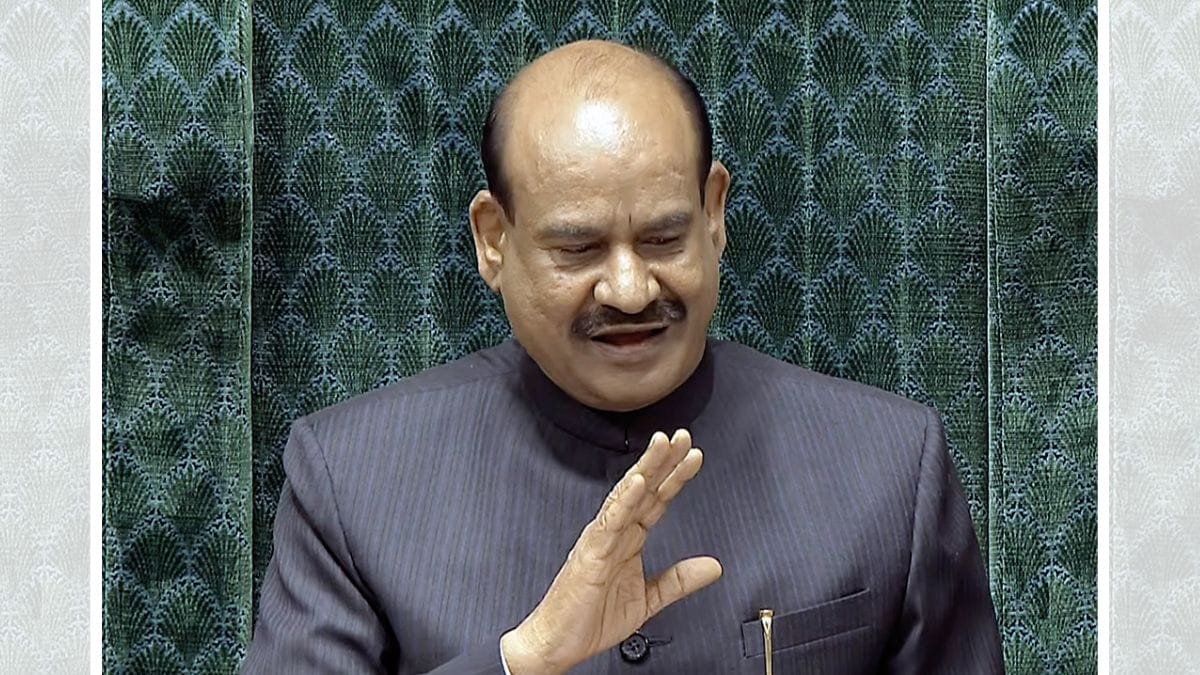
Ultimately Speaker Om Birla would have no more of it. So he said, If you’re continuing to make allegations in this case against Home Minister Amit Shah, then I will not allow it. And that’s how the Lok Sabha was adjourned.
Following that, Rahul Gandhi held his press conference. Let me again simplify without using the adjective what Rahul Gandhi said. He said the young student told him that I’m a student. I have to learn a lot. I know that I know a few things, but this is not the final truth. As I go along in life, I will learn more and more and more and. I will discover more truths, and she said there is a second kind of person who thinks he’s God, and what he knows and what he says is the truth now and forever. And the third category, she said as per Gandhi, is a person who actually believes that the second kind is a god, the final truth, and this is the andhbhakt.
We saw some replies. Defence Minister Rajnath Singh said that the police followed utmost restraint, and Minister of State Jitendra Singh said no bullets were fired, and that orders to use force or fire at protesters are taken by the magistrate on the ground, not the minister.
Target acquisition: In Parliament as well as the press conference, Gandhi said that Dharmendra Pradhan is not your enemy. Speaking to the students, he said he’s not somebody whose departure should make you happy.
Your enemy is the RSS, he said. It’s the RSS that is capturing all institutions in such a way that you are not allowed to be students in India, he said. The RSS is interfering in all your lifestyle choices, all your choices in life, he said. And that is what young people, children are angry about. They are not just angry about paper leaks, which is just the spark. They’re angry about all this controlling mechanism that’s being put in place, and for that Gandhi blames the RSS. So you can see that the attack now is going to be on the RSS.
He says that the parents have also known this, but haven’t had the courage to speak out, and their children now have broken this omerta, again his words, not mine.
Children have broken this omerta, he said, and they have shown the courage that the parents have lacked so far. In Parliament, the ruling party demanded that Rahul Gandhi apologise for the charges he laid against Amit Shah. Gandhi said, I’ve never apologized, and I will not. He repeated that at his press conference.
Now this is setting the agenda for what’s going to happen over the next three days, but I can promise you this will go into the elections. This will go deep into politics, even more than the economy, international affairs, this will become the theme that drives electoral politics, at least in the Uttar Pradesh and Punjab elections, although I suspect that this is going to endure beyond that. That’s also because education actually has been the most political ministry in the country.
Also Read: PM should sack Amit Shah, order SC-monitored probe into protest crackdown, says Rahul Gandhi
Politics of policy: All of us, old students of Indian politics, by default say that the home ministry is the most political ministry. Because it manages politics in the country, wields political control over governance in the country, and because governors report to it. All that is fine, but deeper down, the education ministry is the most politicised from within.
That is something that happened in the Congress era. In many phases that was politicisation towards the Left, towards the left, and towards active promotion of the Congress definition of secularism.
Whenever BJP has come to power, there’s been an effort to take it to the Right, to bring in the Hindutva agenda and to also airbrush what the RSS or the Hindutva ideology sees as the political “correction”, or maybe in their words “distortion” by what they call the ‘pseudo-secular’ Congress and its Left allies.
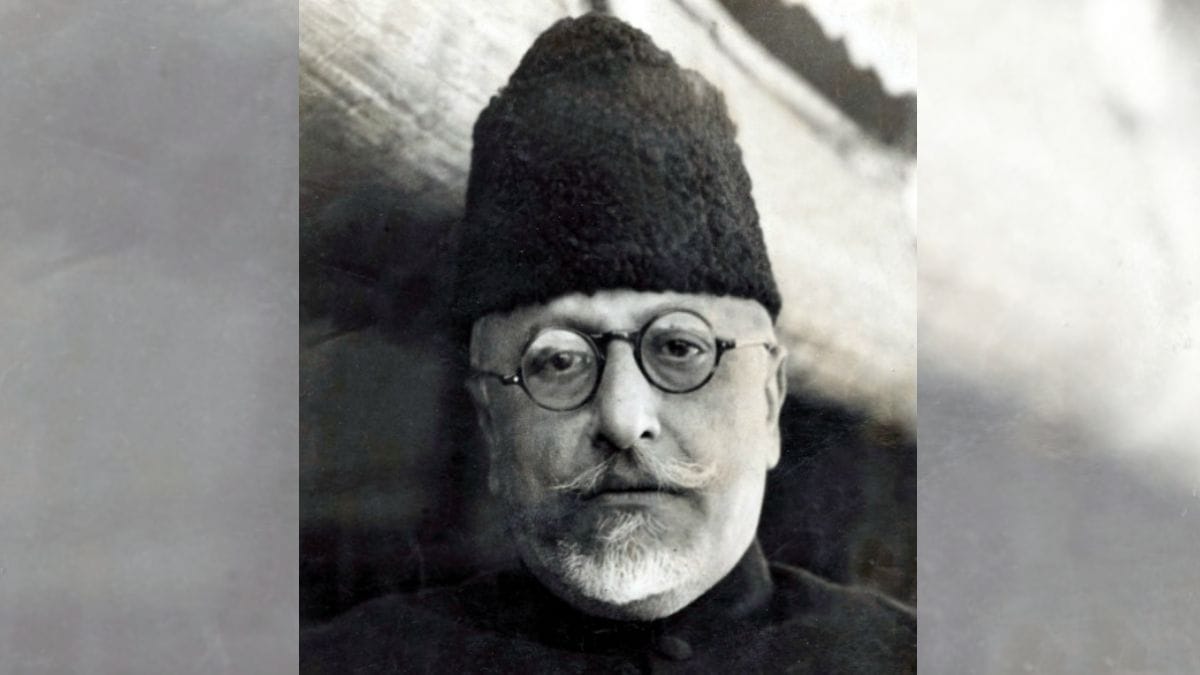
Azad India: Look at on the ministers who’ve had this department. The first education minister, and the longest serving so far, was Maulana Abul Kalam Azad, a home-tutored theologian and Islamic scholar who launched a newspaper, a newspaper of poetry to begin with, at the age of 11. During the Khilafat movement, he launched another significant newspaper called Al Hilal.
Serving for nearly 11 years, until he died on 22 February 1958, Azad’s legacy is seen by the BJP-RSS as an effort to give India’s education a direction, although it was in his time that the first Indian Institute of Technology was set up, that the University Grants Commission was set up, and many other reforms were carried out.
India at Independence was really in a very bad way. Literacy for women in India in 1951, not even in 1947, was just 4.87 per cent, which means 952 of every thousand women were illiterate. At about 19 per cent, it was as bad for men; only one in five men was literate.
By the 2011 census, this improved to 57.93 per cent for women, and 77.15 per cent for men, for a 66.77 per cent overall figure. A census will take place next year, but all projections tell us that India’s literacy rate would have gone way above 80 per cent.
Education in India was thus both a challenge of basic literacy and of higher education. There was also a lot of politics in it. This politics, however, intensified in the late 60s, when Indira Gandhi split her party and was left with a minority in the Lok Sabha. She needed the support of the Communist parties which were aligned with the Soviet Union, and that also influenced her getting closer to them. The Communist Party of India (CPI) then wanted its own pound of flesh, and that’s how in 1972 India got its most Leftist, in fact for all practical purposes, a Communist, education minister, even although he was not formally a member of any Left Party.
That was Saiyid Nurul Hasan, who was education minister from 1972 to 1977, later serving as a governor too. There was some reform in education then, and then later the launch of some interesting initiatives like Jawahar Navodaya Vidyalaya under P.V. Narasimha Rao (1985-89) under Rajiv Gandhi.
What’s in a name? The ideological politics began to seep in. In fact, Rajiv Gandhi had changed has the name of the ministry to human resources development. Arjun Singh became the minister under P.V. Narasimha Rao, serving from 1991 to 1994, but he broke away because he was disapproved of the way Rao had handled the Babri Masjid issue. He had also been trying very hard to bring Sonia Gandhi into politics and sabotage Rao’s government, so he became a rebel, and went out as a consequence.
Singh got a turn again in 2004, when the United Progressive Alliance (UPA) came to power. He got a full term as HRD 2004 to 2009 as HRD minister, but after that Manmohan Singh would not have any more of him because he had also begun to create issues in the HRD ministry with his own peculiar politics and also because he had started bringing in his version of caste-based reservation. For example, he extended Other Backward Caste reservation to all Central institutions for which India was not ready.
He thought that that would destabilise and maybe bring down Manmohan Singh just as V.P. Singh’s Mandal report introduction had brought his government down, Manmohan Singh was clever enough to appoint Veerappa Moily as head of a committee, which then led to a massive expansion of all Central institutions whereby the reservation was carried out.
Nobody can stop reservation when somebody implements it. At the same time nobody was denied their seats. So if an institution had 100 seats, now it had 130 seats, and that was provided for, That’s why the non-reserved classes did not feel the pinch. and this change was carried out.
However, Arjun Singh by this time was seen as too much of a troublemaker by Manmohan Singh, so he did not feature in the second UPA term from 2009 to 2014.
Turnaround time: In between, came a phase of politicisation of the Right, because Atal Bihari Vajpayee was in power from 1998 to 2004. All these six years, Doctor Murli Manohar Joshi, a well-known physics professor from Allahabad University, was the HRD minister and he took HRD, or education and curricula, hard to the Right, although he did not have sufficient time to complete the job. Everybody thought Vajpayee will win one more term and then this job will be completed.
Doctor Joshi, by the way, is a very sprightly 92, and while all this trouble was brewing posted a tweet seen as an admonition of this government and its handling of the protest. He still did quite a bit to underline the fact that most of HRD, or education, continues to be our most politicised and most ideological ministry.
Since, Prime Minister Narendra Modi came in, we have seen many education ministers in 12 years. You may not even remember the names of all. You may remember Smriti Irani, but after that Prakash Javadekar, then Ramesh Pokhriyal Nishank, followed by Dharmendra Pradhan who continued on to the same ministry in 2024.
Now, Pralhad Joshi has additional charge of the ministry. Soon there will be a new minister. Circling back to those five points, two key elements emerge: one, that the attack is on Amit Shah. That the education minister doesn’t matter, it is Amit Shah who ordered the use of force against students, and he is the one controlling everything.
The second factor that emerges is that, ideologically and politically, the attack is on the RSS, and that’s where you can expect all other allies of the Congress, current allies or former allies, sort of joining hands. This is how competitive politics or rival politics is going to be built going ahead from now. To that extent, the die has been cast.
Also Read: CJP impact — BJP’s narrative hegemony dented, the pall of fear lifted