








New Delhi: Starting 26 December, long distance rail journeys in non-AC and AC coaches will cost Rs 10 extra for 500 km, the railway ministry announced Sunday.
This is the second fare hike of the year and has been necessitated by “higher manpower” demand, the Indian Railways said.
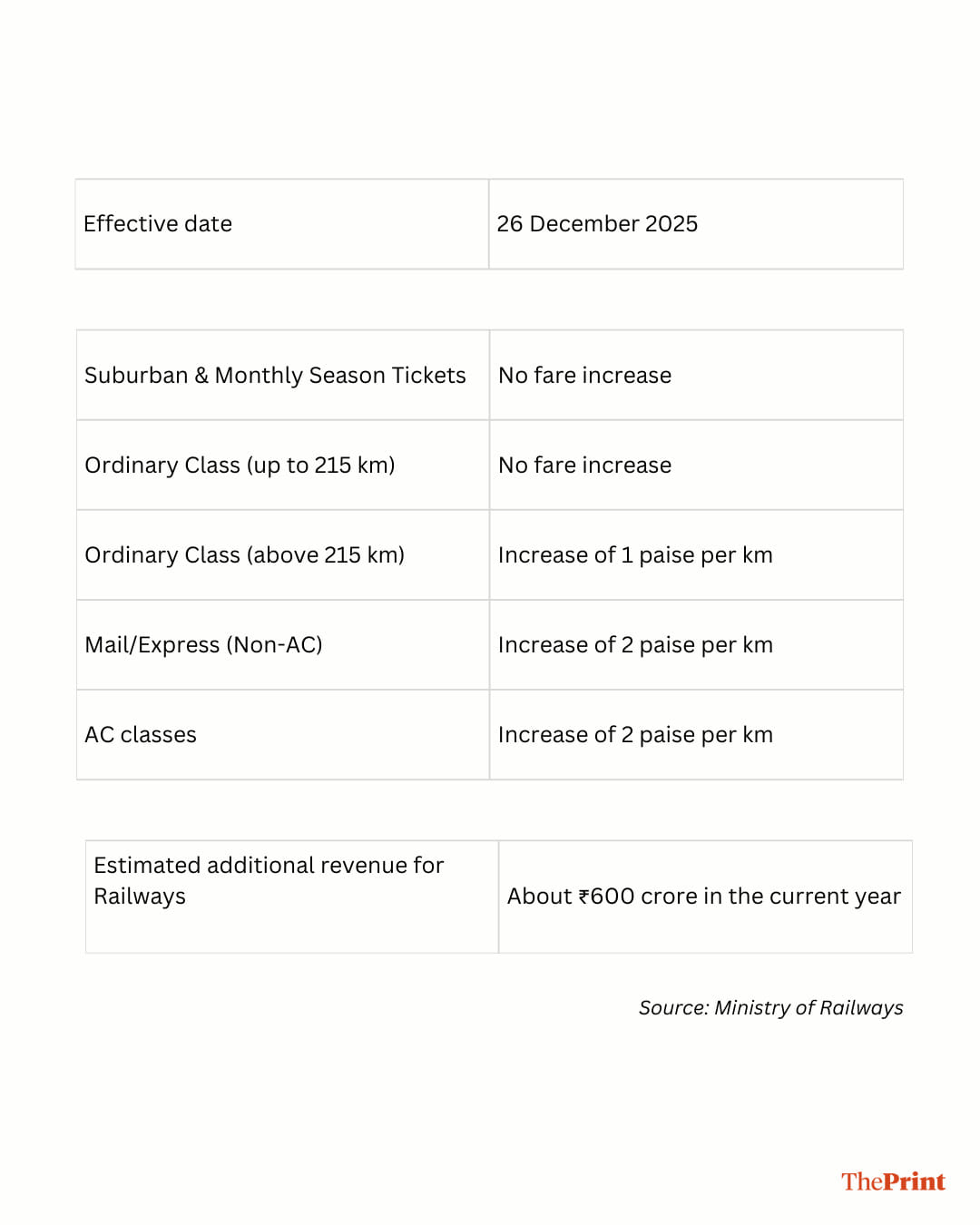
For Ordinary Class, fare for travel beyond 215 km will increase by 1 paise per km. Mail and Express non-AC fares will go up by 2 paise per km, while AC class fares will also rise by 2 paise per km.
According to a Ministry of Railways statement issued Sunday, there will be no increase in fares for suburban services and Monthly Season Tickets. Ordinary Class, or the unreserved General coach fares will also remain unchanged for journeys up to 215 km.
Travelling 500 km in non-AC and AC coaches will amount to additional 10 Rupees in the base fare. The rationalisation is expected to fetch about ₹600 crore in additional revenue for the Railways this year.
In July, the Indian Railways had increased the train fare to “enhance financial sustainability of passenger services”. In case of ordinary non-AC trains, passengers were to pay Rs 5 extra for 501–1,500 km, Rs 10 extra for 1,501–2,500 km, and Rs 15 extra for 2,501–3,000 km. Sleeper and first class fares were also increased by half paisa per kilometre.
In Mail and Express non-AC trains, fares for second class, sleeper and first class were increased marginally by one paisa for each kilometre. For all AC classes, including Chair Car, 3-Tier, 2-Tier and First Class, fares were raised by two paisa per kilometre.
According to Sunday’s statement, the Railways has increased its network and operations, and the fare increase will support the cost of manpower needed to cater to the “higher level of operations”. It further said that the total cost of operations has gone up to Rs 2,63,000 crores.
Indian Railways saw an all-time high since COVID in passenger volume, with more than 7 billion people taking the trains in the financial year 2024-25.
(Edited by Mannat Chugh)
Also Read: Indian Railways achieves 99.2% electrification, beats Japan and China. What it means