





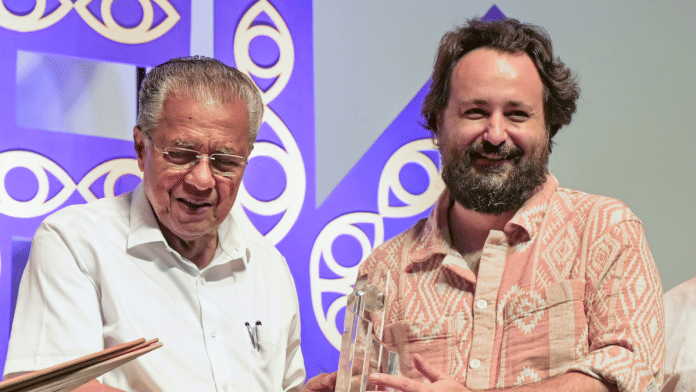



New Delhi: Kerala Chief Minister Pinarayi Vijayan Friday condemned what he called an “attempt to sabotage” the International Film Festival of Kerala (IFFK), accusing the Centre of denying clearance to several films and insisting on political vetting of guests and programmes.
The remarks came as the week-long festival closed amid a standoff between the Kerala State Chalachitra Academy, which organises IFFK, and central authorities over film clearances and visa denials to foreign filmmakers.
Ridiculing the Union Ministry of Information and Broadcasting’s initial refusal to allow the Spanish film Beef to be screened, Vijayan said at the festival’s closing ceremony, “to them, the word ‘beef’ has only one meaning. Actually, beef also means struggle”.
The film was, however, eventually given clearance for screening.
The CM accused the Union government of failing to understand world cinema and attempting to curtail freedom of expression.
The controversy erupted after the Centre refused to grant censor-exemption certificates for 19 foreign titles programmed by the festival. Following intervention and negotiations, 13 films were cleared, but six remained banned. Organisers and state officials said the Ministry of External Affairs (MEA) had raised objections on diplomatic and foreign-policy grounds.
Resul Pookutty, chairperson of the Chalachitra Academy, said they decided “to give in” and withheld six films “in the interest of national considerations”, despite backing from the Kerala government to screen them with or without the certificate.
According to a report by news agency PTI, the academy removed the titles from the schedule following MEA’s objections. Pookutty also said visas were denied to foreign filmmakers on the grounds of India’s foreign policy.
The six unscreened titles include Clash (Eshtebak) by Egyptian director Mohamed Diab, Eagles of the Republic by Tarik Saleh, Flames by Ravishankar Kaushik, All That’s Left of You by Cherien Dabis, Yes, and A Poet: Unconcealed Poetry. The films include Egyptian, Palestinian, Israeli and Indonesian works as well as an Indian entry.
All That’s Left of You is an Arabic film about a Palestinian family amid the Israeli-Palestinian conflict. Clash is an Arabic film about the Egyptian protests. Eagles of the Republic is a political thriller about an Egyptian actor who is forced to make a propaganda film.
Flames is an Indian film about a mute migrant farmworker’s fight for survival when his minor son is accused of murder. Yes is an Israeli film related to the 7 October 2023 attack on Israel by Hamas. And A Poet: Unconcealed Poetry is an Indonesian film on the 1965 anti-communist purges.
Kerala’s Cultural Affairs Minister Saji Cheriyan had described the controversy as a deliberate attempt to undermine the festival. Vijayan had vowed that the IFFK will continue to oppose “anti-democratic, fascist moves” and would not “bow down to encroachments on freedom of expression”.
Festival officials said they will cooperate with authorities but defended the artistic intent of their programming.
Two Seasons, Two Stranger directed by Sho Miyake, won the festival’s top prize –the Suvarna Chakoram (Golden Crow Pheasant). The jury complimented the film for its powerful narrative voice and political complexity.
The IFFK, which began in 1996 and concluded its 30th edition Friday, has received more scrutiny in the previous two or three years.
Also Read: Actor-writer Sreenivasan dies at 69. Malayalam cinema loses its sharpest satirist