








New Delhi: The Sahitya Akademi Monday announced its annual awards for 2025 across 24 Indian languages, ending a three-month institutional stand-off that had left the literary world in a rare limbo since December.
The 24 winners—spanning 8 books of poetry, 4 novels, 6 short story collections, 2 essays, 1 literary criticism, 1 autobiography and 2 memoirs—will be formally honoured at a ceremony in New Delhi on 31 March. Each awardee receives an engraved copper plaque, a shawl, and Rs 1,00,000.
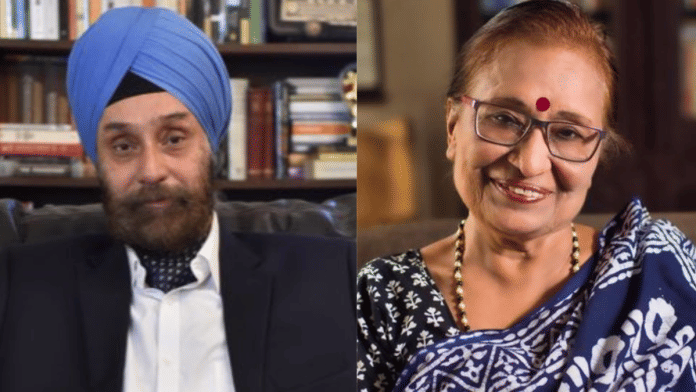
The award for the English language novel goes to former diplomat Navtej Sarna for ‘Crimson Spring’, a novel set around the Jallianwala Bagh massacre of April 1919. Sarna, 68, spent four decades in the Indian Foreign Service—serving as India’s ambassador to the United States, High Commissioner to the United Kingdom, and the foreign ministry’s longest-serving spokesperson under two prime ministers. He retired in 2018 to write full-time.
The English jury that picked Sarna was chaired by Prof. Neelum Saran Gour—herself a Sahitya Akademi English winner in 2023—alongside Somdatta Mandal and Dr Taisha Abraham.
Mamta Kalia, 85, has been selected for ‘Jeete Jee Allahabad’—a literary memoir in Hindi of the city, now officially renamed Prayagraj. Kalia has been writing Hindi fiction about middle-class Indian women since the 1960s and won the Vyas Samman in 2017. The jury that recommended her included Dr Anamika—who in 2020 became the first woman to win the Sahitya Akademi for Hindi poetry in the award’s 65-year history—alongside Prof. A. Aravindakshan and Arun Kamal.
The Telugu award goes to Nandini Sidha Reddy for the poetry collection Animesha—one of the most politically layered profiles on this year’s list. Born in Medak district in 1955, Reddy was a prominent leader of the Telangana statehood movement and was appointed the first chairman of the Telangana Sahitya Akademi when it was formed in 2017. His father was a communist who fought against the Nizam’s Razakars (paramilitary).
His 1997 poem ‘Nageti Salallo Na Telangana’, written in a single hour, became an anthem of the statehood movement and won a Nandi Award after being used in the film ‘Poru Telangana’. In December 2024, he declined a Rs 1 crore cash prize and a residential plot offered by the Telangana state government—a gesture that was widely noted across party lines.
Poll-bound states
With West Bengal, Kerala, Tamil Nadu, and Assam heading to polls in the near future, the awards carry a political significance this year.
The Bengali award goes to Prasun Bandyopadhyay for the poetry collection ‘Shrestha Kabita’. The Bengali jury included Sri Amar Mitra, Prof. Chinmoy Guha, and Prof. Jaydeep Sarangi—a panel drawn from within Bengal’s established literary institutions.
The Malayalam award goes to N. Prabhakaran for the novel ‘Maayaamanushyar’, described as a meditation on human compassion and the forces that obstruct it. Born in 1952 in Kannur, Prabhakaran is considered a pioneer of the post-modern turn in Malayalam fiction with over 55 books to his name. He won the Kerala Sahitya Akademi Fellowship in 2022.
Devabrat Das gets the Assamese award for the novel ‘Karhi Khelar Sadhu’, an unconventional narrative in the tradition of his earlier celebrated work ‘Hiyar Pakhilobor’.
In Tamil Nadu, the award goes to Sa. Tamilselvan for ‘Thamiz Sirukathaiyin Thadangal’, a work of literary criticism. Tamilselvan is the president of the Tamil Nadu Progressive Writers’ Association and a well-known screenwriter; he won the state government’s best screenplay award for the film ‘Poo’.
Other notable winners
Author Jinder has been selected for the Punjabi award for the short story collection ‘Safety Kit’. A retired transportation department employee from Jalandhar, his stories grapple with the unprecedented recent migration of Punjabis abroad. Jinder won the Dhahan Prize for Punjabi literature last year, widely considered the world’s most lucrative Punjabi literary award.
The Kannada award goes to Amaresh Nugadoni for ‘Dada Seerisu Tande’, a short story collection praised for its unflinching treatment of caste, power, and rural violence; his fiction has previously been adapted for Kannada cinema.
Raju Baviskar has got the Marathi award goes for the autobiography ‘Kalyanilya Resha’.
Among the year’s most significant recognitions are those for writers from traditions that receive limited national attention: Haobam Nalini wins the Manipuri award for short stories, Sumitra Soren wins the Santhali award, and Sahaisuli Brahma wins the Bodo award for the novel ‘Dwngnwi Lama Mwnse Gathwn’.
How the awards almost didn’t happen
The announcement comes after an extraordinary three-month stand-off. On 18 December 2025, the Akademi had convened a press conference to announce the winners—juries for all 24 languages had finalised their recommendations and the executive board had approved the full list—when a Ministry of Culture circular arrived directing that no award declaration be made without prior ministerial approval, citing a Memorandum of Understanding signed with four autonomous cultural institutions in July 2025.
The press conference was cancelled. Board members subsequently said a ministry representative’s suggestion to review the names of awardees was rejected by the board. K. P. Ramanunni, writer and board member, called it the first such cancellation in the Akademi’s history. CPI(M) general secretary M. A. Baby described it as “extremely deplorable”.
In January, Tamil Nadu Chief Minister M. K. Stalin responded by announcing the Semmozhi Literary Award—new national-level prizes across seven languages for Rs 5 lakh each, notably excluding Hindi. This was widely seen as a direct challenge to both the Akademi and the Centre’s claim over Indian cultural authority.
The winners announced Monday are the same as those the juries finalised in December. The Akademi has not commented publicly on the terms of its resolution with the ministry.
(Edited by Viny Mishra)
Also read: Sahitya Akademi is promoting Ramayana, Modi policies. But also queer & Dalit writers now