





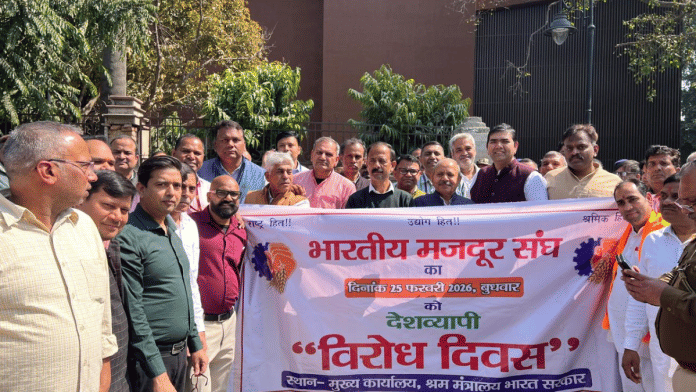



New Delhi: Expressing concerns over “poor implementation” of the newly approved labour codes, RSS-affiliate Bharatiya Mazdoor Sangh (BMS) has submitted a memorandum to the Modi government, demanding their universal implementation across sectors and worker categories.
The Centre made the four labour codes operational last year, after they remained pending for almost six years.
The four codes—Code on Wages, the Code on Industrial Relations, the Code on Occupational Safety, Health and Working Conditions, and the Code on Social Security—consolidate 29 central labour laws that the Parliament passed between 2019 and 2020.
Rules under the multiple labour laws could not be operationalied because the Centre, under pressure from labour unions and pushback from some states, was unable to notify the codes.
In its representation to the Centre, the BMS has also demanded immediate implementation of five-day working week in the banking industry.
The BMS observed February 25 as “Virodh Diwas” across the country under which demonstrations were carried out in several states to mount pressure on both the Central and state governments to resolve the long-pending issues faced by workers across sectors and industries.
As part of the protest, demand for implementation of a five-day week in the banking sector was among the key issues raised.
BMS’ Delhi wing general secretary Deependra Chahar said that during the 21st All India Triennial Conference of the BMS held between 6 and 8 February in Odisha deliberations were held on various pressing issues concerning workers across the country.
Chahar said the demand for a five-day work week in the Indian banking sector is a long-standing one, led by unions such as the National Organisation of Bank Workers (NOBW) and National Organisation of Bank Officers (NOBO).
“The demand for a 5-day work week in the banking industry has been pending for several years. Protests were carried out by banks demanding a five-day week as there have been many instances of employees losing their lives owing to work-related stress. The most stressful jobs are in the hospitals and banking sector,” he added.
He said labour laws have been passed by the government but its implementation is a cause of concern. “We raised this issue with the authorities. In addition to this, we have also asked the Centre to address and resolve workers’ concerns arising out of Industrial Relations Code, 2020 and the Occupational Safety, Health and Working Conditions Code, 2020.”
Also Read: How India’s new labour laws are much better than the UK’s
Pension enhancement
The RSS-affiliate has demanded an enhancement of the minimum pension under Employees’ Pension Scheme, 1995 (EPS-95) from Rs Rs 1,000 to Rs 7,500 per month along with dearness relief.
“Increase in the wage ceiling for mandatory EPF coverage from Rs 15,000 to Rs 30,000 per month. Similarly, the wage ceiling for ESIC coverage should be enhanced from Rs 21,000 to Rs 42,000 per month. Enhancement of the calculation ceiling (Rs 7,000) and eligibility ceiling (Rs 21,000 per month) under the Payment of Bonus Act, 1965,” read the memorandum.
The organisation has also urged the government for regularisation of scheme workers and contract workers “in the true spirit of Articles 14, 15, 16 and 21 of the Constitution of India’.
“Immediate lifting of the ban on General Recruitment and assurance of guaranteed employment without uncertainty or insecurity,” it added.
In a statement issued on Monday, it had said that while the BMS has consistently raised several pressing issues before the government, the response has remained “lukewarm and inadequate”.
(Edited by Ajeet Tiwari)
Also Read: How do workers and employers view India’s new Labour Codes? New study has answers