





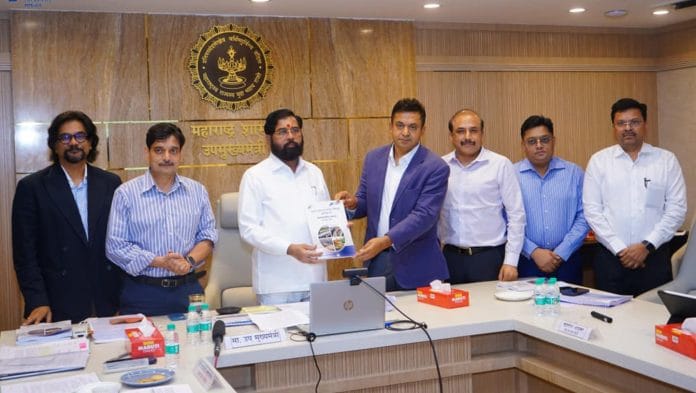



Mumbai: With an outlay of nearly Rs 47,000 crore and a decisive shift towards fiscal consolidation, the Mumbai Metropolitan Region Development Authority (MMRDA) Monday presented its budget for FY 2026–27, marking its first surplus financial statement since FY 2017-18.
Of the total proposed expenditure, 87.42 percent has been earmarked for development projects, extensively focusing on accelerating Metro rail works, underground road tunnels and large-scale regional connectivity projects across the Mumbai Metropolitan Region (MMR).
The budget estimates receipts of Rs 48,072.57 crore against an expenditure of Rs 48,072.40 crore, resulting in a modest surplus of Rs 17 lakh. While marginal in absolute terms, the surplus is being viewed within the authority as a symbolic turnaround, coming after years of persistent deficits. As recently as FY 2024-25, MMRDA had recorded a deficit of Rs 7,468 crore.
“MMRDA’s first surplus budget since 2017–18 marks a defining institutional milestone. This budget reflects global investor confidence and a long-term infrastructure-led growth vision. It positions the Mumbai Metropolitan Region as a modern, investment-ready and globally competitive urban region,” said Maharashtra CM Devendra Fadnavis, during the budget announcement.
Deputy Chief Minister and Chairman of MMRDA Eknath Shinde said, “With 87 percent allocation towards projects, this budget demonstrates focused, accountable governance. Under the Growth Hub concept, MMRDA has set a benchmark for structured regional expansion.”
Development-first allocation
The development thrust of the budget is evident in the allocation of Rs 42,026.14 crore, or 87.42 percent of total spending, to infrastructure projects and schemes.
The overall budget size is 58.57 per cent higher than the revised estimate for FY 2025–26, pointing to an aggressive scale-up of project execution even as fiscal balance has been restored.The scale of spending is most visible in a clutch of big-ticket projects.
Metro rail continues to dominate MMRDA’s capital programme, with Rs 13,838.88 crore allocated for multiple corridors. Funding has been provided for lines 2B, 4, 5, 6, 9, 10, 12, 13 and 14, covering Mumbai, Thane, Mira-Bhayander, Kalyan-Dombivli, Bhiwandi and Badlapur.
The MMRDA has earmarked Rs 3,630.71 crore for Metro Line 4 (Wadala–Kasarvadavali), Rs 2,407.78 crore for Metro Line 6 (Swami Samarth Nagar–Kanjurmarg), and Rs 1,309.30 crore for Metro Line 5 (Thane–Bhiwandi–Kalyan), alongside Rs 1,151.87 crore for the extended Metro Line 9 and 7A corridors linking Dahisar, Mira-Bhayander and the airport.
A substantial portion of the outlay has been directed towards underground road tunnels aimed at decongesting Mumbai’s core and improving east-west connectivity. These include Rs 3,029.51 crore allocated for the Thane–Borivali four-lane underground tunnel, Rs 1,250 crore for the Orange Gate–Marine Drive underground link and Rs 1,189 crore for the Mumbai Integrated Tunnel connecting BWSL, Bandra-Kurla Complex, HSR and Chhatrapati Shivaji Maharaj International Airport (CSMIA) Terminal 2. Together, tunnel projects account for more than Rs 5,500 crore.
Beyond tunnels, MMRDA has committed over Rs 12,800 crore to arterial roads, elevated corridors and creek bridges forming part of a multi-ring road strategy for the region. Projects linking the already constructed Atal Bihari Vajpayee Sewri-Nhava Atal Setu, also known as the Mumbai Trans Harbour Link (MTHL), to the Mumbai-Pune Expressway, the Worli–Sewri elevated corridor, the Thane coastal road and the proposed Uttan–Virar sea link feature prominently.
Also Read: With Dec 2028 deadline, MMRDA begins tunnelling for Orange Gate-Marine Drive link
Mumbai 3.0 and housing plans
The budget for FY 2026-27 is aimed at advancing the “Mumbai 3.0” vision through a focused push on decentralised urban growth.
The MMRDA has allocated Rs 4,600 crore for ‘growth hub’ projects, with the single largest provision of Rs 4,000 crore earmarked for the Karnala-Sai-Chirner (KSC) New Town.
According to the budget document, the ‘Mumbai 3.0’ programme is aimed at decongesting Mumbai by creating planned urban nodes with integrated economic, residential and employment ecosystems. The KSC New Town is positioned as the next major urban frontier in the Mumbai Metropolitan Region, intended to attract investment and generate employment while supporting structured development in adjoining districts.
Smaller allocations include Rs 500 crore for the Raigad Pen Growth Centre and Rs 100 crore for the Kharbav Integrated Business Park, signalling operationalisation of a new phase of regional expansion beyond Mumbai’s saturated core.
The allocations reflect MMRDA’s strategy of using ‘growth hubs’ to redistribute population and economic activity across the region, in line with the broader regional development framework outlined in the budget.
On housing and rehabilitation, the budget provided targeted allocations under slum rehabilitation and resettlement schemes. A provision of Rs 551 crore has been made for the Mata Ramabai Ambedkar Nagar slum rehabilitation project, while Rs 150 crore has been earmarked for rehabilitation and resettlement works.
An additional Rs 30.33 crore has been allocated for affordable rental housing. Together, these provisions, totalling Rs 731.33 crore, form part of MMRDA’s social infrastructure spending aimed at supporting housing redevelopment and resettlement requirements linked to large infrastructure projects across the region.
Also Read: 1 dead, 3 injured as under-construction Mumbai metro parapet falls onto auto-rickshaw
Surplus of Rs 17 lakh
According to the Mumbai Metropolitan Region Development Authority, the fiscal turnaround has been driven primarily by enhanced revenue mobilisation and more structured financial planning. A key pillar of this strategy has been land monetisation, with land sales alone expected to generate over Rs 11,000 crore.
In addition, inflows into the Urban Transport Fund have been strengthened with Rs 6,368.42 crore in estimated receipts. The budget also points to better alignment between borrowing and asset creation. The budget states calibrated borrowing, improved cash-flow management and diversification of revenue sources have together helped restore financial stability and investor confidence. Borrowings of about Rs 23,700 crore have been planned alongside state subordinate loans and government grants.
By combining land monetisation, transport-linked revenues and tighter expenditure oversight, MMRDA’s budget has moved from a phase of financial stress to one of stability, while retaining the capacity to fund large-scale Metro, tunnel and road projects across the Mumbai Metropolitan Region.
Dr Sanjay Mukherjee, IAS, Metropolitan Commissioner of the MMRDA, said, “This surplus Budget is the outcome of fiscal discipline, calibrated capital mobilisation, and sustained infrastructure delivery. We are simultaneously expanding connectivity, decentralising growth through Mumbai 3.0, and strengthening regional sustainability. This budget marks a transition from financial stress to financial stability while maintaining development momentum at scale.”
(Edited by Amrtansh Arora)
Also Read: Davos: Mumbai development body MMRDA signs 10 MoUs worth $96 billion at World Economic Forum summit