





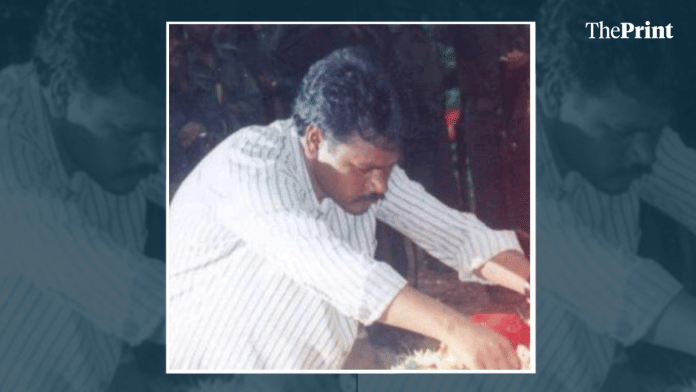



New Delhi: For nearly two decades, Pathiram Manjhi was a name whispered in police circles across Jharkhand’s red corridor—never an ideologue, but always in the spotlight for the violence he could unleash. From looting an armoury in Giridih to orchestrating deadly ambushes on security camps, Manjhi built his reputation as the Maoists’ most lethal military commander in the state.
His journey—from a tribal hamlet to the central committee of the CPI (Maoist)—ended last week in the dense forests of Saranda, when, security forces say, they dealt a crippling blow to insurgency in Jharkhand.
The beginning of his downfall began less than a week after the then CPI (Maoist) party chief and head of the organisation, Nambala Keshava Rao alias Basavaraju, was surrounded and killed in an encounter with security forces in their den, Abujhmarh forest.
On 27 May 2025, a bunch of around 15 armed Maoist cadre overpowered a truck carrying around 200 explosive packets, each containing 20 kg of explosives, in the Rourkela district. The truck was carrying explosives for use at the stone quarry at Banko, inside the Saranda forest. The Maoist team was led by Pathiram Manjhi.
In December 2025, the National Investigation Agency charged him, a central committee leader of the Communist Party of India (Maoist), and another leader Pintu Lohra, along with nine others for the theft of the explosives.
The Saranda forest, spread across Rourkela and the neighbouring West Singhbhum district of Jharkhand, had, for decades, offered Maoist cadres, including several central committee leaders, a safe haven due to its location along interstate borders and dense forest cover.
But on Friday, none of these deterred the team of Central Reserve Police Force and Jharkhand Police which hunted down 15 Maoist cadre, including Manjhi.
Also read: India’s long war with Maoists has a huge void—no number of dead bodies can fill it
‘The most deadly military man in Jharkhand’
From a poor tribal family from Jharha village in Jharkhand’s Giridih, Manjhi had a slow and steady rise to the central committee of the Communist Party of India (Maoist).
The central committee is the top decision-making body of the banned outfit, and Manjhi was promoted to the coveted group around a decade ago, in 2017.
Along the way he carried of over a 100 attacks, including some of the worst attacks on the state’s security and administrative apparatus.
He first entered police records in 2005, when he organised a loot of weapons including 183 rifles and 2,000 live cartridges from the Home Guards’ armoury in his home district of Giridih.
The following year, in March, he attacked a Central Industrial Security Force camp in Bokaro, killing seven men from the central force and state police.
Over the following years, the area of his attacks and ambushes on government facilities kept increasing in number and intensity.
“He was one of the deadliest Naxal commanders, who actually carried out attacks on police and security installations in the state,” a source in the security establishment told ThePrint, adding that he operated for more than a decade in the trijunction between West Singhbhum, Saraikela-Kharsawan and Khunti in the state.
The trijunction was once considered the hotbed for Maoist infestation in the state, with a number of attacks and ambushes on forces reported from the region during the 2010s, when Left wing extremism was arguably at its peak.
Manjhi, according to police records, had at least 149 cases against him and a cumulative bounty of Rs 2.40 crore on his head, announced by the police of Jharkhand, Chhattisgarh, Madhya Pradesh and Maharashtra.
Officials in the security establishment stopped short of referring to him as the Madvi Hidma (a highly wanted Indian Naxalite commander, known for orchestrating numerous deadly attacks on security forces and civilians in Chhattisgarh and killed in 2025) of Jharkhand, adding that he was a similar “nuisance” and “deadly threat” in the state.
‘Crippling blow to Besra & movement in Jharkhand’
Sources in the Jharkhand Police suggested that Manjhi made his move outside the trijunction around September 2022, when the security forces stepped up pressure in the region and cleared it of Maoist infestation to a great extent.
After the trijunction, Manjhi moved to the Saranda forests and stayed with Misir Besra, the lone surviving central committee member from Jharkhand.
“He was a bigger military force and threat than Mesra, who has been mostly away from the active battlefield due to health issues. Manjhi’s active involvement can be established through the loot of explosives in Rourkela last year. This is a crippling blow to prospects of both Besra as well as the overall strength of the Maoist movement in the state,” another official said.
Senior officials in the state police forces also argued that Manjhi was never considered a senior figure or an ideologue among the other central committee members, even among the ones from Jharkhand.
“The organisation of the Maoists were clearly divided along ideological and military lines, and the senior leaders from undivided Andhra Pradesh had promoted leaders among tribals based on their utility in the military crafts, and Manjhi was no different,” another official said.
(Edited by Viny Mishra)