





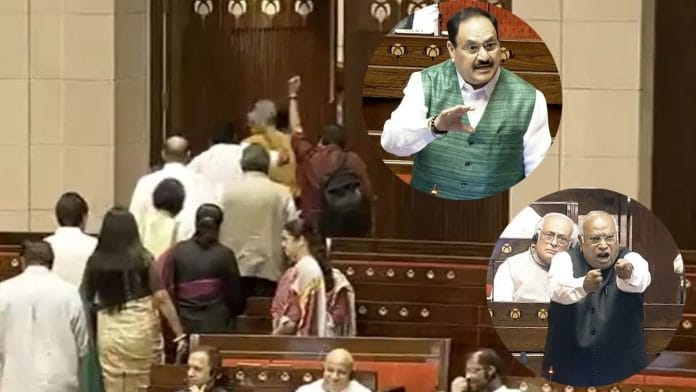



New Delhi: The Rajya Sabha Wednesday passed the Central Armed Police Forces (General Administration) Bill, 2026, while Opposition MPs staged a walkout saying that they wanted the Bill to go to a select committee.
“These people give up their lives for the nation, so we wanted that the Bill should be sent to a select committee, so that there’s a discussion and remove the shortcoming of the Bill,” Leader of Opposition in the Rajya Sabha Mallikarjun Kharge said, after the response by Minister of State for Home Affairs Nityanand Rai.
Kharge raised several objections to the Bill, including institutionalisation of deputation, adverse impact on CAPF personnel’s career progression and morale, lack of consultation and representation, and violation of Supreme Court directions.
In response to Kharge’s objections, Leader of the House J.P. Nadda said that Kharge’s response was against Parliamentary procedure, because he put forth his points after Rai’s response to the debate.
“It is one thing for the speaker to give a speech in a debate and ask for clarification after the minister’s reply, but misusing his position, he (Kharge) started giving his statement after the minister’s reply. This is against parliamentary procedure. I’ve said it before, they don’t have any interest in debate, we have seen this in every debate,” Nadda said.
Among other things, the Bill ensures that a significant number of top positions in CAPFs are held by Indian Police Service (IPS) officers. It reserves at least 50 percent of the posts at the Inspector General (IG) position, and 67 percent of the posts at the Additional Director General (ADG)-level for IPS officers on deputation.
The Opposition has raised several objections to the Bill, alleging that it is unconstitutional and also violates a May 2025 Supreme Court judgment, which had asked the government to “progressively reduce” the deputation up to the level of Senior Administrative Grade (SAG) within a period of two years. The court had also directed the Ministry of Home Affairs (MHA) to carry out a comprehensive cadre review of the personnel and officers of the CAPFs, which was initially due in 2021, within six months.
While the government’s review petition against the judgment was rejected last year, a contempt petition filed by retired CAPF officers is pending. In March this year, the MHA requested the apex court to give it up to 20 months for the cadre review, citing the “nature and complexity” of the process. It had also hinted at a “statutory intervention” on the issue.
While the Bill is in consonance with the status quo where all top posts in the CAPFs are predominantly held by IPS officers on deputation, it does not provide for any such reservation at the level of Deputy Inspector General (DIG)— a departure from the current rules reserving 20 percent posts for IPS officers at the DIG level.
‘Negates SC judgment’
During the debate Monday, Congress MP Vivek Tankha alleged that the Bill was being introduced to “negate the Supreme Court judgement and it will not succeed”, and said that he does not think that the law ministry had vetted the Bill. DMK MP Tiruchi Siva said that the Bill would impact the morale of CAPF personnel, while AAP MP Sanjay Singh urged that such an “injustice” should not be done to CAPF personnel.
During the debate Wednesday, Shiv Sena (UBT) MP Priyanka Chaturvedi expressed her disagreement with the debate taking the nature of a CAPF versus IPS discourse in the Rajya Sabha. She also advocated for sending the Bill to a select committee.
Chaturvedi referred to Section 3(1) of the bill, which allows the central government to make rules for the method, manner and mode of recruitment including promotion and deputation and the conditions of service of CAPF officers, notwithstanding any judgment of any court.
“We are three pillars and the three pillars keep each other accountable. If you can override the verdict of one pillar, how is this in line with the spirit of the Constitution?” she asked.
Congress MP Renuka Chowdhury defended the Opposition walkout on the Bill, saying, “If we do not get answers, then we will not sit and listen to false claims; this is not going to happen. We have walked out and strongly protested. We have raised five points on the issue, but we have not received an answer to even one, so we will not sit and listen to false claims.”
‘Robust and organised’
In response to the discussion, MoS for Home Affairs Nityanand Rai said the Bill wasn’t just a legislative proposal but has been presented with the objective of making the country’s security system more robust and organised.
He told the House that this Bill is “an important effort towards addressing the challenges of cadre management, so that both the work efficiency and morale of these forces can be improved”.
“This Bill has been brought to ensure that operations are conducted under a well-organised framework,” he said, explaining that the Bill had been brought in with the objective of providing a clear umbrella framework or managing matters relating to recruitment, promotion, seniority and other service conditions of the CAPF.
He also negated the contention raised by the Opposition that the Bill was against the spirit of federalism and the Constitution.
“I want to clarify that this Bill in fact makes the federal structure stronger. The CAPF operates in close coordination with the State Police and administration in various States of the country. The presence of officers having experience in various States also leads to coordination and synergy across States, thereby developing a coordinated national approach to internal security management,” he explained.
Rai alleged that Congress governments in the past restricted security forces in the country. “They would take bullets on their chest but they were not allowed to fire bullets…But now, the central government headed by PM Narendra Modi, they have been empowered to take necessary action, give a befitting reply and take the harshest possible action against those who pose a threat to the integrity, security and sovereignty of the country, due to which the morale of our security personnel, soldiers and officers has increased today,” he said.
(Edited by Amrtansh Arora)