





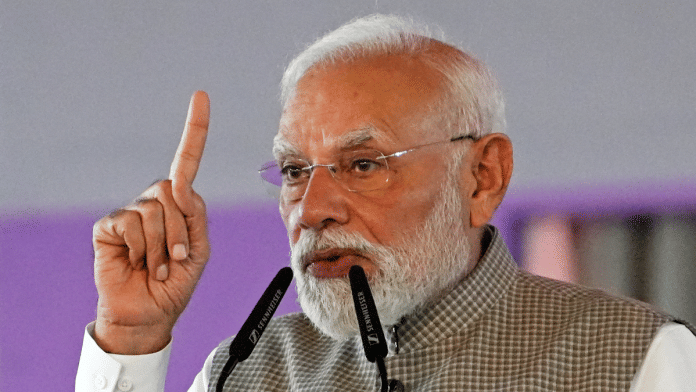



Prime Minister Narendra Modi’s government is set to introduce sweeping economic reforms in the upcoming parliament session as part of a plan to attract foreign investment and boost growth.
The government will seek parliament’s approval for 100% foreign investment in insurance firms, liberalize rules in the atomic-energy sector and overhaul laws to expedite insolvency cases. The legislations are part of the parliament session beginning Monday.
Buoyed by a massive electoral win in a key state poll and an economy that expanded over 8% in the last quarter, Modi aims to transform India into a developed economy by 2047 and cement his legacy as one of the nation’s most consequential reformers. He wants the South Asian nation to become a $10 trillion economy by then.
Gross domestic product beat all estimates to expand 8.2% in the three months through September, data released on Friday showed. The print followed a major victory for the ruling coalition in a key state poll, reinforcing Modi’s popularity after a lackluster performance in last year’s national elections and a fraught relationship with strategic ally, US President Donald Trump, in recent months.
The conditions are ripe “for pushing these kinds of reforms,” said Rahul Verma, fellow at the New Delhi-based think tank Centre for Policy Research. “The government is now, after 2024 elections, in a much more commanding position after successive victories in Delhi and Bihar.”
Earlier this year, the government proposed removing limits on foreign direct investment in the insurance sector, from the current 74%. The legislation related to the atomic energy would open power generation to non-state firms while the insolvency bill will accelerate resolution in bankruptcy cases and strengthen creditor rights.
Amid sloganeering from opposition parties against nationwide verification of electoral rolls, Finance Minister Nirmala Sitharaman on Monday tabled two bills — one related to a new health and national security levy on machines used to produce a tobacco products and the other to amend the current compensation levy under the goods and services tax.
The finance minister also sought parliament’s approval for an additional 1.32 trillion rupees ($14.7 billion) expenditure.
Opposition’s Demand
Opposition parties want parliament to discuss allegations of voter fraud, a nationwide effort to overhaul electoral rolls, tensions with Washington over trade and visas for IT workers and a lapse in intelligence that led to the recent terror attack in the capital, New Delhi.
Bilateral relations with the US have soured after President Trump slapped punitive 50% tariff on Indian imports, partly for buying Russian oil, despite being one of the first countries to start trade talks with Washington. Officials in New Delhi say they remain hopeful of a deal.
“The new US tariffs, higher H-1B visa fees and the issue of Russian oil — these are all undermining our strategic independence,” said Syed Naseer Hussain, member of the opposition Congress party. “So security lapse and intelligence failure are important issues, especially with the BJP trumpeting itself as a nationalist party.”
India is saddled with the highest tariffs among most major economies, which have begun to weigh on sentiment. Modi has enacted tax cuts and labor-law reforms to spur consumer and business spending.
(Reporting by Shruti Srivastava. With assistance from Swati Gupta and Abhijit Roy Chowdhury)
Also read: ‘Delivery, not drama’: PM Modi’s swipe at Oppn sets stage for a turbulent Parliament Winter Session