








New Delhi: Making it clear that elected government representatives cannot be legally forced to deliver on promises in the absence of legal instruments like regulations or government orders, the Delhi High Court Monday overturned a 2021 ruling that asked the then Delhi Chief Minister Arvind Kejriwal to fulfill pledges he made during the COVID-19 outbreak.
A bench of Justices C. Hari Shankar and Justice Om Prakash Shukla of the Delhi HC noted: “A mere statement, even if made by the elected representative in the government, which is not preceded or followed by any executive instruction, rule, regulation or other instrument having the force of law” cannot be enforced through a mandamus (court order to a public official).
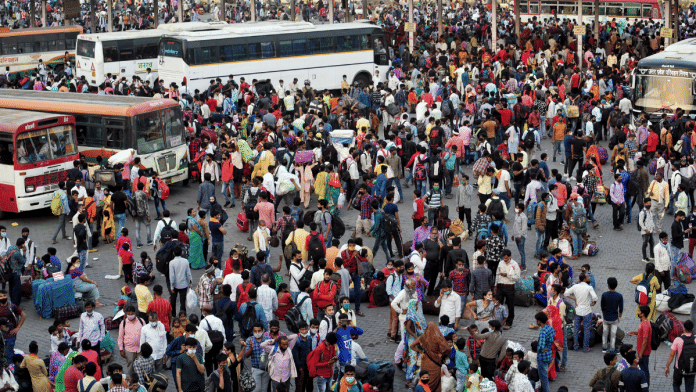
The case dates back to March 2020, when Kejriwal held a press conference during the pandemic and assured daily-wage labourers and migrant workers that the Delhi government would pay their rent if they were unable to do so.
The two-judge bench also noted in its 50-page ruling that the assurance, made by the former CM, “was not made after the requisite degree of study and application of mind to all relevant aspects”.
After Kejriwal’s promise, a group of five migrant workers and daily wagers had approached the court asking for a ‘refund’ of their rent.
Besides there, a landlord had asked the Delhi government to cover the shortfall in the rent from his migrant labourer tenants.
Subsequently, in July 2021, Justice Pratibha Singh had directed the Delhi government to come up with a “clear policy” in this regard, and to decide on its implementation within six weeks. The court had also said the decision should be taken “bearing in mind the larger interest of the persons” for whom the benefits were intended.
“Good governance requires that promises made to citizens, by those who govern, are not broken, without valid and justifiable reasons,” the court had ruled in its 89-page decision in 2021.
Kejriwal’s promise & the 2021 ruling
In his press conference in March, 2020, during the COVID-19 pandemic, Kejriwal had said: “Today, I am appealing to the landlords of entire Delhi, if you consider me your son or brother, then all landlords must talk to their tenants and ask them to rest assured that you (the landlords) are with them and won’t force them to pay rent. Today, all of you must go and give assurance to them,” he had said.
Pointing to reports that some landlords were forcing their tenants to pay, due to which they were evacuating and leaving Delhi, Kejriwal had said, “Please don’t force them. Kindly postpone their rent.”
He even said: “In a month or two when this entire mess is over, if a tenant has been unable to pay rent due to poverty, I assure you the government will pay for it.”
After the petitioners approached the Delhi HC on 22 July 2021, the single judge had relied on the principles of promissory estoppel and legitimate expectation. Promissory estoppel allows a promisee to recover damages when they reasonably relied on another person’s promise, even without a formal written contract. On the other hand, the legitimate expectation doctrine was created to keep the abuse of power by public authorities in check.
“As per this doctrine, the public authorities are responsible to act according to the legitimate expectations borne out of their express promise or consistent past actions,” the Indian Law Institute has stated.
Taking this into account, the judge had pointed out that labourers were facing extreme distress during the pandemic. This, coupled with a verbal assurance made by the CM during the crisis, had led the court to direct the Delhi government to come up with a policy to implement the promise.
In times of distress, elected representatives, especially those holding posts of heads of government, are expected to make responsible assurances and promises, which can be believed by the citizenry, the court had noted in 2021.
Monday’s ruling
But on Monday, the Delhi HC said a statement made by the state that rent would be paid during COVID “is not a legally enforceable assurance, even applying the principles of promissory estoppel and legitimate expectation”.
Pointing out that Kejriwal’s assurance was restricted to a statement made by him during a 2020 press conference, the court said that it “was never reduced to writing in the form of any official document or communication made known to the public”.
The Delhi HC also said that even if citizens believed assurances made by the CM, they were not legally enforceable.
In May, 2020, when the lockdown was announced, the Delhi Disaster Management Authority (DDMA), had directed landlords not to insist on payment of rent by migrants for a period of one month. However, the two-judge bench has now pointed out that even this DDMA order “did not contain any assurance that the rent payable by the migrants to the landlords would be paid by the state”.
The then Delhi government should have translated the assurance given by the Chief Minister into a written document, so that it would acquire legal form and sanctity, the court noted while pointing out that this “never happened”.
(Edited by Viny Mishra)
Also read: LPG crises bringing chulhas back, migrant workers suffering most. ‘Will leave city soon’