





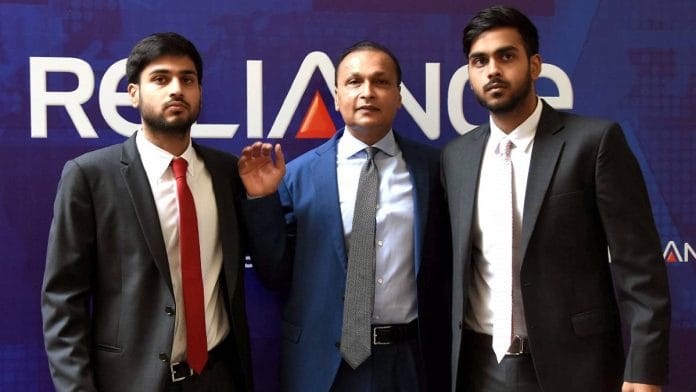



New Delhi: Criminal conspiracy with mala fide intention to cheat the bank, misutilisation of hundreds of crores of loan funds and their subsequent diversion through sister concerns, criminal breach of trust—these sum up the allegations of Union Bank of India against Jai Anmol, son of businessman Anil Ambani.
The Central Bureau of Investigation (CBI) has registered a case against Jai Anmol in connection with an alleged Rs 228 crore bank fraud involving Reliance Home Finance following a complaint from Union Bank of India. Jai Anmol was the promoter-director of the housing finance firm that has been admitted into the corporate insolvency resolution process.
Union Bank of India wrote to the Banking Security & Fraud Branch of the CBI last month, providing detailed findings on alleged diversion of loan funds by Reliance Home Finance. The complaint is part of the FIR filed by CBI.
The CBI Tuesday conducted raids at the residences of Jai Anmol and Ravindra Sharad Sudhalkar, former CEO and whole-time director of the firm. The searches were carried out days after the agency booked them as well as unidentified public servants under Sections 420 (cheating) and 120-B (criminal conspiracy) of the erstwhile Indian Penal Code, and relevant provisions of the Prevention of Corruption Act.
The agency has also booked Reliance Commercial Finance, its two directors, Devang Pravin Mody and Ravindra Somayajula Rao, and unknown public servants for allegedly causing Bank of Maharashtra loss of Rs 57.47 crore. Reliance Commercial Finance has already undergone an insolvency resolution process.
Both firms were earlier part of the Reliance Group, helmed by Anil Ambani.
Union Bank of India reported the Reliance Home Finance account to the Reserve Bank of India as fraudulent in October last year, while Bank of Maharashtra classified the Reliance Commercial Finance account as fraudulent this October.
ThePrint has reached out to the Reliance Group spokesperson for a response on the charges. This report will be updated if and when a response is received.
Also Read: Remembering Dhirubhai Ambani, the polyester prince who made himself king of India Inc.
‘Clear that they entered into criminal conspiracy’
Incorporated in June 2008 as a housing finance company, Reliance Home Finance subsequently approached the Mumbai branch of Andhra Bank seeking financial facilities based on its financials and projections. Andhra Bank was merged into the Union Bank of India in April 2020.
Based on the firm’s presentation and projections, Andhra Bank sanctioned credit limits totalling Rs 450 crore in three tranches: Rs 200 crore in January 2015, followed by Rs 150 crore and Rs 100 crore in May 2015, as mentioned in the bank’s complaint to the CBI.
In its complaint, Union Bank of India has stated that the credit facilities were extended on strict terms and conditions, such as maintaining financial discipline, including timely repayment, service of interest and other charges, submission of the position of security and other required papers in time and routing of sale proceeds through the bank account.
The bank also subscribed to the company’s non-convertible debentures (NCDs) for Rs 100 crore, based on representations made to its management. NCDs are debt instruments through which firms raise money without diluting their stake, as investments in these instruments are not convertible into equity.
However, Reliance Home Finance’s account was classified as a non-performing asset by the bank in September 2019. This was followed by the appointment of Grant Thornton (GT), chartered accountants, to conduct a forensic audit for the period 1 April, 2016, to 30 June, 2019.
Submitted in May 2020, the forensic report revealed the scale of diversion of loan funds to sister concerns and for purposes not listed at the time of sanctioning of loan tranches, according to the complaint.
The forensic audit of Reliance Home Finance’s accounts also revealed that approximately 48 percent of its loan book during the review period consisted of corporate loans, which is opposed to the core objective of a housing finance firm. The firm sanctioned Rs 12,573 crore in corporate loans, of which 86 percent was disbursed to sister concerns, without due consideration for their loan repayment capacity and other lending parameters, it states.
The audit report further revealed that around Rs 3,573 crore was used for debt servicing of group companies for term loans, NCDs and commercial papers. The firm allegedly diverted Rs 1,334.64 crore to bank payments, while Rs 2,238.42 crore was utilised for payments to third parties and non-banking financial companies.
Around 18 percent of the funds mapped by auditors (Rs 1,610 crore) were allegedly circular transactions routed back to the company. Around 9 percent of the funds, aggregating to Rs 819.10 crore, were utilised for investments in fixed deposits, auto sweep, and mutual funds, states the complaint.
The auditors were unable to trace the full end-to-end utilisation of around 22 percent of the funds, amounting to Rs 1,934.88 crore, due to limited information.
“That the erstwhile promoters/directors of borrower company 1) Mr Jai Anmol Anil Ambani and 2) Mr Ravindra Sharad Sudhalkar were in-charge of and responsible for the day-today affairs and business decisions of the company at the relevant period of time, it is clear that they have, entered into a criminal conspiracy with their associates and with the maIa fide intention to cheat the lenders including the complainant bank herein, misutilised the loan fund and committed diversion of funds/routed it through its sister/associate concerns, misappropriation of fund, criminal branch of trust,” Union Bank of India alleges in its complaint to the CBI.
(Edited by Nida Fatima Siddiqui)
Also Read: ‘Covid the new dogmatic religious cult…’: Anil Ambani’s son Jai Anmol calls out ‘scamdemic’