








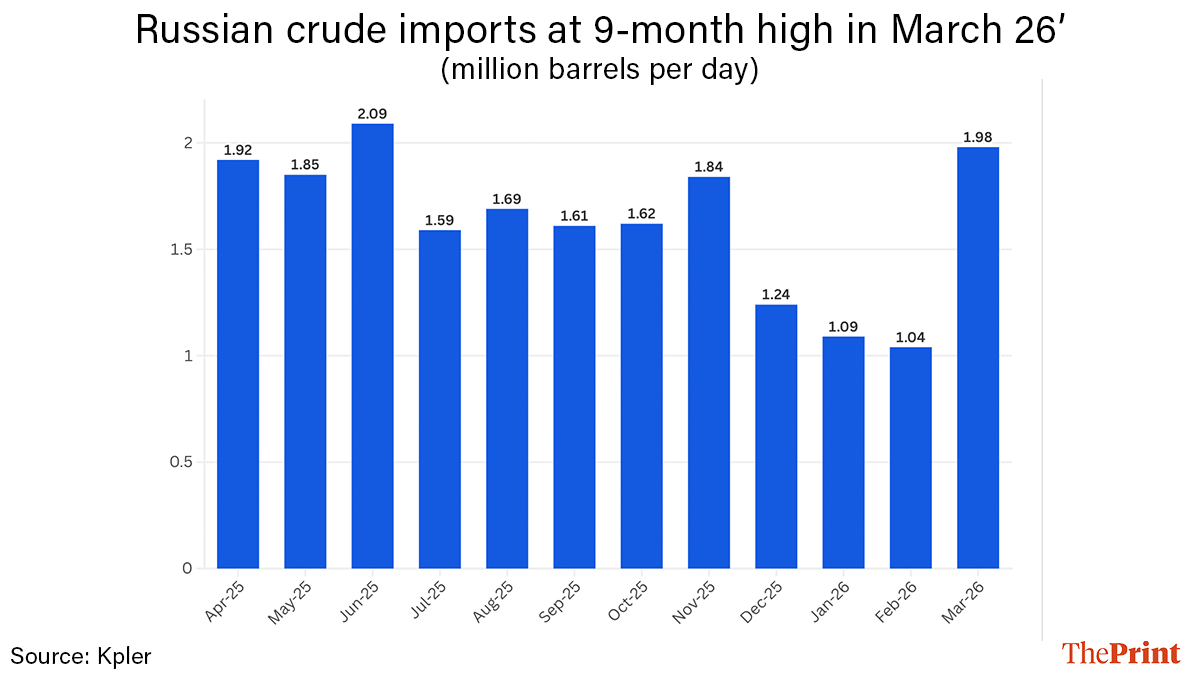
New Delhi: India imported nearly two million barrels per day (mbpd) of Russian crude in March 2026—the highest since June 2025—as the war in West Asia disrupted traditional supply routes of crude, and a US waiver allowed India to purchase additional barrels of Russian oil at sea. However, the steep discounts that once made Russian crude attractive to India have nearly vanished.
Russian crude imports started dipping from December 2025, following US sanctions.
“Earlier, India was buying Russian crude at a meaningful discount, typically in the range of $3–5 per barrel below Brent, and at times even wider. However, in the current situation, that discount has largely disappeared,” Sumit Ritolia, the manager for modelling refinery and oil markets at Kpler, a trade data intelligence firm, told ThePrint.
He added, “In fact, for recent cargoes, India is paying close to market prices. And in some cases, even a premium of around $5–$15 per barrel over Brent on a delivered basis, due to tight supply and strong competition for Russian barrels.”
In effect, Russian crude is no longer about price advantage. Instead, availability and supply security are now the key drivers, Ritolia said.
The shift comes as India remains “structurally exposed” to disruptions in the Strait of Hormuz, a key route that has historically accounted for nearly half of its crude imports.
The ongoing conflict has hit both crude and liquefied petroleum gas (LPG) flows, forcing refiners to quickly rework their sourcing strategies.
According to Kpler data, Indian refiners ramped up imports from Russia, particularly after the US eased restrictions on incremental purchases in early March.
Before the escalation involving the US, Israel, and Iran, approximately 2.6–2.7 mbpd of India’s crude arrived from West Asia, largely via the Strait of Hormuz. This was in addition to nearly 1 mbpd crude from Russia.
Russian imports surged in March 2026, offsetting a significant portion of the disrupted supplies. It reached 2 mbpd approximately.
“Post-conflict, flows via Hormuz have sharply declined. But Russian imports have increased to ~1.9–2.0 Mbd, effectively offsetting a large portion of the disruption,” Ritolia said.
With physical tightness emerging in global crude markets, refiners have relied heavily on Russian barrels. From an energy security standpoint, the shift appears pragmatic—companies prioritise stable and readily available supplies.
Looking ahead, strong buying in March is expected to maintain steady arrivals of Russian crude right into April 2026.
However, risks remain. The situation around the Bab al Mandeb Strait is fluid, and most Russian cargoes, along with rerouted Saudi West Coast shipments, pass through this route. Any disruption could increase transit time and freight costs.
Also Read: We must find oil in our country and become self-sufficient: Nehru
Sharp drop in Gulf supplies
The disruption in the Hormuz Strait has sharply reduced India’s intake of Gulf crude.
This March, supplies—usually half of India’s imports—dropped from 2.6–2.7 mbpd to 1.2–1.3 mbpd.
In February2026, five major Gulf crude producers, Saudi Arabia, Iraq, the United Arab Emirates, Qatar, and Kuwait, supplied 2.9 mbpd, or 56 percent of India’s total crude imports. This month, due to the Hormuz closure, supplies were at 1.26 mbpd—down by 56 percent.
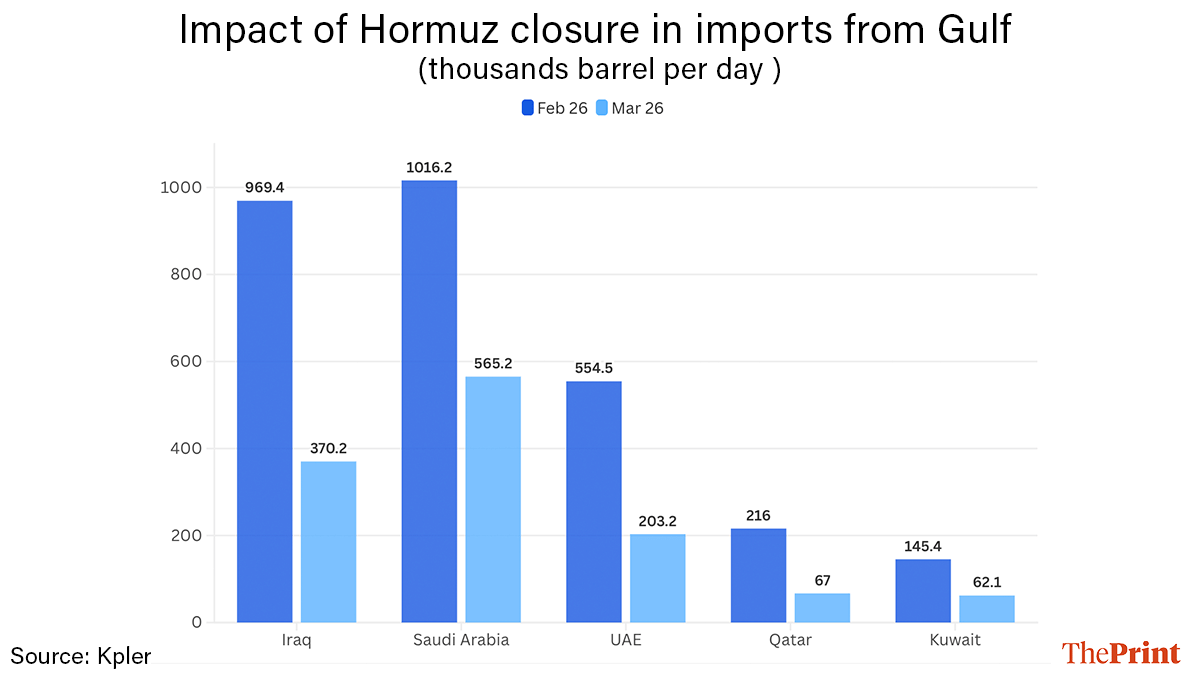
Among major suppliers, the decline was least severe for Saudi Arabia, which supplied 572 thousand barrels per day. It was able to reroute some volumes using its East-West pipeline.
“Middle Eastern producers are partially rerouting supplies via pipelines that bypass Hormuz, notably Saudi Arabia’s East-West (Yanbu) pipeline and the UAE’s Habshan–Fujairah pipeline,” Ritolia said.
He added: “These flows have provided incremental support, allowing India to continue sourcing some volumes from the region despite maritime constraints.”
Despite these adjustments, India’s overall crude imports were still 8,00,000 barrels per day lower than the pre-war levels, as seen in January and February 2026.
Refinery operations, however, have remained stable.
“Refiners have drawn down commercial inventories (excluding strategic petroleum reserves) to sustain throughput, while product exports continue to track near historical levels,” Ritolia said.
Beyond Russia and the Gulf
Even as Russia offsets a large share of the disruption, India is also tapping newer sources.
Kpler data shows that for the first time in months, India imported crude from Ecuador, Brunei, and Gabon this March, while also increasing purchases from Angola and the Republic of Congo.
Iranian and Venezuelan crude would likely enter the mix in April.
“There is potential for opportunistic purchases of Iranian barrels—particularly cargoes already on water—although no significant flows to India have been observed yet,” Ritolia said.
While no Iranian crude has officially arrived, a vessel, Ping Shun, carrying 600,000 barrels, is signalling arrival at Vadinar port on 4 April, according to Kpler data. It remains unclear which refinery has purchased the cargo. Vadinar port handles crude for Indian Oil Corporation, Bharat Petroleum, and Nayara Energy.
Venezuelan supplies are expected to begin arriving in April, which could help ease supply pressures. ThePrint earlier reported that 7–8 million barrels of Venezuelan crude might reach India this month.
(Edited by Madhurita Goswami)
Also Read: Why shielding consumers from rising fuel prices can backfire