





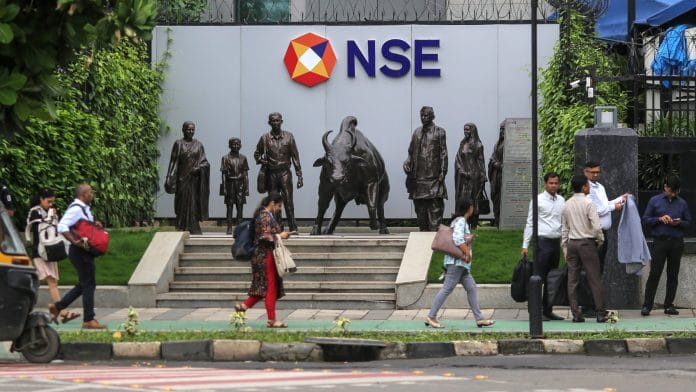


Student protests in India’s capital, a political headache for Prime Minister Narendra Modi, aren’t reflecting in the country’s financial markets.
The India VIX, a measure of implied volatility for stocks, is below the level on June 6 when the demonstrations started and is trading in a narrow range. While the rupee has weakened 0.3% this week toward a record low, the currency hasn’t shown sharp swings and seems driven by the oil-price outlook. The 10-year bond yield is capped below 7% amid foreign inflows.
“Markets are neither nationalist nor loyal to any government or ideology. They are loyal only to profits and the ability to generate returns,” said Phanisekhar Ponangi, co-founder of Mumbai-based investment firm Mavenark Advisors. “The current student protests do not qualify as an event that creates either significant greed or fear among investors.”
Markets will instead monitor whether the government is politically weakened and how key legislation progresses, said traders and economists. Any signs of a severe state crackdown or that the protests are spreading across the country could also indicate stress.
With the first major state election only due next year, signals about the path ahead may emerge from the ongoing parliament session where the government and opposition are locked in an impasse. While Modi’s administration said it is willing to debate allegations of exam-paper leaks and potential education reforms, the opposition is insisting that Education Minister Dharmendra Pradhan must first resign.
Thousands of young Indians have been sitting in protest in New Delhi, seeking government accountability and Pradhan’s resignation after the national medical exam paper leaked, forcing a retest and allegedly leading to student deaths by suicide.
Tempers flared when Sonam Wangchuk, an activist who was on a hunger strike in support of the students, was hauled to hospital against his will last week, and police used batons and tear gas against demonstrators marching toward Parliament on July 20.
“There is clearly a risk that if confrontations intensify, policing becomes more forceful, or the movement broadens into a general protest against unemployment, corruption and unequal opportunity” it could begin to resemble recent protest movements in neighboring countries, said Alexandra Hermann Prasad, an economist at Oxford Economics in London.
In the age of artificial intelligence, India “must produce a variety of soft and hard skills that employers actually need,” she said.
While India’s economy is among the world’s fastest-growing, its per capita income remains just about $3,000, one of the lowest among peers, highlighting weak job creation and low productivity.
The Indian markets were already among Asia’s worst performers this year as a spike in crude prices after the US-Iran war increased inflationary pressures. Foreign funds are also on course for their biggest annual selloff, having withdrawn almost $27 billion in 2026, though selling has abated in recent weeks. Global investors have remained net buyers of India’s sovereign debt worth more than $2 billion.
The Reserve Bank of India said in a report Wednesday that the economy remains resilient, with the immediate risks stemming from renewed uncertainty in the Middle East and a deficient monsoon that has delayed crop sowing.
Modi also made a fresh bid to calm mounting anger. He posted a video on his X account in the late hours of Thursday, saying the paper leak was “not a trivial matter,” the culprits had been caught and his government is pushing for “fast-track courts and stringent punishments.”
The protestors’ spokesman said the group’s “demands remain the same” and the demonstrations would continue until they are met.
Investors are monitoring the scale and intensity of the protests, said Priyanka Kishore, a Singapore-based economist at Asia Decoded Pte Ltd.
The demonstrations are “too early and localized for now,” she said. “That said, it’s beginning to catch attention. This is the first protest of this scale against the Modi administration and follows Gen Z protests across the region that have had political ramifications.”
Disclaimer: This report is auto generated from the Bloomberg news service. ThePrint holds no responsibility for its content.
Trying to link everything to protests is a lazy exercise. Especially the markets. I had to read it twice to understand the relation until I read the footnote. Bloomberg. Yawn. No wonder they grt wet dreams just looking at protests. They can never understand Indian democracy. Never.