





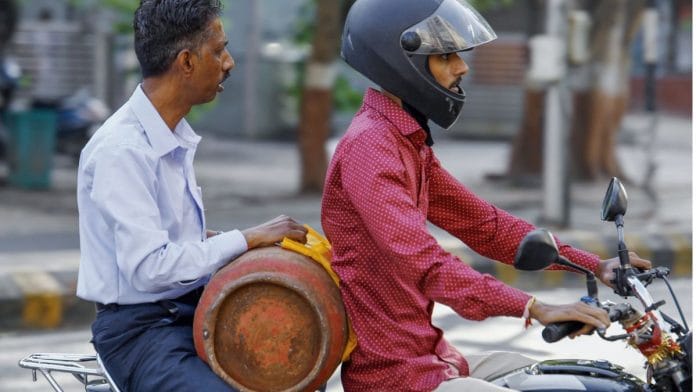


New Delhi: India’s government is leaning on its refineries to survive an acute shortage of cooking gas as the war in Iran drags on, while also scouring the world for additional suppliers and nudging consumers toward alternatives.
Still, with cargoes of liquefied petroleum gas trapped in the Persian Gulf, the country has yet to find enough supply to meet pre-crisis demand — exposing a major energy vulnerability, forcing prices up and pushing out some consumers entirely.
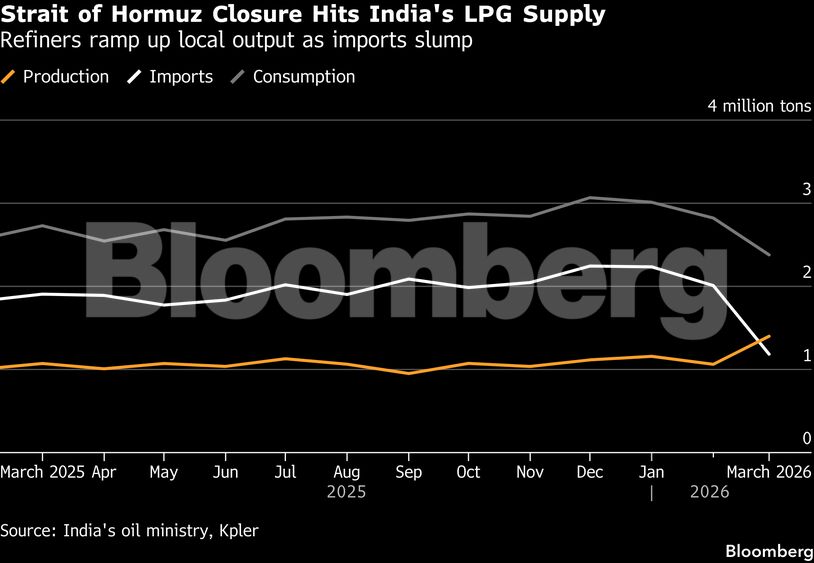
India has raised local output by over a fifth since strikes on Iran began in February, to about 46,000 tons a day. That will rise to 50,000 tons after Nayara Energy Ltd.’s refinery restarts in May after a period of maintenance, according to the oil ministry.
Refiners have also secured about 650,000 tons of additional supply for May, roughly 21,000 tons a day, including record volumes from the US, according to people familiar with the matter. They asked not to be named as the issue is not public.
“India has been facing challenges in LPG but the government has taken several steps,” Sujata Sharma, joint secretary in the oil ministry, said Thursday. “Enough cargoes have been tied up.”
That total, however, is still well below the 100,000 tons that India — the world’s second-largest consumer of LPG — consumed daily before the crisis.
A historic energy crisis has rippled across Asia over the past two months, with countries struggling to manage shortages of crude, LPG and liquefied natural gas, as well as spiking prices.
India has ordered state refiners to maximize production of low-margin LPG at any cost, and has cut supplies to the commercial sector to 70% of normal levels in order to protect households. LPG cylinder refill times have lengthened. The government has pushed more consumers to switch to piped gas — which comes from domestic sources — while also relaxing pollution rules to allow coal and kerosene.
But change is slow, after years of government campaigns to get consumers to use LPG cylinders as a cleaner alternative to biomass. There are now 334 million LPG users, while piped gas connections are being added at a rate of 10,000 a day. That’s an increase of just 3% since the conflict began, to a little over 17 million.
“India is likely to face tight LPG supply through May,” said Sumit Ritolia, lead analyst at Kpler. Imports may shift to the Atlantic Basin and other non-Middle East sources, helping supply chains to normalize — albeit at a higher price from here, with normalization likely from June as supply chains stabilize.
State refiners Indian Oil Corp. and Bharat Petroleum Corp. have recently purchased spot cargoes for May-June loading from the US, people familiar with the matter said. Some vessels are being redirected from Hormuz routes to US loadings. The US is set to export a record 471,000 tons of LPG to India this month, Kpler data show.
The impact of the crunch is visible across the economy. Restaurant menus have been cut back and hotplate sales have jumped. Workers on the outskirts of New Delhi staged violent protests earlier this month over the rising cost of living, and some migrant workers have left for their villages, unable to afford the cost of cooking in the city.
Panic buying and price gouging have worsened the crunch, and the government said this week that authorities have conducted nearly 150,000 raids, arrested 255 people and penalized nearly 300 distributors.
India has managed to move eight LPG vessels through Hormuz after bilateral negotiations with Tehran. It is now seeking the safe exit of the DV Sarv Shakti, SYMI and Gaschem Erica, the people said.
Yet with a US blockade and two Iranian shooting incidents in a week, transits through the waterway remain at a standstill.