





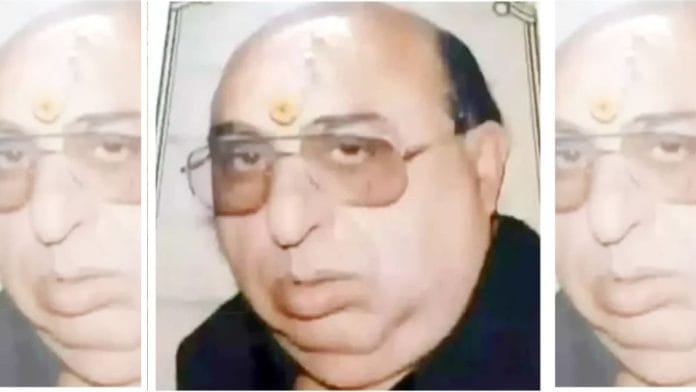



New Delhi: The day was 4 June 2003. Three gunshots rang out in a quiet Rajpur neighbourhood and changed Chhattisgarh’s politics forever.
Ramavatar Jaggi, a 58-year-old opposition leader, was shot at close range in his white Maruti Alto. What looked like a simple street crime was actually one of the first political murders in the new state’s history. It took 23 years, 29 accused, two conflicting police reports, a trial court acquittal, an institutional cover-up by police, and a CBI investigation to finally bring the primary accused—Amit Jogi, the principal architect of the conspiracy and the son of the sitting chief minister—to justice.
Jaggi’s son, Satish Jaggi, has not missed a single hearing in the last 23 years. From police stations to multiple courtrooms, and 29 convictions later, Satish told ThePrint: “Through this conviction, a tribute has been paid to my father, an honest man.”
Twenty three years is a long time to wait for justice, but for Satish, it was a more than that; it was a never-ending battle against the sitting chief minister and his son.
“In these 23 years, my family and I have fought many battles, we fought against the system, the police, people with financial and political powers, the leaders you trust… but today, I can finally say, the truth has won. Bhagwan ke ghar der hai, andher nahi (There is delay in God’s house but no darkness).”
The 2007 trial court judgment had acquitted Amit Jogi while convicting 28 other co-accused on the same evidence. Jogi also moved the Supreme Court on Monday—hours before the official order was out. In November 2025, the top court had let go of the CBI’s 1,373-day delay in appealing against the trial court order of acquittal and noted that due to the “grave allegations” involved and “in the interest of justice”, the case should reach its logical legal conclusion. The verdict of the Chhattisgarh High Court has finally ended the long-scripted cover-up. The court has confirmed that Jogi was the mastermind of the entire conspiracy and had a commanding position, being the son of the chief minister.
Mens Rea
The motive runs deep. Satish said there was a time when over 350 hardware dealers were working with his father. “My father built a strong management, and when he joined politics, he had massive support, he was seen as an influential figure… at every rally, every meeting, my father was considered important… that is what troubled the Jogis… they told my father to join them, but he refused… I have seen them threaten my father multiple times… and when they couldn’t break him… they killed him…”
This case first went to the Sessions Court. Based on the Chhattisgarh Police investigation, the prosecution alleged that the five accused persons had murdered the deceased with the “motive of robbery”.
During the trial, based on the CBI investigation, the prosecution put forth an entirely different case, alleging that the deceased was murdered for political reasons. It was alleged that the deceased was organising a major Nationalist Congress Party (NCP) rally in Raipur on 10 June 2004 which was expected to draw a large crowd and was perceived as a political threat to then Chief Minister Ajit Jogi alias Ajit Pramod Kumar Jogi and his son Amit Jogi.
It was, as per the CBI probe, in May 2003 that a criminal conspiracy was hatched by Amit Jogi, and co-accused Yahya Dhebar and Abhay Goyal at Hotel Green Park, Raipur “with the object of disrupting a rally of the NCP in the run-up to the assembly elections”. The CBI investigation revealed the masterminds were Amit Jogi, Abhay Goyal, Yahya Dhebar and Firoz Siddiqui.
Investigations revealed that “part of the conspiracy was hatched at the official residence of the then chief minister, with participation of Chiman Singh.” Furthering the conspiracy aspect, Yahya Dhebar travelled to Gujarat, while Amit Jogi and Abhay Goyal proceeded towards Rajnandgaon and Dongargarh. Other co-accused, including Feroz Siddiquie and Chiman Singh, arranged finances and logistics.
Towards the end of May 2003, several accused persons arrived at Raipur and were accommodated at Batra House, having been received from the railway station by Chiman Singh.
Finally, on June 4, at about 9.30 pm, the conspiracy was successfully executed.
Midnight crime
Satish trembles when recalls the night of the incident. “I remember when I got to know about the murder… I just couldn’t process the information… my own father…?’’
It was a hot night on 4 June 2003, and Chhattisgarh was gearing up for its first ever assembly elections. At approximately 11.40 pm, Ramavatar Jaggi, the NCP treasurer, was travelling in his car on the narrow streets of Raipur’s Moudhapara area.
Jaggi was a man wedded to ritual, and he would be seen wearing a sacred garland of Rudraksha beads around his neck. This one detail became a grim marker of his final moments.
The ambush was clinical. Chiman Singh, Shivendra, Sanjay, Banke, Vinod, Vimal, Rakesh, Ashok, Ravi, Narsi, Satyendra, Vivek, Lalla, Sunil, Anil, and Harishchandra, had gathered with a common intention to kill Jaggi.
A group of assistants hired from the Bhind region intercepted the car and began an all-out assault. They “damaged the vehicle with sticks” to create chaos before the lead hitman, Chiman Singh, fired at close range using a .32 bore pistol.
Satish Jaggi ran to the police station to file a report. He submitted a complaint, clearly naming the Jogis. Meanwhile, he got to know police were filing a complaint based on charges of loot and murder. “The police named made-up people in the case, they made up facts, they built a water-tight case thinking they cannot break us but we fought back. The CBI investigated thoroughly.”
Jaggi says the Jogis “left no stone unturned”. “He tried to threaten me, buy me, break me, scare me, but today we managed to finally put all those who killed my father in jail; all this only to safeguard the son of the sitting chief minister.”
The investigation conducted by the CBI reveals that accused Chiman Singh was a long-standing associate of Ajit Jogi, the then chief minister of Chhattisgarh, and had actively supported him in electoral constituencies such as Marwahi and Shahdol.
The CBI investigation has revealed just how the conspiracy was executed. Shivendra Singh Parihar drove a Maruti van with a manipulated registration plate, while Chiman Singh and other accused travelled in a Bolero vehicle driven by Vinod Rathore. They were armed with bamboo sticks and petrol-filled bottles, and proceeded towards the vicinity of the NCP office at Budhapara, Raipur, the investigation said.
Jaggi, upon leaving the NCP office in his Alto car, was followed, intercepted, and forcibly stopped. Thereafter, the accused persons alighted from their respective vehicles and vandalised the vehicle of the deceased. Chiman Singh fired at the deceased, resulting in his death, while Rakesh Kumar Sharma removed the Rudraksha necklace worn by the deceased.
Honest father
All Satish can remember is how his father would tell him to do the right thing, no matter what. “My father was an honest man. He would keep us grounded. He hated power,” he said.
Jaggi started working as a bus conductor in the Madhya Pradesh Tourism department, and would earn Rs 800 per month. He also worked at his father’s bread factory, delivering bread to multiple villages on cycle. Slowly, he managed to save money, and started a wooden toy factory.
The toy factory helped Jaggi pivot to hardware materials. “My father built a name for himself. Back then, there were only a few people. He managed to build a dealer network in Chhattisgarh. That is when he got close to Vidya Charan Shukla,” said Satish. “Finally, when NCP was formed, Shukla ji wanted to give my father a post, but he did not want any political post so finally agreed to become a treasurer.”
Scripted cover-up
But the scale of the attack wasn’t just Jaggi’s killing. The CBI investigation disclosed a parallel conspiracy involving Sub-Inspector R.C. Trivedi, Station House Officer V.K. Pandey and City Superintendent of Police Amrik Singh Gill. “With the object of shielding the actual 53 perpetrators, certain individuals—Avinash Singh, Jambwant Kashyap, Shyam Sundar, Vinod Singh, and Vishwanath Rajbhar—were falsely implicated and induced to assume culpability, particularly in light of the FIR having initially named Ajit Jogi and Amit Jogi,” the CBI said.
In its order, the Chhattisgarh High Court refers to the cover-up. It was also the prosecution’s case that the five accused persons above were in fact imposters, who had been falsely implicated by the real perpetrators with the assistance of certain police officials who conducted a sham investigation and filed a fabricated chargesheet. These imposters, the concerned police officials, and those involved in arranging them were arrayed as accused in the CBI case.
“However, the manner in which the offence was conceived, coordinated, and executed unmistakably reflects a well-entrenched and centrally directed conspiracy. The orchestration of such a sophisticated and high-level organized crime, particularly one involving imposters, pre-planned execution, and apparent compromise of the State Police machinery could not have been possible without the active involvement, guidance, and protection of a person wielding considerable influence and authority,” the court said. “In this backdrop, the role is merely as a passive or incidental beneficiary, but as the principal architect and driving force behind the conspiracy and the ultimate beneficiary.”
“The scale of planning, the coordination among multiple actors, and the systemic shielding of the perpetrators collectively indicate that such an operation required a commanding figure exercising control and instilling confidence among the co-conspirators attributes that are clearly attributable to Amit Jogi,” it said.
“Consequently, his involvement stands on a higher footing than that of the other accused, and his acquittal, in the face of such compelling circumstances, is rendered wholly unsustainable and contrary to the weight of evidence on record. accused-Amit Jogi assumes critical significance. The material on record, when appreciated holistically, points towards his position not merely as a passive or incidental beneficiary, but as the principal architect and driving force behind the conspiracy and the ultimate beneficiary.”
Shady meetings
In order to establish that the accused, Amit Jogi, was an integral part of the alleged conspiracy, the deposition of the manager of Hotel Green Park, where meetings of the accused were held on various occasions. In his deposition, he said that he knew Amit Jogi, Yahya Dhebar, and Abhay Goyal, and that they used to come to Hotel Green Park occasionally for dinner, would stay for an hour, and would come once or twice a month, back in 2003.
“Whenever they came, they would be accompanied by four or five other people. It is true that they would receive a call from the CM House before their arrival, informing them that they were coming, that a table should be reserved, and that they would be arriving at the time.”
Amit’s college friend Reginald Jeremiah further deposed that he had known him since their time as students at St. Stephen’s College, Delhi. According to Jeremiah, on May 21, 2003, he was summoned by Amit Jogi to Hotel Green Park, where a meeting was convened to deliberate upon a plan to disrupt an NCP rally.
He affirmed the presence of several individuals at the meeting. “During the course of the meeting, Amit Jogi proposed that Balwinder Jaggi, Pramod Choubey, and the deceased, who were associated with the NCP, be eliminated,” said Jeremiah in his deposition.
He further said that he, along with two or three others present, objected to this suggestion and urged accused Amit Jogi not to cause harm to any NCP members. Their objections were, however, disregarded.
‘Amit Jogi, the mastermind’
Speaking to ThePrint, Amit Jogi said, “I was acquitted 23 years back. The leave to appeal was allowed without hearing me.” He said, the CBI appeal against my acquittal was allowed again without hearing him, first on March 25, then on April 2.
“Today, in the Supreme Court, we moved a Special Leave Petition (SLP) against the ex parte order granting leave to appeal to the CBI. The SLP has been accepted by the Supreme Court for hearing. Furthermore, the order was also brought to the notice of the Supreme Court. The order itself states that I, the accused, was not heard. I was not heard, I was not even allowed to speak. They go against the principles of natural justice.”
The Supreme Court has called both the orders and will review them on April 20.
Further, Jogi said: “This kind of a travesty of justice wherein you set aside the acquittal of a person without hearing him. The matter comes up for hearing in six days, and in six days you convict me without even hearing me. So this travesty will not be allowed to stand, I am sure the Supreme Court will intervene.”
The state of Chhattisgarh was founded in 2000, and Indian National Congress candidate Ajit Jogi, a former bureaucrat, was the chief minister. In 2004, Jogi met with a crash while campaigning for the Lok Sabha elections, which paralysed him from waist downwards. He died in 2020 following a heart attack.
His son, Amit Jogi, was also a member of the Chhattisgarh Legislative Assembly from 2013 – 2018. However, in 2016, after the father-son duo were expelled from INC for anti-party activities and for sabotaging the Antagarh bypoll, they founded the Chhattisgarh Janata Congress.
The Chhattisgarh High Court said, “On the contrary, from the entire evidence, it is amply clear that Amit Jogi was the mastermind of the entire conspiracy and he was also having the commanding position being the son of the then Chief Minister.”
The court said Jogi was an “influential person” to such an extent that he could manage police authorities to arrange for persons who could forge themselves as the assailants.
“The transaction of funds, evidence of frequent meetings in Batra House, Hotel Green Park and CM House of the accused persons along with Amit Jogi clearly demonstrates that he was aware of all the activities right from the very beginning and the entire offence was orchestrated as per the directions of Amit Jogi.”
“In view of the foregoing discussions, we are of the considered opinion that the judgment passed by the learned trial Judge acquitting the accused-Amit Jogi is palpably illegal, wrong, perverse, contrary to the evidence available on record and without any concrete basis,” court said.
“Amit Jogi alias Amit Aishwarya Jogi, is held guilty and is convicted for the offence punishable under section 302, section 120-B of the IPC and is sentenced to undergo imprisonment for life with fine of Rs 1,000, and in default thereof, to undergo additional six months of rigorous imprisonment.”
(Edited by Nardeep Singh Dahiya)
Also read: How HC punched holes in ED, EoW probe, granted bail to Chhattisgarh ex-CM Bhupesh Baghel’s son