





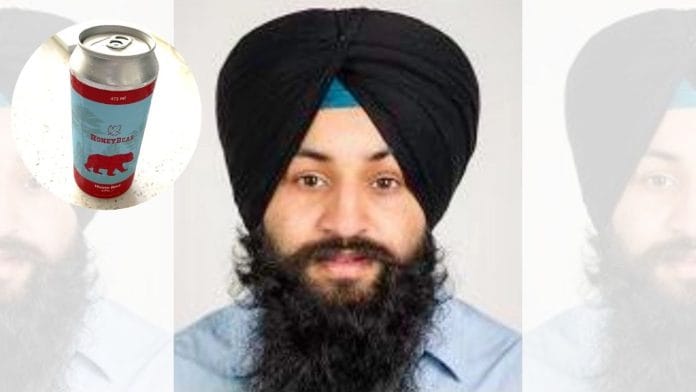



New Delhi: Unholy twists continue to wrack New Zealand’s largest ever drug seizure case, with the latest revelation about the mastermind of the racket sending renewed shockwaves all the way to India. Not only is the man at the centre of the largest drug bust in New Zealand of Indian origin, but he has now been revealed to be the nephew of Satwant Singh, one of former Prime Minister Indira Gandhi’s two killers.
It all began with a big mistake on 2 March 2023, when a manager at New Zealand’s largest dairy in Auckland—one of the world’s largest—made a deal with his team members: free beer if they completed their task on time. Suitably motivated, they did so, and got their gift from their boss, Himatjit Singh Kahlon.
Kahlon had made a mistake, a huge one. Among the team members, 21-year-old Aiden Sagala took some of the beer home. It was in tallish cans called Honey Bear House Beer, made in Canada. Sagala cracked one open, little knowing where his first sip would take him. It tasted weird, and he turned aggressive at first, flailing about and repeatedly telling his brother-in-law that he was “dying”.
By the time his sister managed to reach home, Sagala had gone blue; emergency CPR was of no help. Sagala was evacuated to Auckland Hospital, but fell into a coma, and died a few days later of multiple organ failure.
It turned out that the can’s contents were a form of liquid methamphetamine—or meth in common parlance—a powerful, highly addictive synthetic stimulant that affects the central nervous system. In the investigation that followed, the New Zealand Police uncovered a massive meth racket involving the import of hundreds of kilos of the banned substance in beer, coconut water and kombucha, a tea drink.
They soon arrested Sagala’s boss, Kahlon, along with the main mastermind of the methamphetamine plot. Both of them were sentenced to more than 21 years in prison by the Auckland High Court. Kahlon’s error was giving one of the wrong Honey Bear cans to Sagala.
But here’s the newest twist: According to reports in the New Zealand media, the mastermind, one Baltej Singh whose plea to keep his identity confidential was granted by the court at the time of sentencing, is the nephew of Satwant Singh, one of the two bodyguards who assassinated Prime Minister Indira Gandhi on 31 October 1984. They had carried out the killing as an act of revenge for the military action, called Operation Bluestar, at the oldest shrine of Sikhs, Sri Harmandir Sahib.
His identity was revealed by a New Zealand media outlet called Stuff after a court-ordered name suppression that had been granted in apprehension of harm to the family, owing to its notoriety among Indians across the world, was overturned. Singh’s father had said in an affidavit to court that the family had faced threats, intimidation and hostility after the assassination made them “notorious” among Sikh and Hindu communities worldwide.
The court had at first accepted this. Later, on an appeal by New Zealand government, the court withdrew the protection, saying there was an “appreciable public interest” in identifying the man behind the country’s biggest drug case. It also remarked that anyone motivated by revenge connected to the 1984 assassination would likely already know who Singh is.
Singh was called “Mr X” in the sentencing order, but the High Court had in November last year overturned the order on confidentiality. Baltej Singh’s father decided to move the Supreme Court, seeking to keep the name confidential, but has since withdrawn his plea seeking maintenance of confidentiality regarding his son’s name in the case.
According to the court filings, Singh was arrested by the police at Auckland International Airport on 10 March 2023 while attempting to flee the country.
The Auckland High Court had, in February last year, sentenced Kahlon to 21 years in prison with a minimum period of imprisonment of 10 years, for manslaughter and possession for supply of methamphetamine, while Singh was sentenced to 22 years imprisonment, with a minimum period of imprisonment of 10 years, for multiple drugs offences, including possession for supply of methamphetamine and importing methamphetamine.
Also Read: Secret tokens, semi trucks: How ‘king’ Guramrit Sidhu moved $17mn worth of cocaine, meth into Canada
Meth in the madness
According to the case records before Auckland High Court, the contraband arrived in the country in January 2023 when it was delivered at a storage facility in Maukau. According to case records, the banned substance was imported in 28,800 cans of beer from Canada and 22,680 bottles of kombucha from Los Angeles, for which “Mr X” who has since been identified as Singh, rented a storage house.
There is no mention of a consignment of coconut water in the court records of New Zealand, since made public by the authorities. However, Canadian media CTV has claimed that the banned substance was also transported through coconut water.
To avoid detection by the law enforcement agencies, Singh, according to the court documents, had mixed the Honey Bear cans and kombucha bottles containing methamphetamine dissolved in water among cans and bottles containing beer or kombucha.
Kahlon had helped Singh in placing the cans and bottles containing methamphetamine at the storage facility in January 2023, as well as purchasing equipment which was further used for the extraction of the contraband from the containers.
The Auckland High Court had observed in its order that Kahlon had visited the warehouse where the beer cans and bottles were stored on at least 28 occasions between 7 January and 6 March 2023. Kahlon had admitted before the police that he helped Singh crystallise the meth out from the cans into containers.
Methamphetamine was everywhere in the storage facility, the High Court had observed. The New Zealand Police recovered 700 kilograms of liquid methamphetamine from the same warehouse.
Months after their sentencing, the New Zealand Police had in October last year, attached properties of worth more than $35 million belonging to both Kahlon and Singh in Auckland.
“Through extensive financial investigation and analysis, our team has now restrained an estimated $36 million in real estate property alleged to be connected with the importation and supply of methamphetamine. These properties are a mix of residential and commercial rural properties across the Whitford, Totora Heights, Karaka and Bombay areas,” Detective Inspector Chris Allan of the Financial Crime Group said in a statement.
(Edited by Nardeep Singh Dahiya)
Also Read: Drugs from Myanmar are taking over Northeast. India must recognise national security threat