





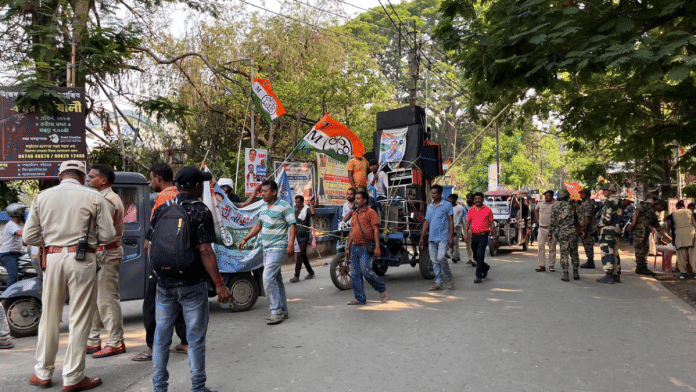



Kolkata: Of the approximately 27 lakh people in West Bengal, whose names have been struck off the voter’s list following adjudication by judicial officers, the highest number—nearly 4.55 lakh—is from Murshidabad.
The district, with a population of 71 lakhs as per the 2011 Union Census, has 66 percent Muslim and 33 percent Hindu, according to data available on the district administration’s website. Murshidabad has 22 assembly seats and nearly 4.55 lakh deletion means that on an average 20,668 names were excluded from each constituency.
Two other Muslim majority districts—Malda and North Dinajpur—had also seen high deletions. While 2.49 lakh names were found to be ineligible in Malda, the number stood at 1.76 lakh in North Dinajpur.
A Trinamool Congress (TMC) leader, who did not want to be named, said such high deletions in Muslim dominated constituencies will have a bearing on the results, while refusing to give any specific figure.
It’s not just the TMC, who are wary. Even the Bharatiya Janata Party (BJP) and the Rashtriya Swayamsevak Sangh (RSS) are figuring out the impact large deletions in North-24 Parganas and Nadia—two districts which is home to large number of people from the Matua community, who are BJP voters.
The Matuas belong to the Scheduled Caste and comprises approximate 17 percent of Bengal’s population. In North 24-Parganas, the Matuas comprise almost 30 percent of the population. Here, 3.25 lakh names were excluded.
Overall, the total number of voters in West Bengal stands at 7.04 crore, after the final list published 28 February by the Election Commission (EC). A total of 60 lakh names were removed from the electoral list because the individuals are either dead or no longer live in West Bengal.
Another 60.06 lakh names, which had ‘logical discrepancies’, including mismatch of names and dates, were put under adjudication. Of these 60.06 lakh names, the EC said Monday night that 58 lakh names have been reviewed, out of which nearly 27 lakh names were found ineligible and struck off the voter’s list.
In a press conference, West Bengal Chief Electoral Officer (CEO) Manoj Kumar Agarwal said that the 27 lakh people, whose names have been deleted can appeal before Appellate Tribunals for reconsideration. If their names are cleared by the tribunal, they will be included in the electoral roll and can vote again but not in this election. The 19 appellate tribunals were constituted by the Supreme Court.
West Bengal will vote in two phases, with 152 of the total 294 seats going to polls in the first phase on 23 April and the remaining 147 seats in the second phase on 29 April.
Demography of constituencies
The EC has not published the names of the people who have been struck off the voter rolls. It has just published the name of assembly constituencies along with the total number of people who have been found eligible or ineligible in the adjudication process.
But examining the demography of constituencies based on information available on the respective district administration’s portal reveal that constituencies with a large Muslim population have seen a high number of deletions.
Murshidabad, for instance, where 4.55 lakh names have been excluded, has a population of 71 lakh. Of this 66 percent are Muslims and 33 percent Hindu, according to data available on the district administration’s website.
Similarly, Malda with the third highest deletions–2.39 lakh–has a population of 39 lakh. Of this, 51 percent are Muslims and 48 percent are Hindus. Here on an average 19,948 names have been deleted in each of the 12 assembly constituencies.
But, it’s not just constituencies with sizable Muslim populations that have seen maximum exclusion of names from the voter’s list. Some of the constituencies with a high Hindu population have also seen high deletions. However, it is difficult to determine the demography of the people whose names have been deleted since the EC data only provides a break-up of those who are eligible or ineligible.
For instance, North-24 Parganas has seen the second highest deletions, with 3.25 lakh names removed from the voter’s list. The district comprises five sub-divisions—Barasat, Barrackpore, Bongaon, Basirhat, and Bidhannagar. Of the total one crore population in the district, 74 percent are Hindus and 25 percent Muslims.
In Hooghly, approximately 1.20 lakh names have been struck off the electoral roll. Of the total population of 55 lakh in Hooghly, nearly 83 percent are Hindus and 15.77 percent are Muslims.
In contrast, other constituencies including Jhargram and Purulia, where BJP has a presence, has seen limited exclusions. Purulia has 5,942 deletions while Jhargram 1,240.
Former Election Commissioner Ashok Lavasa says that the CEO’s actions are in accordance with the existing rules and law, because the rules state that the list must be published by the deadline.
“In the Act, there is no provision for a situation where the Appellate Tribunal decides cases between the finalisation of the electoral roll and the polling date. It will require a court order saying that please bring out a supplementary list of those cases that received a favorable decision from the Appellate Tribunal,” he told ThePrint.
He asserted that those who are later found to be eligible by the Appellate Tribunals would be deprived from exercising their rights in these elections. “This happened because of the SIR process initiated by the EC, not due to any fault of their own.”
With inputs from Apoorva Mandhani in New Delhi
(Edited by Tony Rai)
Also Read:Sandeshkhali, RG Kar & a BJP ‘bonus’: Mamata’s core woman vote faces the test in Bengal