





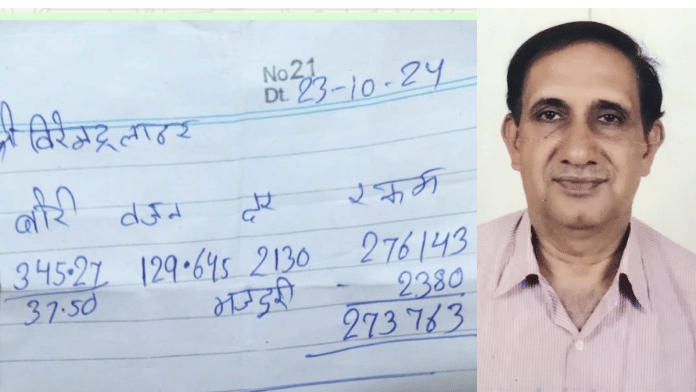



Gurugram: For decades, the transaction happened the same way. A farmer would bring their produce to the mandi, hand it over to the arhtiya, the commission agent, and walk away with a handwritten scrap of paper.
No shop name, no address, no date, no legal standing—just a number scrawled in ink that the agent could, and often did, quietly revise later.
The ‘kachi parchi‘, literally, the raw slip, was the instrument through which, according to those who have studied it closely, farmers in Haryana were routinely paid Rs 400 to Rs 800 less per quintal than the government’s Minimum Support Price, while official records showed the full MSP had been paid.
On Wednesday, the Haryana State Agricultural Marketing Board issued a memo, directing all Secretary-cum-Executive Officers of market committees across the state to immediately instruct every arhtiya under their jurisdiction to stop issuing kachi parchis.
The gap between those two figures, multiplied across thousands of transactions every procurement season, amounts to what petitioner Dr. Virendra Singh Lathar estimates at more than Rs 10,000 crore annually in Haryana alone.
Henceforth, a J-Form must accompany every transaction involving agricultural produce, as the rules had always required but seldom enforced.
Also Read: What’s the sunflower MSP dispute that has Haryana farmers on warpath against Khattar govt
The scientist who moved court
Dr. Virendra Singh Lathar spent his career at the Indian Agricultural Research Institute (IARI) in New Delhi, retiring as Principal Scientist in 2017. What he saw in Haryana’s mandis after retirement disturbed him enough to file a public interest litigation (PIL) in the Punjab and Haryana High Court, through advocate Pradeep Raparia.
The petition argued that the kachi parchi system was not an informal convenience but a structured mechanism of exploitation. Arthiyas, it alleged, formed corrupt cartels within the mandis, purchasing farmers’ produce through unauthorised slips at rates well below MSP, then selling the same produce to government agencies at full MSP, pocketing the difference.
Farmers, who had no legal document to challenge the transaction, had no recourse. The court directed the Haryana government to issue clear and concrete orders within 30 days. Wednesday’s memo is the government’s compliance.
Speaking to The Print on Wednesday, Lathar said, “Farmers will welcome the government’s ban on the illegal kachi parchi trade that arthiyas have been running for decades.”
“In the agricultural produce markets, arthiyas have been forming corrupt cartels, purchasing farmers’ produce through illegal kachi receipts at Rs 400 to Rs 800 per quintal below the support price, and then, through collusion with corrupt elements in the government system, selling that same produce to the government at MSP. This amounts to a scam of more than Rs 10,000 crore per year in Haryana’s mandis,” Lathar added.
What petition demanded
Lathar’s PIL had asked for several things beyond merely banning the kachi parchi. He demanded that printed receipts, carrying the shop’s name, address, registration number, and date, be issued to every farmer immediately upon the sale of produce.
It asked for a dedicated, round-the-clock helpline through which farmers could register complaints in real time. And he asked that J-Forms be issued without delay after every transaction, so that payment could not be held up or manipulated.
Lathar’s central argument was that the gap between what farmers actually received and what government records showed was not incidental but systemic. Punjab and Haryana’s farmers, he pointed out, remain heavily indebted despite selling crops at ostensible MSP, a contradiction that the kachi parchi system helps explain.
Production costs have risen, MSP carries no legal guarantee of payment, and middlemen have built structures that siphon off whatever margin remains, his petition said.
The J-Form & why it matters
The J-Form has existed within the mandi regulatory framework for years. It records the transaction formally, the quantity of produce, the price paid, the identity of buyer and seller, creating a paper trail that can be audited, disputed, and verified.
However, the arhtiyas, according to Lathar, had been hoodwinking the process and siphoning off farmers’ money by issuing them kachi parchi instead. They would issue get the J Form against farmers’ crop against the names of their own people so that the money from the procurement agencies as per MSP got transferred to their accounts and they could deceive farmers by paying a lesser amount.
(Edited by Ajeet Tiwari)