





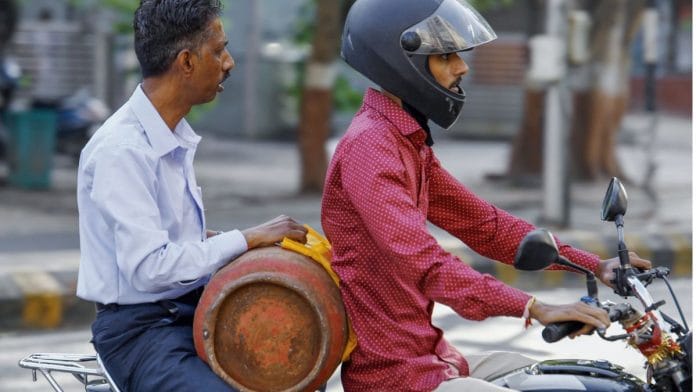



New Delhi: The government has doubled the distribution of 5 kg free trade LPG (FTL) cylinders to migrant labourers across states and Union Territories, in a move aimed at improving access to cooking fuel for weaker sections, particularly migrant workers.
In a letter made public Tuesday, Petroleum and Natural Gas Secretary Neeraj Mittal wrote to chief secretaries of states, stating, “It is conveyed that daily quantity of 5kg FTL cylinder in each state available for disbursal to migrant labourers is being doubled based on average daily supply (number of cylinders) to migrant labourers during 2nd–3rd March 2026.”
Effectively, the increase removes the earlier 20 percent ceiling, thereby giving states greater flexibility to meet demands. State governments and their food and civil supplies departments will receive the additional cylinders for distribution exclusively to migrant labourers. Oil marketing companies (OMCs) will provide logistical support.
Speaking at an inter-ministerial briefing Tuesday, Sujata Sharma, Joint Secretary at the Ministry of Petroleum and Natural Gas, said that the demand for smaller cylinders had risen sharply in recent weeks. “5 kg FTL cylinders have seen strong demand with one lakh sold yesterday and over 7.8 lakh since 23 March, supported by awareness campaigns,” Sharma said.
She added that in February 2026, average daily sales of 5 kg FTL cylinders stood at approximately 77,000. But it saw a sharp uptick in March.
Providing additional details, Sharma said that along with the expansion of piped natural gas (PNG) connections, more than 16,500 consumers surrendered their LPG connections in the last month, while over 3,76,000 new PNG connections were issued.
Regarding commercial LPG consumption, she added that nearly 45.5 lakh 19 kg cylinders, totaling 86,400 metric tonnes, had been sold since 14 March.
At the same briefing, Asangba Chuba Ao, Joint Secretary at the Ministry of Civil Aviation, flagged the impact of the ongoing West Asia conflict on Indian aviation.
He said that before the conflict, nearly 50 percent of international operations by Indian carriers were to the Gulf region—this has been significantly impacted. Indian carriers, which were operating 300–350 daily flights to West Asia earlier, are now running only 80–90 flights per day.
“International flights are a good source of revenue for the airlines. So, it [West Asia conflict] has definitely impacted their revenue income, which obviously affects the financials of the airline,” he said.
Chuba Ao added that Indian carriers had cancelled over 10,000 international flights since the start of the conflict.
On airlines levying fuel charges based on flight distance, he said, “This is done to cover up the operational cost due to the increasing ATF [Aviation Turbine Fuel] pricing.”
On Tuesday, the aviation regulator, Directorate General of Civil Aviation (DGCA), temporarily relaxed pilot flight duty time limitations (FDTL) for long-haul flights until the end of April 2026.
Explaining the decision, Chuba Ao said that restrictions in Gulf airspace had forced flights to Europe and North America to take longer routes, necessitating a slight relaxation in FDTL norms.
“The Ministry of Civil Aviation is actively working with all stakeholders, exploring all means on how we can support the industry, especially the airlines, and to bring down the cost which eventually gets passed on to the passengers,” Chuba Ao said.