





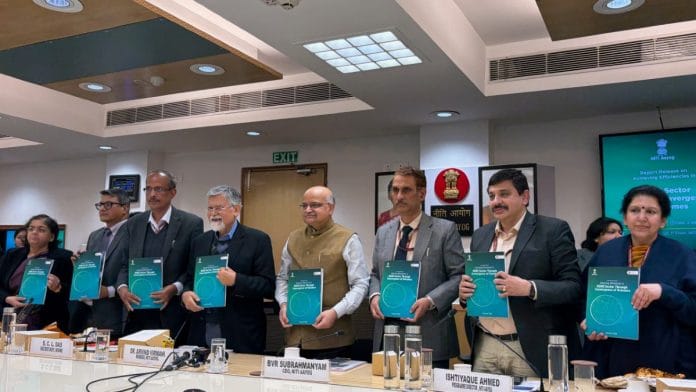



New Delhi: Multiple government schemes for micro, small and medium enterprises (MSMEs) are failing to deliver optimal results due to overlapping objectives and duplication, according to a report released by federal think tank NITI Aayog Thursday.
Releasing the report titled “Achieving Efficiencies in MSME Sector through Convergence of Schemes,” NITI Aayog CEO B.V.R. Subrahmanyam said that while the central government is introducing new programmes and schemes for the MSME sector, very often some overlap.
This duplication, he said, impacts the desired outcomes of the schemes.
Currently, the Ministry of Micro Small and Medium Enterprises runs 18 schemes spanning credit and financial assistance, skill development and training, infrastructure development, marketing support, technological and quality upgradation, and innovation. Many of these schemes are spread across different ministries and departments, leading to overlaps in objectives and the impact they seek to create.
Strengthening MSMEs through Smarter Scheme Convergence
NITI Aayog released the report “Achieving Efficiencies in MSME Sector through Convergence of Schemes”, presenting a strategic framework to enhance the efficiency, outreach, and impact of government support for Micro, Small… pic.twitter.com/0dCszaTuha
— NITI Aayog (@NITIAayog) January 15, 2026
For instance, under credit assistance alone, there are five schemes: Prime Minister’s Employment Generation Programme (PMEGP), Credit Guarantee Fund Trust for Micro and Small Enterprises (CGTMSE), Self-Reliant India (SRI) Fund, National SC-ST Hub, and PM Vishwakarma.
Similarly, the Centre has five infrastructure development schemes: Micro & Small Enterprises – Cluster Development Programme (MSE-CDP), Scheme of Fund for Regeneration of Traditional Industries (SFURTI), Promotion of MSME in the North Eastern Region & Sikkim, Coir Vikas Yojana (CVY), and Khadi Gramodyog Vikas Yojana (KGVY).
“Previous studies on MSME have highlighted a systemic weakness in the duplication of same/similar programmes run by various ministries/departments for the same target group,” the report states.
Highlighting specific cases, the report points to similarities between ASPIRE (A Scheme for Promotion of Innovation, Rural Industry and Entrepreneurship) and MSME Champions.
Both focus on skill development, financial support for innovation, and promoting technological advancement in the MSME sector.
The report also flags overlaps between MSE-CDP and SFURTI.
While MSE-CDP is implemented by institutions of the central and state governments and SFURTI by the Development Commissioner of MSME, both focus on cluster development, capacity building, market promotion, raw material banks, warehousing facilities, and training centres.
Apart from scheme duplication, the report underlines challenges caused by multiple digital platforms such as My MSME, National Single Window System (NSWS), My Scheme, and the Udyam Registration Portal.
The dispersed nature of these platforms makes it difficult for MSMEs to access information on government schemes, compliance requirements, and financial assistance, the report states.
Adding, “The fragmented information infrastructure may lead to inefficiencies, increased administrative burdens, and potential information gaps.”
Also Read: NITI Aayog flags what India needs for its ‘$30 tn by 2047’ goal—‘a developed corporate bond market’
Way forward
To improve outcomes, NITI Aayog has recommended convergence and alignment of government schemes, processes, and activities related to MSMEs.
One of its key proposals is the creation of a centralised, artificial intelligence-powered portal for MSMEs.
The portal would act as a single window for information on central and state government schemes, filing and applying for schemes, online tracking, access for approving authorities, and a 24×7 helpline.
“The proposed portal broadens its scope by incorporating cross-government integration at the central, state, and ministry levels, making it more comprehensive than the approaches adopted by the other portals, which are often limited to specific administrative levels or services,” the report says.
To streamline skill development initiatives, the federal think tank recommends merging existing programmes into three broad categories—Entrepreneurship and Business Skills Development Programme, MSME Technical Skill Development Programme, and Training Programme for Rural and Women Artisans.
It suggests merging the skill components of PMEGP, International Cooperation (IC), and Procurement and Marketing Scheme (PMS) under the Entrepreneurship and Skill Development Programme (ESDP) within the Entrepreneurship and Business Skills Development category.
The report also recommends merging SFURTI with MSE-CDP, citing overlaps in key components such as cluster development through both hard and soft interventions.
“The merger would ensure a special focus on traditional industries within the broader MSE-CDP framework, allowing for better coordination, greater financial backing, and more comprehensive support for cluster development while preserving SFURTI’s original objective of supporting traditional and endangered industries,” the report states.
On similar lines, NITI Aayog has suggested merging ASPIRE with MSME Innovative/Champions, and converging the Procurement and Marketing Support (PMS) and International Cooperation (IC) schemes.
(Edited by Amrtansh Arora)
Also Read: Niti Aayog CEO has a message for power stakeholders. Buckle up for surge to feed EVs, data centres
I think bigger problem is petrol taxes and high electricity costs, which are caused by need to fund freebies to farmers and household sector.
All the special incentives wouldn’t be needed, if petrol and electricity were cheaper.
Arvind Subramanian has stated that, modt if the free electricity benefits only few rich farmers and few rich households.