







New Delhi: India sends more artificial intelligence (AI) researchers abroad than any other country. It also has more workers listing artificial intelligence skills on their profiles than any other nation. Its students use generative AI tools at a higher rate than students in the United States. And in the past year, two of the world’s largest technology companies—Microsoft and Amazon—committed a combined $52.5 billion to AI infrastructure and operations on Indian soil.
But none of this has translated into legislative action. India passed all of one AI-related law between 2016 and 2025.
This gap—between the scale of India’s AI activity and the scarcity of policy and institutional architecture around it—runs through the 2026 AI Index Report, published last week by Stanford University’s Institute for Human-Centered Artificial Intelligence (HAI). The report, now in its ninth year, draws data from LinkedIn, the Ipsos AI Monitor survey, the Pew Research Center, McKinsey, Zeki, Epoch AI, and dozens of other sources to produce what it describes as the most comprehensive independent picture of where artificial intelligence stands globally.
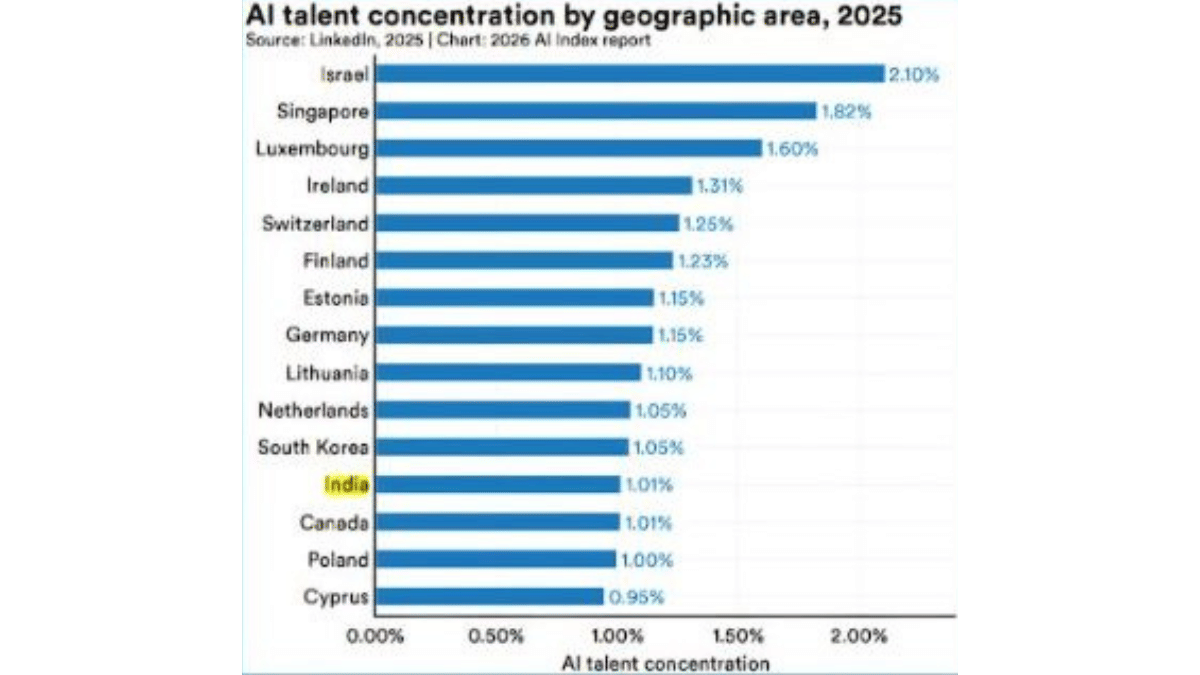
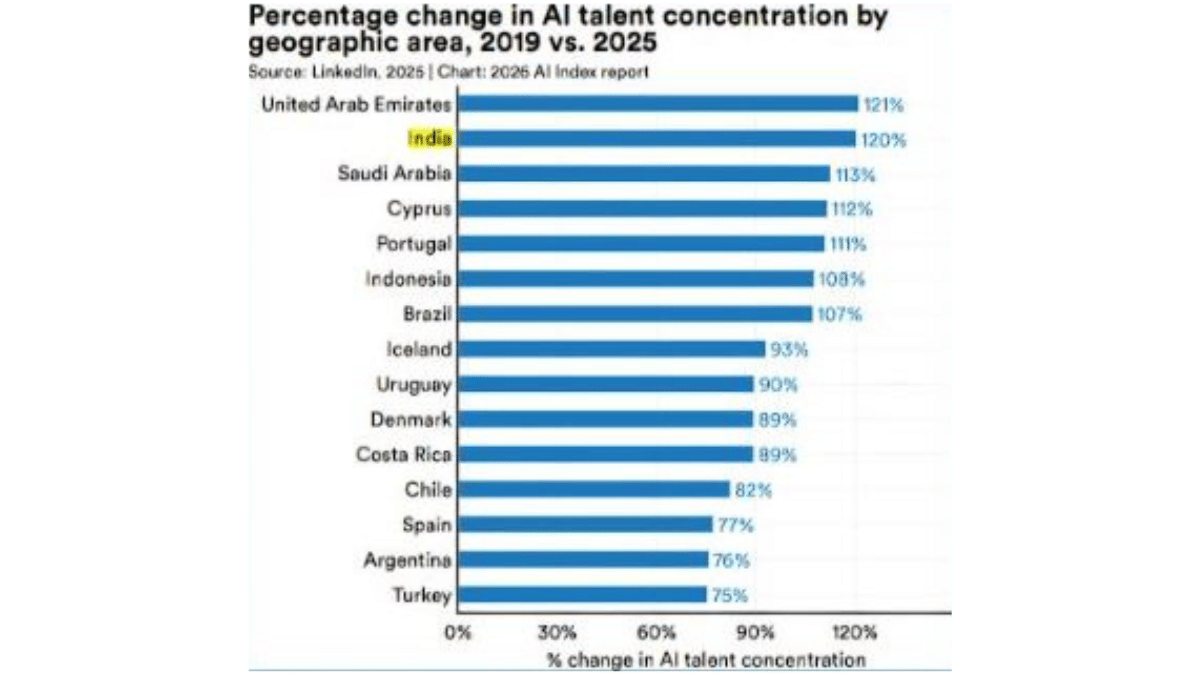
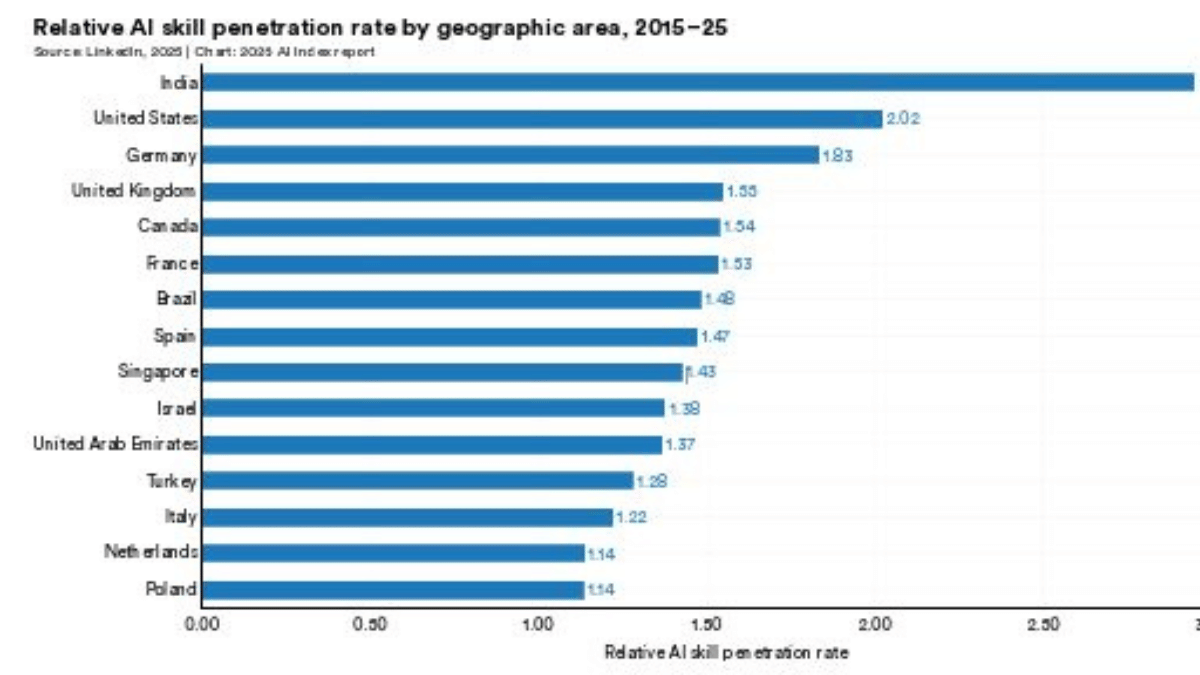
India was ranked second in the world for total AI authors and inventors in 2025 by Zeki (a talent analytics firm that tracks AI researchers and inventors outside China) with 50,460 researchers—behind only the United States (2,20,520) and ahead of Germany (48,520). On LinkedIn’s relative AI skill penetration index, India leads the world at 3.0, meaning AI skills appear in Indian member profiles at three times the global average. Student adoption of generative AI tools reached 84 per cent in India in 2025, up 40 percentage points since 2023.
Also read: India’s CEOs agree AI will transform jobs. They disagree on how
The brain drain
Yet India recorded a net outflow of AI talent of -16.9 in 2025—the largest for any country in the dataset, more than double Canada’s -7.1 and Germany’s -2.4.
The report describes India as being in the process of “transitioning from a net exporter to a net absorber of talent”, a shift it ties directly to what is happening at the other end of that pipeline: The United States.
The number of AI researchers and developers moving to the US has dropped 89 per cent since 2017, with an 80 per cent decline in the last year alone. The report states: “The US is still home to more AI talent than any other country, but it is attracting new talent at the lowest rate in over a decade.”
The implication is that Indian AI talent, historically a supplier to the US system, is beginning to stay home—not because India has resolved its structural weaknesses, but because the US has become less accessible.
$52 billion in, one law out
Microsoft’s December 2024 pledge of $17.5 billion for AI infrastructure in India and Amazon’s announcement that it will invest over $35 billion by 2030—targeting one million new jobs and $80 billion in exports—were among the largest country-specific AI commitments of the year.
India is also part of OpenAI’s Stargate country partnership programme and the subject of Nvidia’s ‘AI Factory’ expansion, in which in-country compute capacity is built in partnership with domestic telecommunications providers.
On the governance side, India has launched an AI Safety Institute, joining a second wave of countries that includes France, Canada, South Korea, Germany, and Brazil. The first wave—the UK, US, Japan, Singapore, and Israel—have operational institutes.
But India has passed one AI-related law in a decade, against 25 in the United States and 17 in South Korea.
The report notes that 65 per cent of Indian respondents said they trust their government to regulate AI responsibly—the eighth highest among 30 countries surveyed and well above the US figure of 31 per cent, which is the lowest for any country in the dataset. On a related question, India was one of only a handful of countries—alongside South Africa and Ireland—where respondents were more likely to prioritise regulation over AI-driven innovation.
The nervousness indicator
The Ipsos AI Monitor survey (an annual survey run by Ipsos, a global market research and consulting firm), conducted across 30 countries with 23,216 adults in early 2025, produced one finding about India that stands apart from all its talent and investment numbers: India registered the sharpest rise in concern about AI usage, up 14 percentage points between 2024 and 2025. Excitement rose by just 2 points over the same period.
Globally, the share of respondents who said AI products make them nervous rose to 52 per cent in 2025. The share of those who said AI offers more benefits than drawbacks rose to 59 per cent, up from 55 per cent in 2024. Both numbers moved up simultaneously—a pattern the report describes as the “central tension” in public view of technology worldwide.
In India’s case, the nervousness spike arrives against a backdrop of workplace AI adoption that exceeds 80 per cent, organisational support for AI strategy and governance that runs at 85–90 per cent of respondents—the highest in any country surveyed—and a student population that is, by the report’s data, among the most AI-engaged in the world.
The expert-public divide in the US
The report’s public opinion chapter, drawn from Pew Research Center surveys, the Forecasting Research Institute’s Longitudinal Expert AI Panel (LEAP), and Ipsos data, documents a gap between what AI experts and the general public believe about the technology that has widened to a point the report treats as a structural feature of the current moment.
On the question of AI’s impact on jobs, 73 per cent AI experts in the US said the effect would be positive, against 23 per cent of the US public—a gap of 50 percentage points. Similar gaps appeared for impact on economy (69 per cent versus 21 per cent) and medical care (84 per cent versus 44 per cent). Both groups agreed on two areas where AI would cause harm: Elections and personal relationships.
The report found that across all 50 US states, concern that federal AI regulation will not go far enough (41 per cent) outweighed concern that it will go too far (27 per cent), with more than one-third of the respondents unsure.
US: Jobs, productivity, and who gets hit first
The workforce data in the report points to effects that are already visible, concentrated among the youngest workers and in specific functions.
Employment for US software developers aged 22 to 25 fell close to 20 per cent from its 2022 peak by September 2025. Headcount for older developers continued to grow over the same period. One-third of organisations surveyed by McKinsey expect AI to reduce their workforce in the coming year, with anticipated reductions highest in service operations, supply chain, and software engineering.
Productivity gains are documented but uneven. Customer support agents using conversational AI resolved 14–15 per cent more issues per hour. GitHub Copilot users completed 26 per cent more pull requests. Marketing teams using multimodal AI for ad creation saw 50 per cent more output per worker. But a study by Model Evaluation and Threat Research (METR) found that experienced open-source developers became 19 per cent slower when using AI assistance—a result the organisation has since been unable to replicate, partly because developers in late 2025 were no longer willing to work without AI tools.
The governance divide
The policy landscape the report describes is one of governments moving in opposite directions at speed.
The Trump administration in 2025 revoked the Biden administration’s 2023 executive order on safe and trustworthy AI development, replacing it with an order titled ‘Removing Barriers to American Leadership in Artificial Intelligence’. A subsequent executive order created an AI Litigation Task Force to challenge state AI laws in court and threatened to withhold federal funding from states that enacted conflicting legislation. US state-level AI laws still rose from fewer than 10 in 2020 to 150 in 2025.
The European Union AI Act’s first prohibitions took effect in 2025. Japan, South Korea, and Italy each passed national AI laws. More than half of newly adopted national AI strategies globally came from developing countries. The US invested $20.5 billion in AI through grants, contracts, and other transaction agreements between 2013 and 2024, with the Department of Defence accounting for 73 per cent of contract and agreement spending.
On the question of which institution the world trusts most to regulate AI, Pew’s 2025 Global Attitudes Survey found that across 25 countries, a median of 53 per cent trusted the EU, against 37 per cent for the United States and 27 per cent for China. The US was the only country where respondents were almost evenly split between trusting and distrusting their own government to regulate AI—44 per cent trusted it, 47 per cent did not.
The numbers behind the headline
US private AI investment reached $285.9 billion in 2025, more than 23 times China’s $12.4 billion. Global corporate investment more than doubled, with generative AI capturing nearly half of all private AI funding after growing more than 200 per cent. Training the Grok 4 model produced an estimated 72,816 tons of carbon dioxide equivalent. AI data centre power capacity has reached 29.6 gigawatts—comparable to New York state at peak demand.
The US-China performance gap at the model level has closed. US and Chinese models have “traded the lead multiple times since early 2025”. As of March 2026, Anthropic’s top model leads by 2.7 percentage points. Industry now produces over 90 per cent of notable frontier models, and the most capable systems are also, by the report’s account, the least transparent: Training code, dataset sizes, and parameter counts are increasingly withheld from public disclosure.
Generative AI reached 53 per cent population adoption within three years—faster than the personal computer or the internet. In India, China, Nigeria, the United Arab Emirates, and Saudi Arabia, more than 80 per cent employees report using AI at work on a regular basis. In the United States, the figure is closer to half. Across the 25 countries in Pew’s survey, the EU is now trusted more than either the US or China to set the rules for what comes next.
The report’s co-chairs, Yolanda Gil and Raymond Perrault, describe what the data shows in terms that cut across every chapter: “The data does not point in a single direction. It reveals a field that is scaling faster than the systems around it can adapt.”
(Edited by Viny Mishra)
Also read: US-based Anthropic PBC conducts the largest-ever AI study. This is what people told them