








New Delhi: The government Wednesday said India has sufficient coal stocks to meet power demand, even as tensions in West Asia push up input costs for the sector and disrupt supply chains.
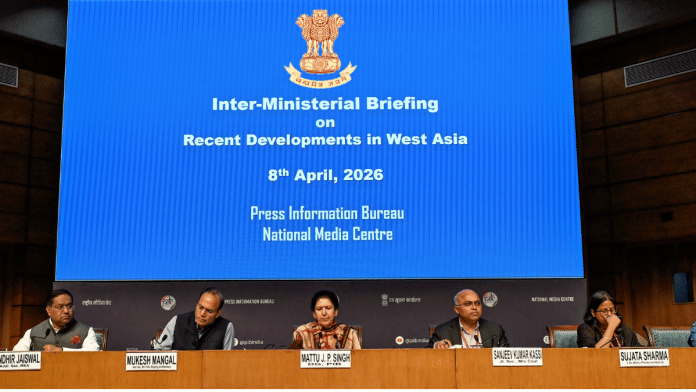
At an inter-ministerial briefing on the West Asia conflict, officials said coal availability remains comfortable across power plants and mines.
“As of yesterday, we have 55 million tonnes of coal available at power plants, enough to generate power for 24 days. In addition to this, we also have stock of 170 million tonnes in mines,” Sanjeev Kumar Kassi, joint secretary at Ministry of Coal, said.
He added, “We are producing coal at a pace matching the consumption levels, so there is no shortage.”
India currently holds around 225 million tonnes of coal across the supply chain, while the power sector consumes nearly 2.4 million tonnes daily. Demand is expected to rise to 906 million tonnes in FY 2027 from 830 million tonnes last fiscal.
Kassi said India has 401 billion tonnes of coal reserves, with annual extraction at about 1 billion tonnes. “It is expected to reach 1.5 billion in a few years,” he said.
However, the ongoing conflict has begun to impact mining costs. Kassi noted that prices of ammonium nitrate, a key input for explosives, have risen sharply from Rs 40,000 per tonne in March 2026 to Rs 72,000 per tonne in April, an increase of almost 43 per cent. He added that prices of explosives have also risen by 26 per cent in the last month.
Despite the spike, coal companies such as Coal India and Singareni Collieries Company Limited are absorbing the higher costs without passing them on to consumers.
On diversification, the government said it is now focusing on coal gasification as the next growth avenue. Kassi said the Talcher fertiliser plant will begin using coal to produce ammonia-based fertiliser by December this year.
He added that under the Rs 8,500 crore incentive schemes to promote coal gasification projects approved in January 2024, funds have already been allocated to seven projects, with ground-breaking completed for four.
Also read: Govt doubles 5 kg LPG cylinder supply for migrant workers, airlines hit hard by West Asia war
Petroleum and natural gas situation
Separately, the government Wednesday allowed a wider set of industrial sectors to access commercial LPG at up to 70 per cent of their pre-March consumption levels, capped at an overall sectoral limit of 200 tonnes per day.
In a letter to state chief secretaries Wednesday, Petroleum Secretary Neeraj Mittal stated, “It is now conveyed that industrial units in the sectors of pharma, food, polymer, agriculture, packaging, paint, uranium, heavy water, steel, seed, metal, ceramic, foundry, forging, glass, aerosol, etc., shall also receive 70 per cent of the units pre-March 2026 bulk non-domestic LPG consumption level subject to an overall sectoral limit of 0.2 TMT/day.”
Providing an update on fuel supplies, Sujata Sharma, joint secretary at the Ministry of Petroleum and Natural Gas, said domestic LPG supply remains normal. The government said commercial LPG supply has risen to 93,000 tonnes since 14 March. “Yesterday 6,000 tonnes of commercial LPG was sold,” Sharma said.
She added that gas supply to fertiliser plants has been increased to 95 per cent from 90 per cent earlier. Between March 2026 and Tuesday, around 3,87,000 new piped natural gas connections have been provided, with nearly 4,21,000 new consumers added.
India welcomes ceasefire
On the geopolitical front, India welcomed the recently announced two-week ceasefire between the US and Iran.
“We welcome the ceasefire and India has always emphasised dialogue and diplomacy,” said Randhir Jaiswal, official spokesperson and additional secretary at Ministry of External Affairs at the briefing.
On the movement of Indian vessels through the Strait of Hormuz, Jaiswal said India is in touch with multiple stakeholders to ensure safe passage. “We expect unimpeded global flow of commerce will prevail through the Strait of Hormuz,” he said, adding that the situation is evolving.
Responding to questions on Pakistan’s role in the ceasefire, he said, “As to the position or role of other countries, it is for them to speak about it.”
Citing the advisory issued by the Indian embassy in Iran, Jaiswal urged Indians in Iran to leave the country. “We are urging Indian nationals to expeditiously exit the country as per the route advised by the Indian embassy in Iran,” he said, referring to the approximately 7,500 Indians currently there.
(Edited by Viny Mishra)
Also read: China insulated itself against energy shocks. India is ‘all talk, no walk’