





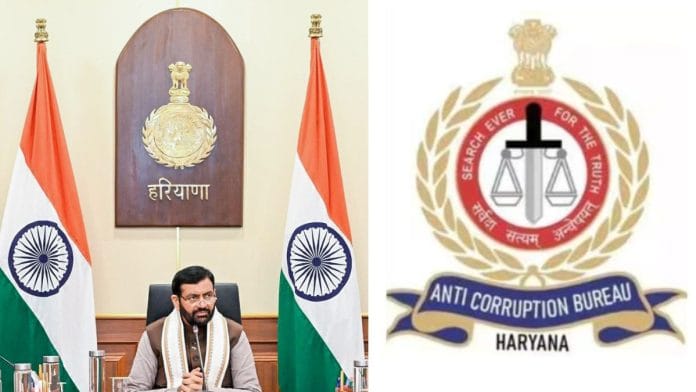



Gurugram: The Haryana government has amended Standard Operating Procedures (SoPs) for probing cases against government officials under the Prevention of Corruption Act, significantly curtailing the Anti-Corruption Bureau’s (ACB’s) investigative powers in a move that appears to be a fallout from IPS officer Y. Puran Kumar’s suicide case and former DGP Shatrujeet Singh Kapur’s exit.
Sources familiar with the matter say the new guidelines mark a complete reversal from the aggressive stance adopted in 2022, when Kapur was heading the bureau and the ACB pursued senior civil servants with unusual zeal.
In one of the most significant changes, the government has tightened Section 17-A of the Prevention of Corruption Act, which bars police from initiating any inquiry or investigation into recommendations or decisions by government officials in the discharge of their duties without prior government sanction—except in trap cases where officials are caught red-handed—by adding stricter procedural safeguards.
The latest SoPs mandate that the Haryana ACB must strictly adhere to prescribed guidelines before even contemplating action against officials.
The contrast with earlier SoPs is stark. In January and July 2022, the government amended procedures to grant wider latitude to investigating agencies.
Those guidelines permitted police to arrest officials even if their recommendations or actions were ‘ex facie’ criminal in nature—a provision that gave teeth to anti-corruption investigations and allowed the ACB to move swiftly against suspected wrongdoing without approval from the government.
A senior IAS officer, requesting anonymity, told ThePrint that in most cases, sections for crimes like extortion were added to FIRs against senior officers, which circumvented the need for government approval.
The FIR against Y. Puran Kumar’s aide, Sushil Kumar, which allegedly led to the senior IPS officer’s suicide, was also registered under Section 308 (3) of the Bharatiya Nyaya Sanhita (Extortion) besides the PC Act. The FIR alleged that Sushil Kumar demanded a bribe of Rs 2.5 lakh from the contractor, purportedly on behalf of Puran Kumar, then IGP Rohtak Range.
The officer quoted earlier said that the FIR under extortion meant that even though neither Y. Puran Kumar nor Sushil Kumar was “caught red-handed”, nor had money in fact changed hands, the “ex facie criminal nature” of the act, as mentioned in the FIR, gave the police a free hand to arrest both.
“This was the reason Y. Puran Kumar committed suicide while mentioning this FIR in his suicide note. He was apprehensive of his arrest because of this FIR,” the officer said.
It was under these very provisions that Haryana’s ACB arrested IAS officers Vijay Singh Dahiya and Jaibir Arya in October 2023.
Dahiya, a 2001-batch IAS officer, was arrested on the evening of 10 October 2023, after being questioned in connection with a bribery trap involving a middlewoman.
Arya was arrested the following day, 11 October, in a separate case involving a bribe for a transfer posting in which his clerk was arrested “red-handed”.
Neither of the officers was caught with bribe money, but they were arrested based on the statement of those apprehended with a bribe.
In both cases, the ACB added extortion under Section 384 of the IPC to the charges besides the relevant sections of the IPC.
Both officers spent nearly one-and-a-half months in jail before a Panchkula court granted regular bail 28 November 2023.
The arrests sent shockwaves through the state’s administrative machinery, with bureaucrats expressing alarm at what they perceived as overreach.
In October 2023, the IAS and HCS officers in Haryana had registered their strong reservations against what they described as the “overreach” of the ACB, with then Chief Secretary, Sanjeev Kaushal, as well as the CM Manohar Lal Khattar.
They said that in the last two years, the ACB has targeted around 12 IAS, 20 HCS and three IFS officers.
However, Khattar refused to relent, saying his government had zero tolerance for corruption.
But in September 2025, the Haryana government declined permission to prosecute Arya in the case, and as a result, a Panchkula court acquitted him of the charges against him in December.
Similarly, the state government declined permission to the ACB to prosecute Vijay Singh Dahiya’s case this month.
Under the new SoPs issued on 8 January 2026, the power earlier given to the police and the Vigilance and Anti-Corruption Bureau to act in case recommendations or actions considered “ex facie criminal” has been taken away.
The order also says that the investigating agency must comply with the provisions of Section 17A before any enquiry/inquiry or investigation, and the revised SoP shall apply to all pending cases where approval under Section 17A has not yet been granted.
Also Read: Haryana’s new anti-corruption chief orders list of officials ‘who don’t budge without bribes’
Other instances of ACB action against IAS officers
In March 2023, the Haryana government had given permission to investigate two IAS officers—Sonal Goyal of the 2008 batch and Anita Yadav of the 2004 batch—in the Faridabad civic body case involving alleged payments to contractors without any work done on the ground.
The names of two more IAS officers—Yash Garg of the 2009 batch and Mohd Shayin of the 2002 batch—also figured in the case. But in September 2025, the state government declined permission to prosecute the above four officers in various FIRs registered by the ACB.
In May 2023, Kanthi D. Suresh, editor-in-chief of Gurugram-based Power Sportz TV and 1995 batch IAS officer D. Suresh’s wife, wrote to the DGP seeking an FIR against certain officers for “harassing her, raiding her premises, blackmail, intrusion and impersonation”.
Later, D. Suresh also wrote to the DGP seeking an FIR in the case.
The ACB initiated action against D. Suresh as well as other state officers for allegedly causing loss to the Haryana Shehri Vikas Pradhikaran (formerly Haryana Urban Development Authority) by re-allotting a plot in 2019 to a school in Gurugram at 1993 land rates.
Suresh told ThePrint the order was quasi-judicial and appealable before the court of law.
“The government gave permission to the ACB to investigate the case against which I approached the Punjab and Haryana High Court. The case is sub judice at the High Court,” said Suresh.
He said that the July 2022 amendment in the SoPs was a wrong interpretation of the statutory provisions.
“If a private person is arrested in a trap case, and the police come to know of the involvement of an official, police are expected to seek permission of the government for initiating a preliminary inquiry. And if a preliminary inquiry reveals the involvement of an official, they should again seek permission to initiate a regular inquiry, seek departmental comments, then proceed further. This is what is mandated,” said D. Suresh.
“Any deviation by the state government is against the law and a violation of the amendment made in the PC Act in 2018, which was aimed to provide an atmosphere to the officers to take decisions in public interest without fear of being prosecuted in the future,” he added.
(Edited by Sugita Katyal)