








Hyderabad: China has its Great Wall, built over centuries as a formidable defence against military attacks. Now, Andhra Pradesh is planning to build its own wall along its long coastline—a green shield to protect it from natural disasters.
The state forest department, led by Deputy Chief Minister Pawan Kalyan, has proposed the concept of “The Great Green Wall of Andhra Pradesh”, a five km-wide, 974 km-long ecological corridor along the coast “to protect lives and enhance the livelihoods of the coastal community”.
“The Great Green Wall is to mitigate cyclones and tsunamis, reduce wave energy, wind speed, and erosion, thereby protecting lives and infrastructure,” Dr P.V. Chalapathi Rao, Principal Chief Conservator of Forests (PCCF) and head of the Forest Force, told ThePrint.
Both Chief Minister N. Chandrababu Naidu and Kalyan—minister for Panchayat Raj, Rural Development & Rural Water Supply, Environment, Forest Science & Technology—are supporting the shoreline management plan, which will be taken up in mission mode this year.
Officials said the vision was to build a resilient, biodiverse and economically strong coastal Andhra Pradesh through a strategic, multi-layered defence that protects communities and ecosystems in the long term. They cited the threat of sea erosion along the Krishna-Godavari delta shores, especially in places like Uppada.
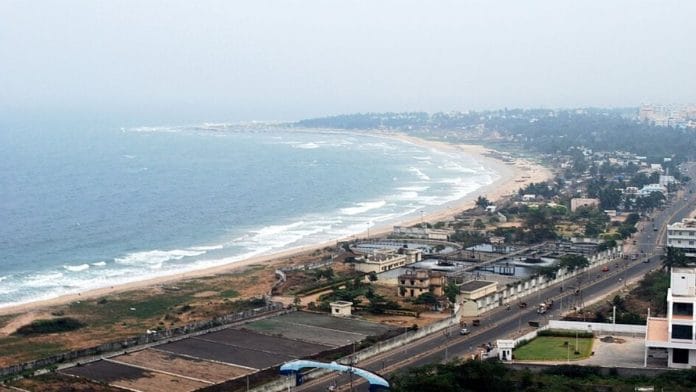
Andhra Pradesh, with a 974 km coastline, is among India’s most natural disaster and climate-vulnerable states. Over 3.3 million people live within five km of the coast, facing rising threats from cyclones, tsunamis, floods, sea level rise and coastal erosion.
“About 32 percent of the state’s shoreline is eroding, particularly around the Krishna and Godavari estuaries, which are guarding the famous Krishna and Godavari Deltas from saltwater ingression,” the state forest department said in a concept note.
“Erosion leads to land loss, ecosystem damage, increased flooding, and community displacement. Many ecosystems are declining due to sea-level rise and storm surges,” it added.
Officials said a sharp rise in sea levels could endanger 282 villages and displace over a million people in the state.
Three zones
The green wall project aims to strengthen the green cover in three zones—the first facing the Bay of Bengal, where mangroves in estuarine areas and shelterbelts in non-estuarine areas will be reinforced.
The second zone will involve canal bund plantations along the largely defunct Buckingham Canal and other canals, and avenue plantation or planting of trees along roads. The third zone will have agro-forestry and community plantations.
“Mangroves and shelterbelts will improve climate resilience and enhance water quality, prevent sea level rise and support our climate goals. The great green wall also enhances livelihood as it will boost sustainable fisheries, eco-tourism, and generate earning opportunities through crab culture, plamyrah products, etc. These green jobs will especially benefit farmers, fishers, and women’s self-help groups,” said Chalapathi.
The coastal afforestation project will help Naidu government’s target of increasing the state’s green cover from 30 percent to 50 percent by 2047.
“While the Green Wall project will not restrict any building or industrial expansion, the idea is to increase the green cover in a saturated mode utilising every bit of land possible, like groves, sand dunes, and along the railroads, highways, and canals,” said Chalapathi.
The project, the PCCF said, is based on several scientific studies and involves institutions, like the National Centre for Sustainable Coastal Management (NCSCM) in Chennai.
Naidu government wants to implement its ambitious idea with funding from multiple sources. “GGW-AP will leverage funds from national and international climate finance programs and schemes for implementation. It leverages cross-departmental collaborations and convergence of schemes and programmes and ensures efficient planning and implementation,” read the concept note.
Chalapathi added, “We will involve all the government departments like education, with the enthusiastic participation of school-college students in plantation drives, and also agriculture, horticulture, etc., wings.”
(Edited by Sugita Katyal)