





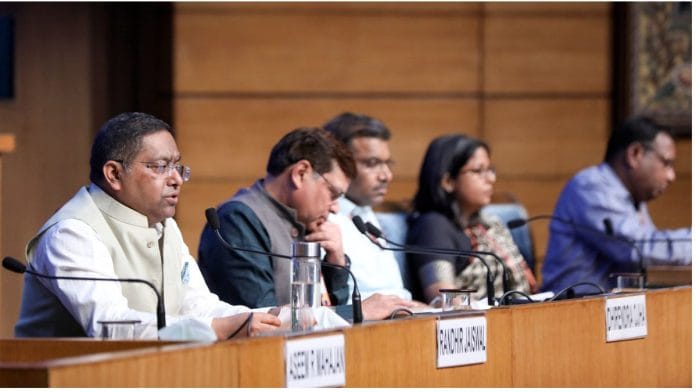



New Delhi: Reiterating that India’s crude oil supplies remain stable despite the Iran war, an inter-ministerial team comprising senior officials from the ministries of petroleum, shipping and external affairs Wednesday outlined measures taken by the government to safeguard the country’s energy supplies.
Briefing reporters in Delhi, officials from the inter-ministerial committee also addressed concerns about Indians caught in the region amid tensions. Randhir Jaiswal, Ministry of External Affairs spokesperson, said the government has also set up a control room to assist Indians stranded in the Gulf region.
Speaking about the measures the government has initiated to ease supply of crude oil, Sujata Sharma, joint secretary at the Ministry of Petroleum and Natural Gas, said at the briefing that India imports crude from about 40 countries and oil marketing companies have secured various crude cargos from different sources.
“As a result of this diversification, about 70 per cent of our crude import is now coming from routes outside the Strait of Hormuz, compared with about 55 per cent earlier,” said Sharma.
India consumes nearly 5.5 million barrels of crude oil daily, Sharma said, adding that supply chains have remained intact due to diversification of import routes.
Two additional crude cargoes are currently in transit to India, which will further strengthen the country’s supply position, the officer said.
On liquefied petroleum gas (LPG), Sharma said imports account for nearly 60 per cent of India’s consumption, with almost 90 per cent of those supplies passing through the Strait of Hormuz.
To cushion any disruption, the ministry directed refineries and petrochemical complexes on 8 March to maximise LPG production. The move has already led to a significant boost in domestic output, the government has said.
“Our domestic LPG production has increased by 25 per cent and it is being directed towards household consumers,” Sharma said.
She added that the normal delivery cycle for domestic LPG remains about two-and-a-half days. However, as a temporary demand management measure, the minimum booking time for a second LPG cylinder has been extended from 21 days to 25 days.
Responding to concerns over the recent Rs 60 increase in LPG cylinder prices, Sharma said the government continues to absorb part of the burden despite sharp global price rise.
“The Saudi contract price, which is the international LPG pricing benchmark, has increased by about 41 per cent since July 2023 and the government is providing Rs 30,000 crore to oil marketing companies for their under-recoveries in LPG,” she said.
On liquefied natural gas (LNG), officials said the conflict has disrupted supplies of 47.4 million metric standard cubic metres per day, which is now being compensated through alternative routes and sourcing arrangements.
Also read: PM reviews oil, gas supply as analysts warn reliance on imports leaves India open to war disruptions
28 Indian-flagged vessels in the Persian Gulf
Addressing concerns about Indian seafarers in the region, Rajesh Kumar Sinha, special secretary at the Ministry of Ports, Shipping and Waterways, said that currently 28 Indian-flagged vessels are currently operating in the Persian Gulf.
Of these, 24 vessels are west of the Strait of Hormuz and carrying 677 Indian seafarers, while four vessels east of the strait have 101 Indians on board.
“All these vessels are being actively monitored for safety and security. Authorities, ship managers and recruitment agencies who recruit these sailors are closely coordinating with Indian embassies and local authorities to ensure safety and render medical assistance to them,” Sinha said.
Talking about the control room set up to assist Indians stranded in the Gulf region, MEA spokesperson Randhir Jaiswal said, “We have been receiving a lot of phone calls, lot of emails with regards to Indian nationals…. We have been guiding them in all possible manner.”
He also expressed condolences over the death of three Indians who were killed in an attack on a shipping vessel.
(Edited by Viny Mishra)