








New Delhi: Instances of electors with an “unusually high number of children”, even some with more than 100 children, and those with an age gap of less than 15 years with their parents—the Election Commission of India (ECI) has flagged crores of voters for such “logical discrepancies” in different states.
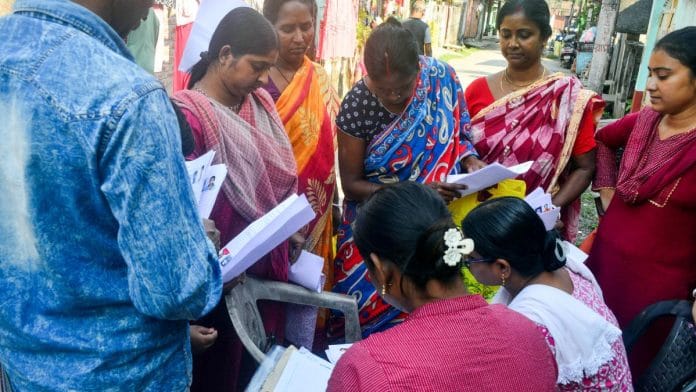
Notices have been issued for verifying the documents of such electors under the Special Intensive Revision (SIR) exercise underway in states. After completion of the SIR in poll-bound Bihar, the ECI had in October 2025 announced its next phase of SIR in 12 states and Union Territories. The list includes West Bengal, Kerala, Tamil Nadu and Puducherry—which have assembly polls due this year.
In West Bengal alone, over 1.36 crore voters have been flagged for such “logical discrepancies”.
In an affidavit filed in the Supreme Court earlier this month, the ECI had assured the court, “logical discrepancies is not a new category for disenfranchisement of any electors”.
“Discovery of a logical discrepancy… merely leads to issuance of notice for the purpose of verification. The noticee will have to clarify the discrepancy and/or produce necessary documents to the satisfaction of the ERO (Electoral Registration Officer),” the affidavit, seen by ThePrint, added.
The Supreme Court had then, on 19 January, directed that the names of persons figuring in the logical discrepancies list may be displayed at gram panchayat bhawans, public places in every Taluka and block office of every Taluka (Sub-Division), as well as at ward offices in cities of urban areas.
Similarly, on 29 January, the Supreme Court directed publication of details of the 1.16 crore electors who had been served notices citing “logical discrepancies”, among other things, in Tamil Nadu.
What exactly are these logical discrepancies? ThePrint explains.
Unusually high number of children
One of the reasons for electors ending up in the “logical discrepancies” list is when six or more electors have been shown to be a single person’s children.
ECI’s submissions in the Supreme Court list puts down instances where a few electors were linked with an “unusually high number of children”
It said that there were 4,59,054 instances of electors with more than 5 children, 2,06,056 instances of electors with more than 6 children, and 8,682 electors with more than 10 children.
The ECI claims that there were 14 instances of electors with more than 30 children, 10 instances each of electors with more than 40 and 50 children, and seven instances where electors were shown to have more than a 100 children.
The ECI, in its submissions to the Supreme Court, therefore asserts, “Many such instances are scientifically impossible to entertain as valid mapping. Therefore, cases in which six or more electors have mapped/linked themselves to one person, merit greater scrutiny as regards validity of linkage.”
EROs have been issuing notices in such cases, to verify whether matching has been done correctly “to weed out the chance of fraudulent mapping”.
Suspicious age gaps
Another manner in which voters are ending up in the “logical discrepancies” list is when the age of the elector and that of the parent is less than 15 years.
The elector’s age is being considered as on 27 October 2025, when the SIR exercise in the states began. The parent’s age is calculated on the basis of the last SIR roll.
“Such small age differences, although possible, give rise to suspicion, especially considering the legal marriage age of 21 for men and 18 years for women. Therefore, such cases warrant verification to avoid either the wrong data in EF (enumeration form) or data entry, or any fraudulent mapping by the elector,” the ECI says in its affidavit before the Supreme Court.
Similarly, an age gap of over 50 years between parents and their children is also a discrepancy that has been categorised as illogical.
“Such large age differences, although possible, give rise to suspicion, especially considering that fertility rate for women becomes negligible after 45 years of age,” it says, citing the National Family Health Survey 2019-21.
An age gap of less than 40 years with one’s grandparents in another similar logical discrepancy flagged by the Election Commission.
According to the ECI, another logical discrepancy in voter details is the name appearing in the elector roll as on 27 October 2025 not matching with what was mentioned in the last SIR roll.
‘Where do criteria come from?’
During the hearing on 19 January, while hearing petitions filed by ruling Trinamool Congress MPs, among others, the petitioners had questioned the criteria of “logical discrepancies” being imposed by the ECI.
Senior Advocate Shyam Divan, appearing for the petitioners, had questioned why the EC needed to know “how many progenies my parents had”.
“Where do all these criteria come from? This kind of profiling on a criterion which you (EC) just invented is undesirable. Where is the statutory sanction? What has the electoral roll got to do with progeny? Can it even be a relevant consideration for the EC? I believe not!” Divan was quoted as saying.
With regard to questionable age gaps between children and parents, Justice Joymalya Bagchi had even asked whether we are in a country “where there is no child marriage”.
Taking note of notices citing such “discrepancies”, the Supreme Court issued orders for publication of the list in West Bengal and Tamil Nadu, and said that the ECI shall issue directions providing an additional 10 extra days to people to submit their claims, documents or objections.
“Such lists obviously will contain the brief reason of discrepancy,” the order passed in Tamil Nadu’s case also said.
(Edited by Viny Mishra)
Also read: ‘SIR – 26 in 26’: Mamata takes pen to take on Delhi, invokes Sunali Khatun & Bengal’s spirit